
Steam is a compressible vapour whose density changes with every swing in boiler pressure, so a meter that ignores density can be wrong by ten percent or more. This guide shows how plants measure steam correctly, from vortex and orifice meters to full mass and energy compensation.
Steam carries most of the energy in a process plant, yet it is one of the hardest fluids to meter well. Good steam flow measurement combines the right primary element, careful installation and live density compensation.
What Is Steam Flow Measurement?
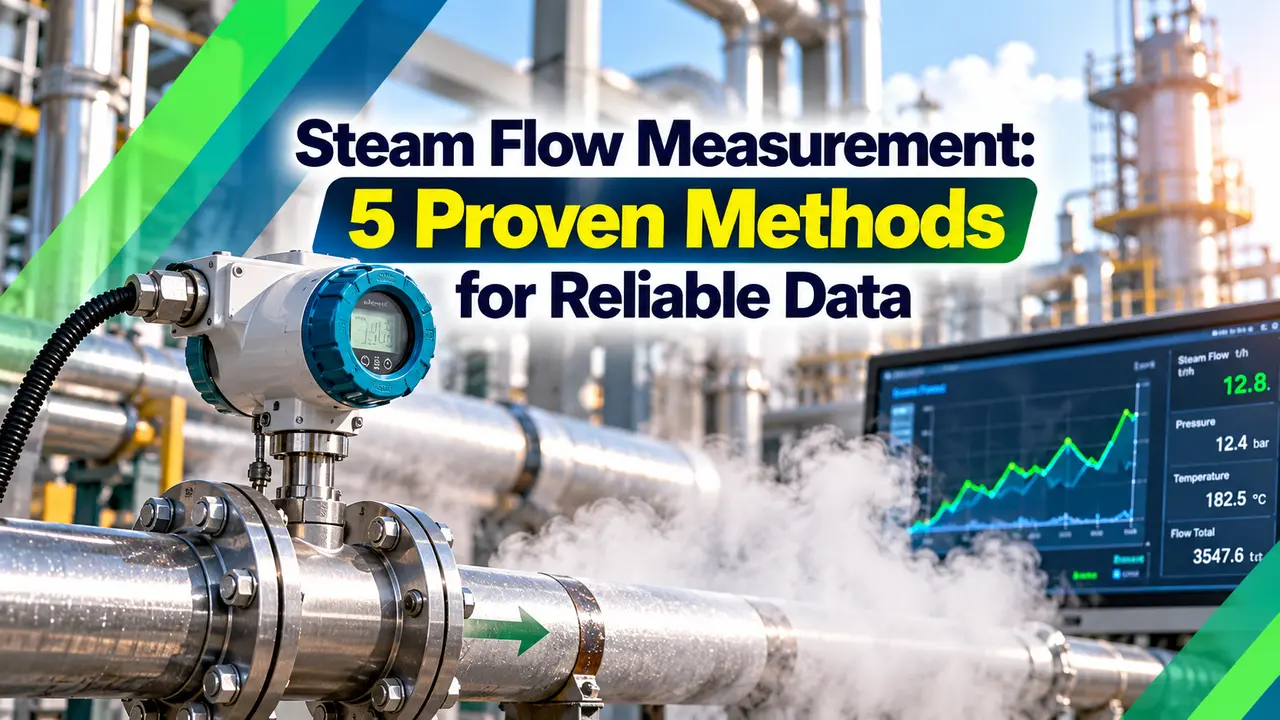
Steam flow measurement is the practice of finding how many kilograms of steam per hour pass through a pipe, using a primary element such as a vortex meter or orifice plate plus a density correction. Plants use the result for boiler efficiency, energy billing between units and boiler drum level control.
Most flow sensors see velocity or volume, while the plant pays for mass and energy. That gap is the heart of the subject, and it is the same idea explained in mass flow versus volumetric flow.
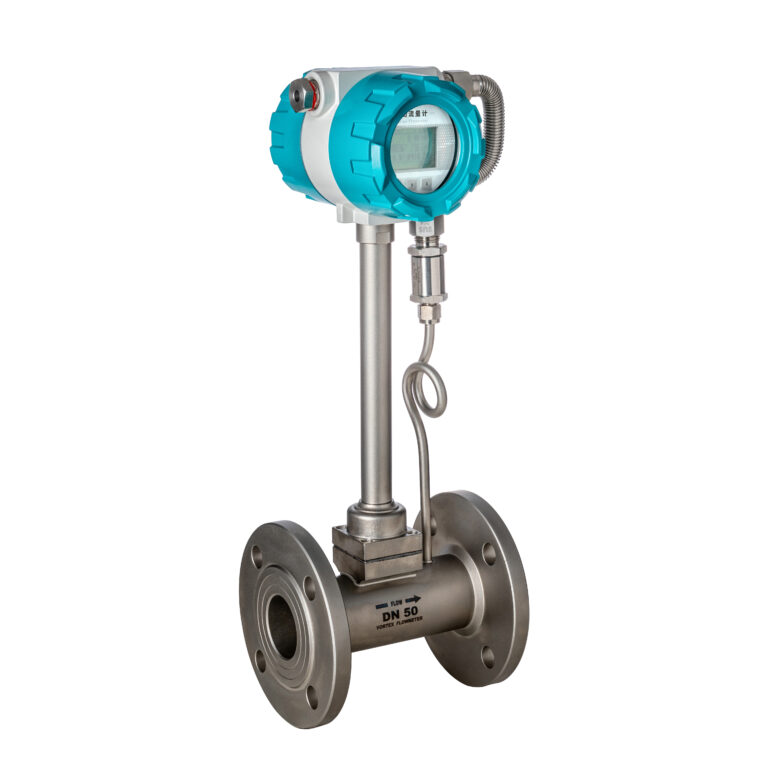
ICS Schneider Messtechnik notes that the same volumetric flow can represent a very different mass, and therefore a very different amount of energy, depending on the operating condition.
Saturated vs Superheated Steam
Saturated steam sits exactly at its boiling temperature, so either pressure or temperature fixes its density. Superheated steam is heated above that point, so you need both.
- Pressure and temperature are linked
- One pressure or temperature input is enough
- Common in process heating and tracing
- May carry water droplets (wet steam)
- Temperature above saturation point
- Needs both pressure and temperature
- Common in turbines and long headers
- Dry, so fewer droplet errors
ICS Schneider warns that a common setup error is to configure a meter for saturated steam when the line actually runs superheated, so the computed mass flow drifts quietly away from reality.
At 10 bar gauge, saturated steam has a specific volume of about 0.177 cubic metres per kilogram, so its density is only about 5.65 kg per cubic metre. Water at room temperature is roughly 175 times denser.
5 Proven Steam Flow Measurement Methods
A bluff body sheds vortices at a frequency proportional to velocity; multivariable models add a temperature sensor for density.
A plate creates a pressure drop that varies with the square of flow, read by a DP transmitter.
A probe senses impact and static pressure across the pipe diameter.
A cone moves against a spring and the DP across it is measured.
A small rotor on a probe spins with the steam velocity.
The vortex principle is covered in detail in vortex flow meter working principle, and the differential pressure route in orifice plate flow measurement. An Annubar flow meter is a useful middle choice when pressure loss must stay low.
Spirax Sarco notes that orifice plate turndown is limited to between 4:1 and 5:1 because flow follows the square root of differential pressure. The same guide quotes up to 100:1 turndown for spring loaded variable area meters and plus or minus 2 percent of reading for insertion turbines on steam.
Size steam meters on the minimum flow you must see, not only the maximum. Many boilers spend nights and weekends at 10 to 20 percent load, where an oversized orifice gives almost no usable signal.
Vortex Meters for Steam Flow Measurement
A vortex meter has no moving parts, tolerates high temperature and gives a frequency output that is linear with velocity. Spirax Sarco notes that vortex meters reach their maximum flow at velocities of 80 or 100 metres per second, while normal steam lines run much slower, which limits usable capacity at the low end.
Multivariable vortex meters carry a temperature sensor in the shedder bar and compute saturated steam density for steam flow measurement inside the transmitter. For superheated steam a pressure input is also required, either built in or wired from a separate gauge pressure transmitter.
Low velocity is the classic weakness, because shedding becomes unstable below a minimum Reynolds number at night time load.
Orifice Plates, DP Transmitters and Condensate Pots
For DP steam flow measurement, the impulse lines must stay full of water, never steam, so both legs read the same water head. Condensate pots at the tapping level provide that liquid seal, as described in condensate pot in steam applications.
The transmitter sits below the line so its electronics never see live steam temperature. Correct tapping positions are summarised in pressure tappings in orifice plate, and the root extraction step is in square root extraction for DP flow.
Density Compensation Formula for Steam
Every DP meter is designed at one reference density, but boiler pressure moves all day. True mass flow through an orifice is proportional to the square root of differential pressure times density, so the controller or flow computer corrects the reading with live values, the method shown in temperature and pressure compensation.
Mass flow, vortex meter: Qm = Qv × ρ actual
Example, orifice designed for 10 bar g saturated steam:
Qmax = 10000 kg/h, ρ design = 5.65 kg/m³
DP reading = 64 percent of span, so √0.64 = 0.8
Line pressure falls to 7 bar g, ρ actual = 4.16 kg/m³
√(4.16 ÷ 5.65) = 0.85807
Qm = 10000 × 0.8 × 0.8581 = 6864.6 kg/h
Uncompensated reading = 8000 kg/h, an over read of 16.54 percent
For steam flow measurement, density values come from IAPWS IF97 steam tables, which Yokogawa uses inside its digitalYEWFLO vortex meters. Never use the ideal gas law for steam near saturation.
Steam Flow Compensation Calculator
Second Worked Example: Vortex Meter on Saturated Steam
A vortex meter on a DN100 header shows a volumetric flow of 1000 cubic metres per hour at 10 bar gauge saturated steam. Mass flow is 1000 × 5.65 = 5650 kg per hour.
If the transmitter was wrongly configured for 7 bar gauge density of 4.16, it would report 4160 kg per hour. That 26 percent shortfall shows why steam flow measurement settings must match the line.
Energy Metering With Steam Flow
Energy flow equals mass flow times specific enthalpy, which also comes from steam tables for the measured pressure and temperature. A flow computer or a multivariable transmitter usually performs this calculation and totalises it in kWh or GJ.
At 10 bar gauge, saturated steam carries about 2781 kJ per kilogram, so 5650 kg per hour delivers roughly 15.7 GJ per hour. This is why steam flow measurement errors become money errors.
When a PLC receives steam flow in kg/h but the tag is scaled in cubic metres per hour, the numbers look plausible yet are wrong. ICS Schneider lists this unit mismatch as a frequent error that has nothing to do with the sensor.
Steam Flow Measurement Error Sources
Real saturated steam often carries 2 to 5 percent water as droplets, especially during start up or on poorly insulated lines. Droplets upset the reading and erode the bluff body, so fit a separator and steam traps ahead of the meter.
| Error Source | Effect on Reading | Practical Fix |
|---|---|---|
| No density compensation | Large error when pressure moves | Live pressure and temperature input |
| Wrong steam state configured | Drifting mass flow | Match saturated or superheated mode |
| Wet steam droplets | Unstable or low reading | Separator and trap upstream |
| Disturbed flow profile | Unstable vortex shedding | Respect straight run lengths |
| Empty impulse leg | Zero shift on DP meter | Refill legs, check condensate pots |
| Oversized meter | Lost low flow signal | Size on minimum flow |
ICS Schneider points out that measuring points just after control valves, pressure reducing stations or several bends disturb the flow profile and destabilise vortex formation. Follow the manufacturer straight run rules, and read common mistakes in DP flow measurement before commissioning.
Selecting a Steam Meter
- Confirm saturated or superheated service and the full pressure range.
- Find minimum, normal and maximum flow, including night loads.
- Check the turndown each meter type really offers on steam.
- Allow for straight runs after valves, reducers and bends.
- Plan pressure and temperature inputs for density compensation.
- Decide whether energy totals in GJ or kWh are needed.
- Plan separators and traps to keep steam dry at the meter.
Wide range header steam flow measurement often favours a vortex or spring loaded variable area meter, while large boiler outlets still use orifice plates. Rangeability is discussed further in turndown ratio of flow meters, and hot service tips in selecting a flow meter for high temperature fluids.
Installation and Commissioning Tips
Insulate the meter body so steam stays dry, but keep vortex electronics away from radiant heat. Allow for pipe growth with proper supports, since long hot headers move, as explained in pipe expansion loops in steam piping.
At commissioning, compare the meter total with boiler feedwater flow over a shift, and if the gap is large, check density, scaling and a 5 point DP transmitter calibration.
The vortex street behind a bluff body was described mathematically by Theodore von Kármán in 1912. The same physics now drives every vortex meter on a steam header.
Applications of Steam Flow Measurement
Yokogawa Steam Mass Flow Calculation Note
Vortex Flow Meter Technology Video
Steam Flow Measurement FAQ
It is the measurement of steam passing through a pipe, usually expressed as mass flow in kilograms per hour. A primary element senses velocity or differential pressure, and a density correction converts that into mass.
Plants use the result for boiler efficiency, energy billing and process control. Without density correction, steam flow measurement can be wrong by many percent whenever line pressure changes.
Steam is compressible, so its density changes strongly with pressure and temperature. A meter scaled at one density gives a wrong mass reading whenever conditions move away from the design point.
Live compensation recalculates density from steam tables on every scan of the controller. Saturated steam needs one input, while superheated steam needs both pressure and temperature.
Multivariable vortex meters are a popular choice because they have no moving parts and compute density internally. Orifice plates remain common on large lines with steady loads and good straight runs.
For very wide load swings, spring loaded variable area meters give much higher turndown. The best choice depends on minimum flow, line size, budget and the required accuracy.
Spirax Sarco states that orifice plate turndown is limited to about 4:1 to 5:1. The square root relation means a small flow gives a very small differential pressure.
At 20 percent flow, the DP is only 4 percent of span, which is close to noise. Using two DP transmitters with stacked ranges is one common way to extend the range.
They create a stable water seal at the tapping level so both impulse legs hold equal columns of water. This keeps hot steam away from the transmitter diaphragm.
Without pots the water levels in the legs can differ and the zero shifts. Fill the legs with water before the first start up to avoid a long settling period.
Water droplets carry mass that the vortex sensor does not register correctly, so the reading becomes low and unstable. Droplets moving at high velocity can also erode the shedder bar over time.
Install a separator with a trap ahead of the meter and insulate the line well. Dry steam improves both measurement and the life of the equipment downstream.
Energy flow equals mass flow multiplied by the specific enthalpy of the steam at its pressure and temperature. Enthalpy is taken from IAPWS IF97 steam tables inside a flow computer or transmitter.
For example, 5650 kg per hour of 10 bar gauge saturated steam carries about 15.7 GJ per hour. Subtract the heat returned in condensate to find the net energy used.
Related Articles
- Vortex Flow Meter Working Principle
- Condensate Pot in Steam Applications
- Temperature and Pressure Compensation
- Orifice Plate Flow Measurement
- Flow Computer Working Principle
External References
- Mass Flow Calculation in digitalYEWFLO Vortex Flow Meter, Yokogawa
- Types of Steam Flowmeter, Spirax Sarco
- Vortex Flowmeter, Wikipedia
What We Learn Today
- Steam flow measurement needs a density correction because steam is compressible, and saturated steam at 10 bar gauge weighs only about 5.65 kg per cubic metre.
- Vortex meters, orifice plates with condensate pots, averaging pitot tubes, spring loaded variable area meters and insertion turbines are the five common methods.
- For a DP meter, true mass flow scales with the square root of actual density divided by design density, so a pressure drop causes an over read.