
Fluid Mechanics · Flow Measurement · Laminar vs Turbulent · Pipe Flow
One dimensionless number decides whether your flow is smooth, chaotic or somewhere in between: and it determines which flow meter will measure it accurately.
The Reynolds number (Re) compares inertial forces to viscous forces in a flowing fluid. Below 2,300 the flow is laminar and smooth. Above 4,000 it is turbulent and chaotic. Between 2,300 and 4,000 it is transitional. This single number determines your pipe sizing, your heat transfer coefficient, your flow meter choice and your pump performance: all from four simple inputs.
What Is Reynolds Number? The Ratio That Predicts Flow Behaviour
Reynolds number is a dimensionless ratio that compares two competing forces in a flowing fluid: the inertial force (which wants to keep the fluid moving in its current direction) and the viscous force (which resists motion and damps out disturbances). It was named after Osborne Reynolds, the British physicist and engineer who demonstrated in 1883 that the transition from smooth to chaotic flow could be predicted by this single number.
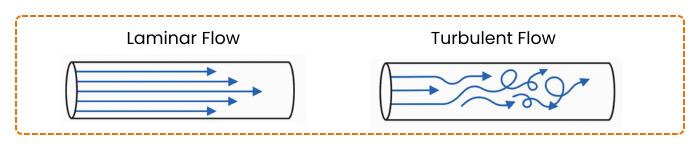
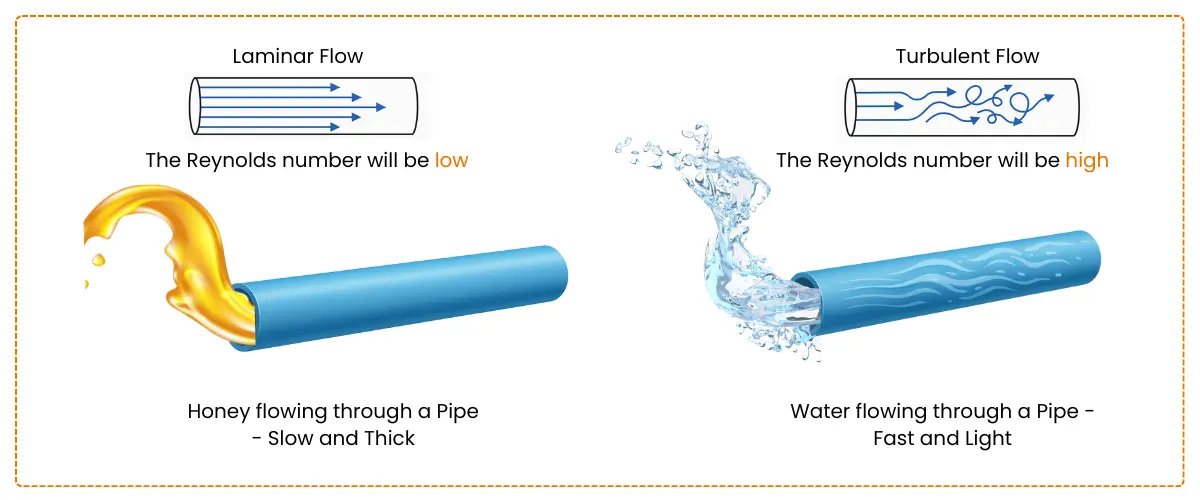
At low Reynolds numbers, viscous forces dominate. The fluid flows in smooth, parallel layers: like sheets of paper sliding over each other. This is laminar flow. At high Reynolds numbers, inertial forces dominate, viscous damping is overwhelmed, and the fluid breaks into chaotic eddies and cross-currents. This is turbulent flow. For instrumentation engineers, this matters directly: almost every differential pressure flow measurement device (orifice plate, venturi, nozzle) is calibrated assuming turbulent flow at a specific Reynolds number range. Outside that range, the measurement error increases significantly.
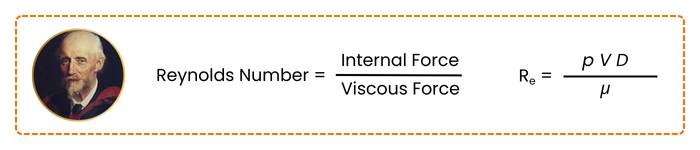
Reynolds Number Formula: Re = rho × v × D / mu
Or equivalently using kinematic viscosity:
Re = (v x D) / nu
Where:
Re = Reynolds number (dimensionless: no units)
rho = fluid density (kg/m³) e.g. water = 1000, air = 1.2, crude oil = 860
v = average fluid velocity in the pipe (m/s)
D = internal pipe diameter (m)
mu = dynamic (absolute) viscosity (Pa.s = kg/m/s) e.g. water at 20°C = 0.001 Pa.s
nu = kinematic viscosity (m²/s) = mu / rho e.g. water at 20°C = 1x10⁻⁶ m²/s
Re = (rho x v x D) / mu = (1000 x 2.0 x 0.1) / 0.001 = 200,000 (turbulent) The Reynolds number has NO units: density and viscosity cancel out completely. This is what makes it universal: Re = 10,000 means the same flow regime in water, oil, gas or any other fluid: despite completely different physical properties.
Reynolds Number Flow Regimes: Laminar, Transitional and Turbulent
Smooth, parallel streamlines. Fluid moves in orderly layers with no mixing between them. Parabolic velocity profile (fastest at centreline, zero at wall). Viscous forces dominate. Typical in viscous fluids, small pipes and low velocities.
Unstable flow that alternates between laminar and turbulent. Unpredictable mixing behaviour. Most flow meters are unreliable in this range. Avoid designing processes to operate in transitional flow: design to be clearly laminar or clearly turbulent.
Chaotic, mixing flow with eddies and cross-currents. Flat velocity profile across most of the pipe cross-section. Inertial forces dominate. Most industrial pipe flows operate here (Re typically 100,000 to 10,000,000). Turbulent flow gives better heat transfer but higher pressure drop.
Reynolds Number Calculator: Find Your Flow Regime Instantly
Enter your fluid and pipe properties below. The calculator computes the Reynolds number, identifies the flow regime and tells you which flow meter technologies work reliably at that Re. This is the same calculation required for orifice plate and venturi meter sizing per ISO 5167.

Reynolds Number Worked Examples: Water, Oil and Air
Re = (1000 x 2.0 x 0.1023) / 0.001
= 204.6 / 0.001
Re = 204,600: FULLY TURBULENT. All standard flow meters work reliably.
Example 2: Heavy crude oil (high viscosity) at 0.5 m/s in DN100 rho = 900 kg/m³, v = 0.5 m/s, D = 0.1023 m, mu = 0.050 Pa.s (50 cP)
Re = (900 x 0.5 x 0.1023) / 0.050
= 46.0 / 0.050
Re = 920: LAMINAR. Orifice plate will not work. Use Coriolis or PD meter.
Example 3: Air at atmospheric pressure, 10 m/s in DN200 duct rho = 1.2 kg/m³, v = 10 m/s, D = 0.200 m, mu = 0.0000182 Pa.s (18.2 µPa.s)
Re = (1.2 x 10 x 0.200) / 0.0000182
= 2.4 / 0.0000182
Re = 131,900: TURBULENT. Orifice plate, vortex meter and ultrasonic all work.
Video: Reynolds Number and Laminar vs Turbulent Flow Explained
Common Fluid Viscosity and Density Reference Values for Reynolds Number Calculation
| Fluid | Temperature | Density (kg/m³) | Dynamic viscosity (Pa.s) | Kinematic viscosity (m²/s) |
|---|---|---|---|---|
| Water | 20°C | 998 | 0.001002 | 1.004 × 10⁻⁶ |
| Water | 60°C | 983 | 0.000467 | 0.475 × 10⁻⁶ |
| Water | 80°C | 972 | 0.000355 | 0.365 × 10⁻⁶ |
| Light crude oil | 20°C | 850 | 0.010 | 11.8 × 10⁻⁶ |
| Heavy crude oil | 20°C | 920 | 0.100 | 109 × 10⁻⁶ |
| Diesel fuel | 20°C | 840 | 0.0030 | 3.57 × 10⁻⁶ |
| Air | 20°C, 1 bar | 1.204 | 0.0000182 | 15.1 × 10⁻⁶ |
| Natural gas | 20°C, 10 bar | ~78 | 0.0000110 | ~0.14 × 10⁻⁶ |
| Glycol (50% aqueous) | 20°C | 1065 | 0.00650 | 6.10 × 10⁻⁶ |
Reynolds Number and Flow Meter Selection: Which Meter for Which Re?
| Flow meter type | Minimum Re required | Accuracy at low Re | Suitable for viscous / laminar flow? |
|---|---|---|---|
| Orifice plate (ISO 5167) | 5,000 to 10,000+ | Poor below minimum: Cd shifts significantly | No |
| Venturi tube (ISO 5167) | 200,000+ | Better than orifice at low Re but still affected | No |
| Vortex flow meter | 10,000 to 20,000 | No vortex shedding below minimum Re: meter is blind | No |
| Turbine flow meter | 5,000 to 10,000 | K-Factor shifts at low Re: needs viscosity correction | Limited |
| Magnetic flow meter | 500 | Good to Re 500: very suitable for viscous conductive liquids | Yes (conductive liquids) |
| Coriolis flow meter | No minimum | Accurate at any Re: measures mass directly | Yes: best choice for viscous fluids |
| Positive displacement (PD) | No minimum | Accurate at low Re and high viscosity | Yes: ideal for heavy oils |
| Ultrasonic (clamp-on) | 10,000+ | Profile-dependent: needs turbulent flat profile | No |
Quick FAQs: Reynolds Number
- Venturi Tube Flow Meter: How Reynolds Number Affects Discharge Coefficient
- Coriolis Flow Meter: Why It Works at Any Reynolds Number
- Turbine Flow Meter: Minimum Reynolds Number and K-Factor Viscosity Effects
- Pressure Drop in Pipes: Darcy-Weisbach Equation and Friction Factor
- 4-20 mA Current Loop: Connecting Flow Meter Outputs to DCS and PLC
External References
- ISO 5167: Measurement of Fluid Flow Using Differential Pressure Devices
- Engineering ToolBox: Reynolds Number Calculator and Reference
- NASA Glenn Research Center: Reynolds Number in Fluid Mechanics
What we learn today
- Reynolds number Re = rho × v × D / mu compares inertial to viscous forces. It is dimensionless: no units. Below 2,300: laminar (smooth, parallel flow). 2,300-4,000: transitional (unstable, avoid for metering). Above 4,000: turbulent (chaotic, mixing). Most industrial flows operate at Re 100,000 to several million.
- High viscosity (heavy oil) reduces Re and pushes flow toward laminar. Higher velocity, larger pipe or lower viscosity all increase Re. A heavy crude oil at 0.5 m/s in DN100 may be at Re 920 (laminar), while water at 2 m/s in the same pipe gives Re 200,000 (turbulent) completely different flow behavior, same pipe.
- Flow meter selection depends on Re: orifice plates and venturis need Re above 10,000-200,000 for accurate Cd. Vortex meters need Re above 10,000. Only Coriolis, positive displacement and magnetic flow meters work reliably at low Re and in laminar flow. Always calculate Re before specifying a flow meter for viscous fluid service.


5 Comments