
A pressure transmitter can survive a spike far above its range, or it can quietly lose calibration, or it can split open. Which one happens depends on four ratings on the datasheet that many engineers read too quickly.
Datasheets list several pressure limits that sound alike but mean very different things. Knowing where each one sits helps you pick a sensor that survives pump starts, valve slams and hydrotests.
What Is Burst Pressure?
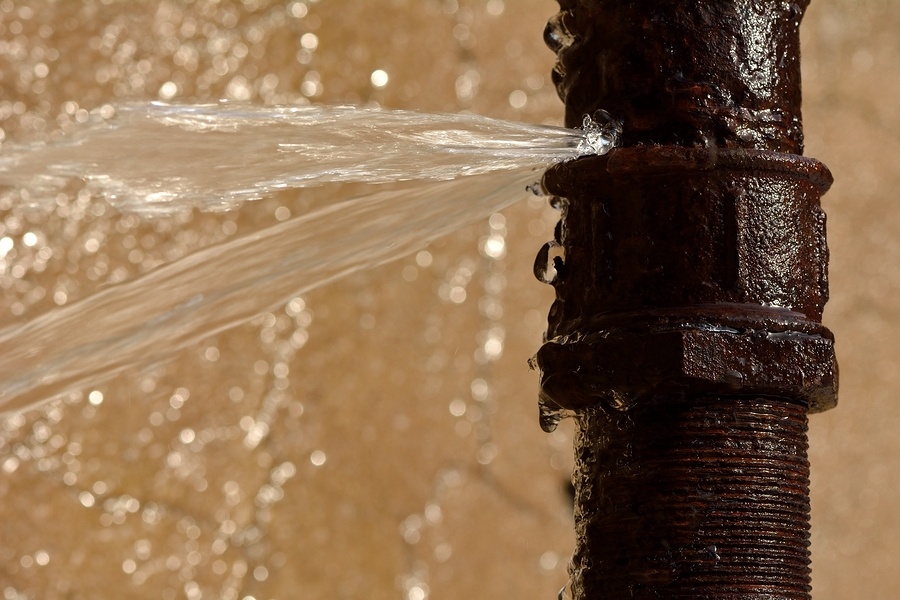
Burst pressure is the highest pressure a sensor, transmitter or gauge can hold before its pressure containment fails, meaning the diaphragm, Bourdon tube or housing ruptures and process fluid can escape. It is the last line on the pressure sensor specifications and it is a safety limit, not a measuring limit.
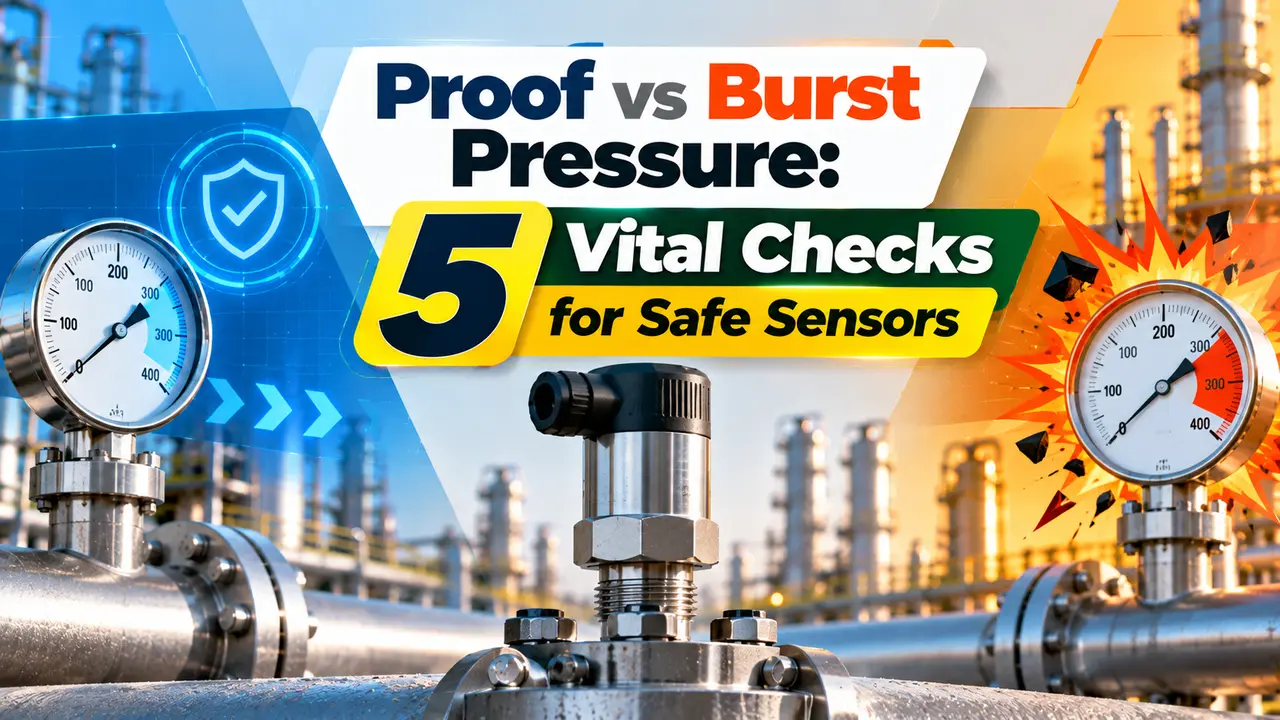
Proof pressure is a lower and very different limit. Setra defines it as the maximum pressure that can be applied without changing the device performance, and often states it as a multiple of range, such as 2X.
Setra gives the example of a 0 to 100 psi sensor with a 2X proof rating, which can tolerate 200 psi without harm. Push past that figure and the sensor may still work, but with a permanent positive zero shift.
Four Pressure Ratings Compared
| Rating | Meaning | Result if Exceeded |
|---|---|---|
| Maximum working pressure | Upper end of the normal range | Reading saturates or goes over range |
| Over range limit | Short excursion allowed on the scale | Accuracy may degrade temporarily |
| Proof pressure | Highest pressure with no lasting change | Permanent zero or span shift |
| Burst pressure | Highest pressure before rupture | Leak, fluid release, possible injury |
SensorsONE shows a typical 7 bar g transmitter with a 4 times overpressure of 28 bar g and a 10 times burst rating of 70 bar g. Ratios vary a lot between suppliers, so compare actual numbers.
Low range sensors usually have the highest multiples, because thin diaphragms sit behind thick bodies. Units for very high ranges often have a burst pressure only a little above proof, as discussed in high pressure transmitter selection.
What Happens as Pressure Rises
The zone above proof is the sneaky one, because the instrument keeps sending a signal that is simply wrong. Our article on pressure transmitter zero shift explains how to detect it.
Once a sensor has passed its burst pressure it must be replaced, never recalibrated. Treat any unit that saw an unknown spike near its burst pressure as suspect until it is checked on a bench.
Over Range Rules for Gauges Under EN 837
For Bourdon tube pressure gauges, EN 837 1 sets how much of the scale may be used. The WIKA PM 02.02 data sheet lists, for 100 mm and 160 mm dials, steady load up to full scale, fluctuating load up to 0.9 times full scale and short time load up to 1.3 times full scale.
Small 63 mm gauges are stricter, at three quarters of scale steady and two thirds fluctuating. Extra protection options are in pressure gauge over range protection.
A good rule when you follow the gauge selection factors is to keep normal pressure in the middle third of the dial. That leaves headroom for spikes and keeps the pointer where it is easiest to read.
Pressure Spikes and Water Hammer
Fast valve closure can create spikes several times the steady pressure, as the Joukowsky equation shows. These surges last milliseconds, far too short for a gauge pointer to show.
Repeated hammer bends pointers and fatigues Bourdon tubes, a problem covered in hammer effect in pressure gauges. A pressure snubber or a diaphragm seal with a damping restriction cuts the peak reaching the element.
5 Vital Checks Before You Buy
Check 1 often catches plant hydrotests, which can run at 1.5 times design pressure. Isolate or remove low range instruments first, as advised in transmitter installation best practices.
Peak Pressure Check Formula
Burst margin = Burst pressure ÷ Peak
Example:
Max operating 10 bar, spike 50 percent, peak 15 bar
Range 16 bar, proof 2 × 16 = 32 bar, burst 5 × 16 = 80 bar
Burst margin = 80 ÷ 15 = 5.3 times, peak within range
If the peak exceeds the range but not the proof rating, the reading clips during the spike but the sensor survives. If it exceeds proof, choose a higher range or add damping.
Burst Pressure Margin Calculator
- Know all four ratings.
- Size for true peak.
- Use snubbers on pulsating lines.
- Isolate during hydrotests.
- Reading only the range.
- Ignoring pump start surges.
- Recalibrating over pressured units.
- Mixing up proof and burst.
WIKA Bourdon Tube Gauge Data Sheet PDF
Proof and Rupture Limits Explained Video
Burst Pressure FAQ
Proof pressure is the highest pressure a device can take without any lasting change in performance. Burst pressure is the point at which the containment itself fails.
Between the two, the sensor survives but may carry a permanent zero shift. Beyond burst, the fluid can escape and the unit must be isolated and replaced at once.
For most transmitters it equals the upper range limit, where the output reaches full scale. For gauges it is the steady load limit printed in the data sheet.
Some flanged DP transmitters also list a separate static line pressure rating. That rating is about the body and flanges, not the measuring range of the cell.
The diaphragm or cell can yield, leaving a permanent offset in the reading. The unit keeps working normally, so the error may go unnoticed for weeks or months.
Check the zero at a known pressure after any suspected event. If the shift exceeds the specification, replace the sensor rather than simply trimming the zero.
Aim for the burst rating to sit several times above the worst credible peak. Many engineers use a factor of 4 or more for toxic or hot fluids.
Also confirm that fittings, valves and manifolds carry the same rating or better. The weakest part of the assembly decides the real limit of the whole installation.
Yes, a snubber slows the pressure rise reaching the sensing element and cuts sharp peaks. It does not reduce the steady pressure, only the fast spikes that cause fatigue.
Pick a snubber grade that suits the fluid viscosity and cleanliness. Dirty fluids can block fine snubbers, so use a diaphragm seal where plugging is likely.
EN 837 1 sets how far a Bourdon gauge may be loaded compared with full scale. Large dials usually allow full scale steady and 1.3 times full scale for short periods.
Small 63 mm dials have tighter limits for steady and fluctuating loads. Always check the specific data sheet, because special overload designs exist for pulsating duty.
Low range instruments should be isolated or removed when the test pressure exceeds their proof rating. A hydrotest at 1.5 times design pressure easily overloads them.
Fit blind plugs or use test rated isolation valves on every tapping. Reinstall and zero check the instruments after the test, and never let test pressure exceed their proof rating.
Related Articles
- Pressure Sensor Specifications Guide
- Pressure Gauge Over Range Protection
- Pressure Snubber Working Principle
- Pressure Transmitter Zero Shift
- Rupture Disc Explained
External References
- Bourdon Tube Pressure Gauge Data Sheet PM 02.02, WIKA
- What Is the Difference Between Proof and Burst Pressure, Setra
- Pressure Sensor, Wikipedia
What We Learn Today
- Proof pressure is the highest load with no lasting change, while burst pressure is the point where the containment itself fails.
- Between proof and burst the sensor survives but can carry a permanent zero shift that can go unnoticed for weeks in service.
- Size instruments for the true peak, including water hammer and hydrotests, and add snubbers or seals to cut fast spikes.