Pressure Sensor Specifications: 8 Essential Terms to Know

Share:
Instrumentation
Pressure Sensor Specifications: A Complete Datasheet Reading Guide

A pressure sensor datasheet is packed with numbers, and picking the wrong one is an easy, expensive mistake.

This guide walks through the eight specifications you must check before ordering, in the order they actually matter.

Pressure Sensor Specifications Accuracy and Linearity Pressure Range Sensor Output Signals Datasheet Checklist

Pressure sensor specifications look like a wall of numbers on paper. Read them in the right order and the right sensor becomes obvious.

Hello everyone, today we are going to learn about pressure sensor specifications, the numbers every datasheet lists before you place an order.

We will cover the eight specifications to check first, how accuracy actually breaks down into three parts, the different pressure reading types, and a checklist to run before you buy.
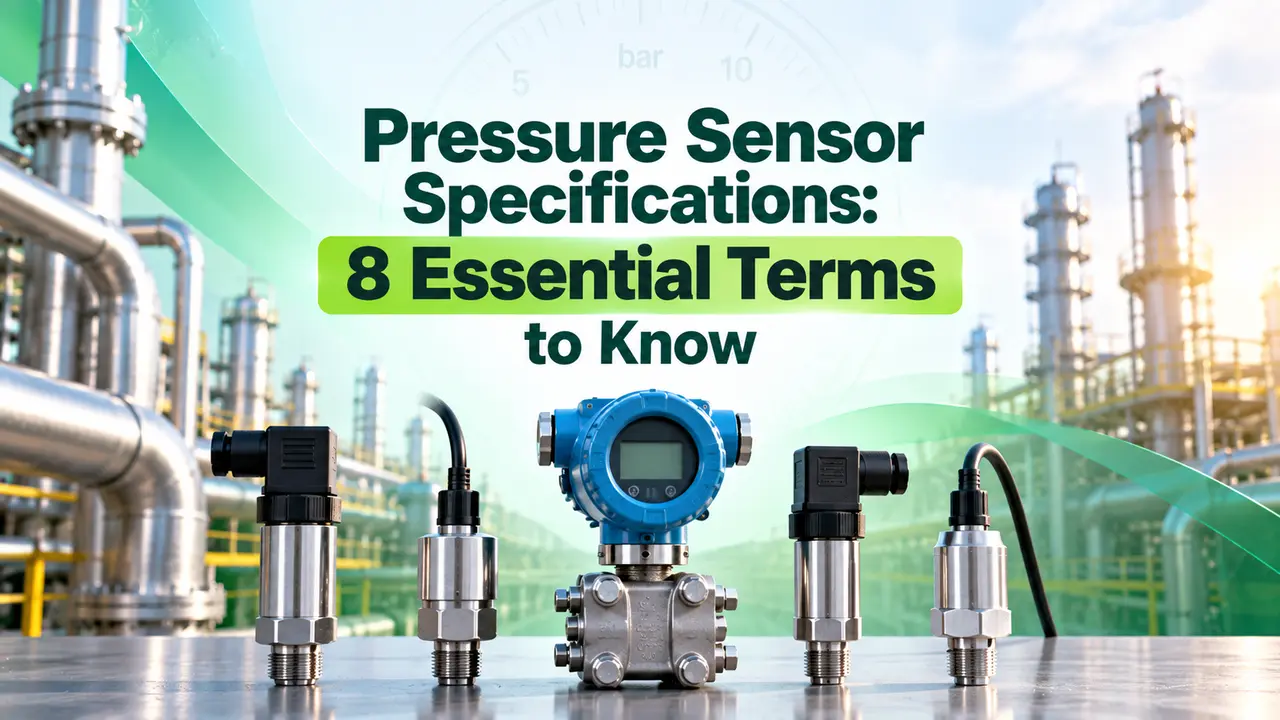
Pressure Sensor Specifications

What Are Pressure Sensor Specifications?

These are the technical values a manufacturer publishes describing how a sensor behaves.

They tell you the range it can measure, how accurate its reading is, what signal it outputs, and where it can physically survive.

Reading them correctly, in order, is what separates a sensor that lasts for years from one replaced within months.

For a deeper look at the vocabulary manufacturers use, see our pressure sensor terms guide, which this article builds on.

Advertisement

8 Pressure Sensor Specifications to Check First

Every datasheet organises itself around the same eight items, whichever manufacturer printed it.

1
Pressure Range
The working range and the burst pressure, the point where the sensor body itself can fail under overpressure.
2
Sensor Output
Analog signals like 4 to 20 mA, digital relay contacts, or a communication protocol such as HART or Profibus.
3
Operating Environment
The ambient temperature and humidity range the sensor can tolerate without its reading drifting off spec.
4
Accuracy
A combined figure built from linearity, hysteresis and repeatability, always expressed as a percent of full scale.
5
Pressure Reading Type
Whether the sensor reads absolute, gauge, differential, sealed, compound or vacuum pressure against its own reference point.
6
Media Type
Confirms the sensor is rated for the actual fluid, whether that is a clean gas, a liquid, or a corrosive process medium.
7
Resolution
The smallest change in pressure the sensor can actually detect, expressed as a percent of full scale output.
8
Enclosure Material
The housing material and rating, which decides whether the sensor survives corrosion and a hazardous area installation.
Advertisement

Understanding Accuracy: Linearity, Hysteresis and Repeatability

Accuracy is not one number. It hides three separate behaviours, and a sensor can be strong in one and weak in another.

Linearity
How closely the output signal tracks a straight line as pressure rises. A poor linearity means the middle of the range reads wrong even at calibration points.
Hysteresis
The gap between the reading on the way up and the way back down from the same pressure, caused by mechanical lag in the sensing element.
Repeatability
How consistently the sensor returns the same output for the same applied pressure across many repeated cycles.

Our pressure transmitter accuracy guide goes deeper into how these three combine into one published accuracy figure.

Types of Pressure Readings Compared

The same physical pressure can be reported six different ways, depending on what reference point the sensor uses.

Reading TypeReference PointCommon Use
AbsoluteFull vacuumVacuum systems, barometric measurement
GaugeLocal atmospheric pressureMost industrial process measurement
DifferentialA second process pressureFlow measurement, filter monitoring
SealedSea level atmospheric pressureSensors that must ignore altitude changes
CompoundAtmospheric, reads both directionsSystems that swing between vacuum and pressure
VacuumAtmospheric, negative side onlySub atmospheric process monitoring

See the full breakdown in our absolute versus gauge pressure guide if these two are still confusing.

A Quick Sizing Example

Sizing the range correctly avoids two failure modes at once, a sensor that overranges and one that reads too coarsely.

Process condition: Maximum working pressure of 8 psi
Safety margin: Add roughly 50 percent headroom
Sensor range to select: 15 psi full scale
Why: Leaves margin for spikes without wasting resolution on an oversized range
Oversizing the range by too much backfires. A sensor rated for 100 psi on an 8 psi process wastes most of its resolution on pressure it will never see.
Advertisement

Datasheet Checklist Before You Order

Run through these six checks on any datasheet before a pressure sensor gets added to a purchase order.

1
Range with margin. Confirm the selected range covers the maximum working pressure plus a sensible safety margin.
2
Output signal match. Verify the output type matches what your control system or gauge panel actually accepts.
3
Accuracy in percent FS. Compare accuracy figures on the same basis, since a lower number is not always better full scale.
4
Correct reading type. Confirm the sensor reads gauge, absolute or differential pressure exactly as the application needs.
5
Media compatibility. Check the wetted parts material can handle the actual process fluid without corroding.
6
Enclosure and area rating. Confirm the housing rating suits the installation, especially in any classified hazardous area.

Watch: Pressure Sensor Accuracy Explained

Pressure Sensor Specifications Questions Engineers Ask

What are the main pressure sensor specifications to check?
Range, output signal, operating environment, accuracy, reading type, media compatibility, resolution and enclosure material cover the essentials.
What is the difference between accuracy and resolution?
Accuracy shows how close a reading is to the true value. Resolution shows the smallest change the sensor can detect.
Why does hysteresis appear on a pressure sensor datasheet?
It shows the gap between rising and falling readings at the same pressure, caused by mechanical lag in the sensing element.
How much margin should I add above the working pressure?
A common rule of thumb is roughly 50 percent above the maximum working pressure, without going so high that resolution suffers.
Does every pressure sensor specification matter equally?
No. Range and reading type usually rule out the wrong sensor first, before accuracy and output signal narrow the final choice.

Related Articles on This Site

External References

Advertisement

What We Learn Today

  • Pressure sensor specifications cover eight areas: range, output, environment, accuracy, reading type, media, resolution and enclosure material.
  • Accuracy is not a single figure. It combines linearity, hysteresis and repeatability into one percent of full scale value.
  • Sizing the range with roughly 50 percent margin above working pressure avoids both overpressure risk and wasted resolution.
I hope you like above blog. There is no cost associated in sharing the article in your social media. Thanks for reading!! Happy Learning!!

Leave a Reply

Your email address will not be published. Required fields are marked *