
Every alternator needs a steady DC field, and a small control loop decides whether the lights stay bright when a big motor starts.
A generator only produces voltage when its rotor field is energised with DC. The equipment that supplies and controls this field current is called the excitation system, and its brain is the automatic voltage regulator.
What Is an Excitation System?
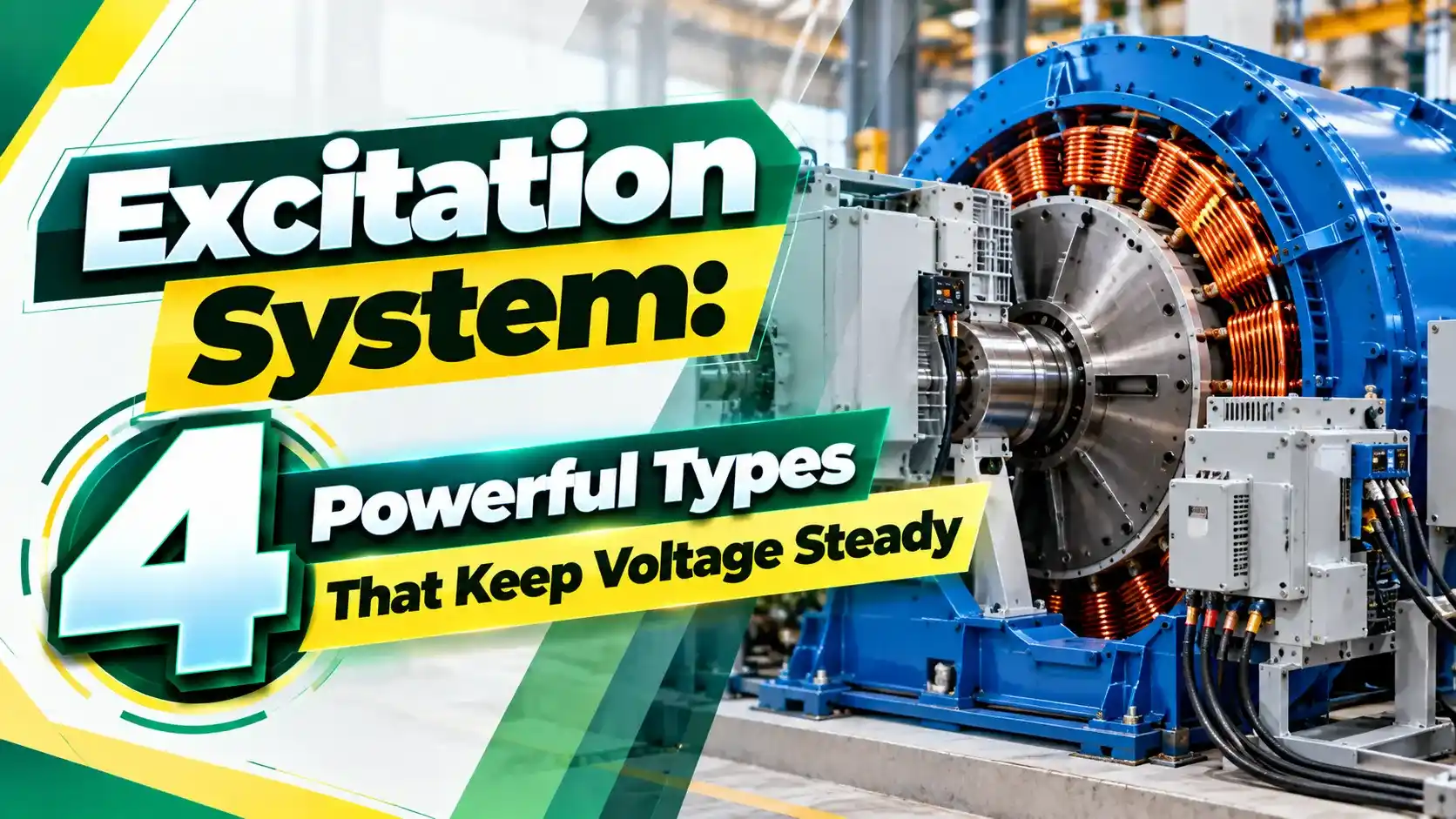
An excitation system is the set of equipment that supplies DC current to the rotor field winding of a synchronous generator and controls it automatically. It includes the exciter, the automatic voltage regulator, limiters and protection, and it sits at the heart of every alternator.
The induced stator voltage follows E = 4.44 × f × N × Φ, so with speed fixed, the field flux sets the voltage. More field current gives more flux and a higher terminal voltage.
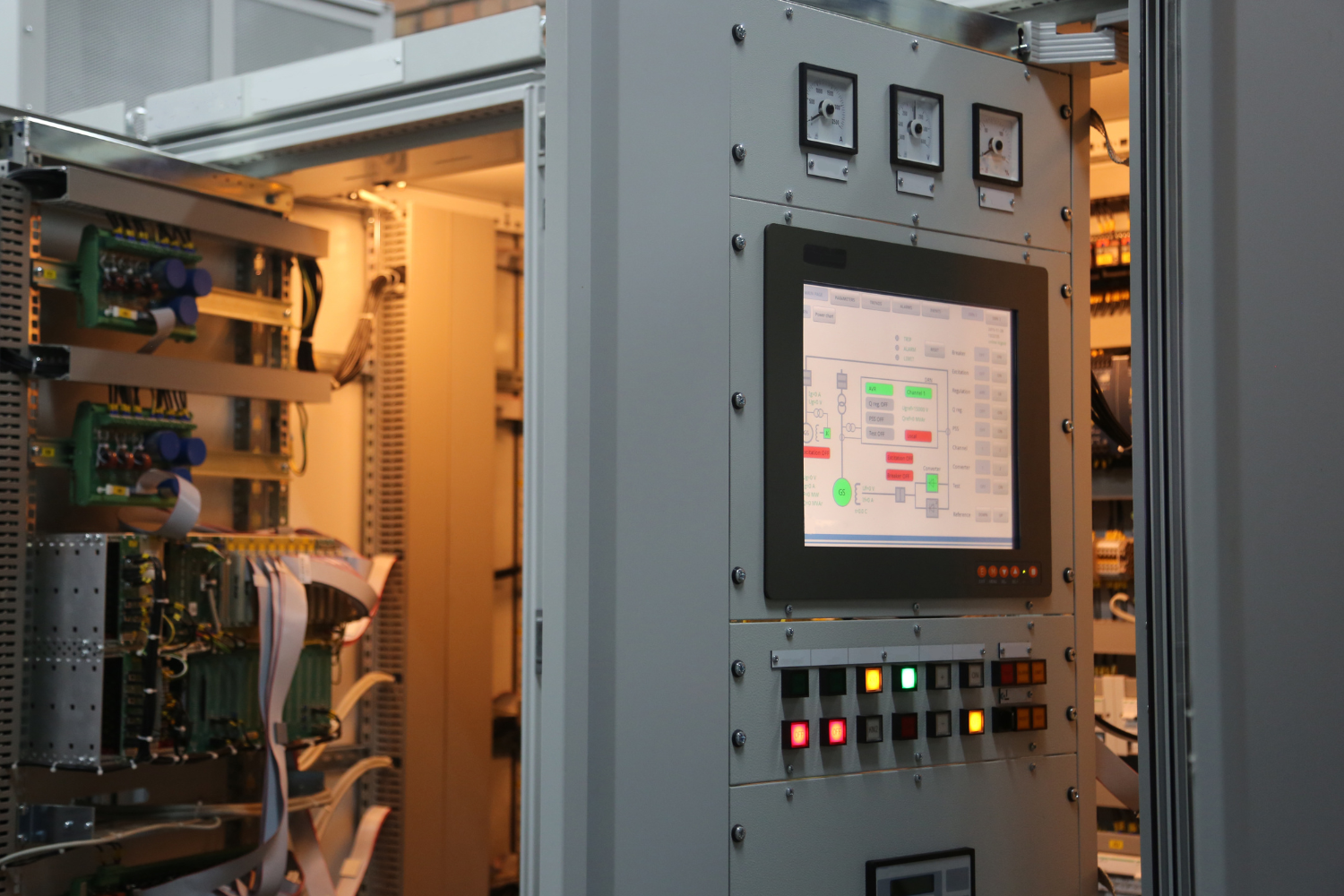
Central States Diesel Generators explains that the AVR takes input from the stator and supplies DC to the exciter using SCR or FET power stages. It adjusts this output many times per second as load changes.
On a grid connected machine, the same field current also controls reactive power. Raising excitation pushes out more kVAR, while lowering it absorbs kVAR.
How the AVR Control Loop Works
The regulator behaves like a fast PID controller with the field winding as its final element. Its gains are tuned so voltage recovers quickly without overshoot.
When a large motor starts, voltage dips and the excitation system forces field current up toward its ceiling. A higher ceiling voltage gives faster recovery.
4 Powerful Excitation System Types
A DC generator on the shaft feeds the field through brushes and slip rings.
An AC exciter with a rotating diode rectifier feeds the field directly.
Thyristor rectifier fed from the terminals supplies the field through slip rings.
A permanent magnet generator powers the AVR independent of terminal voltage.
Van Cutsem groups these into rotating and static families in his Liège lecture notes. Static systems respond fastest because there is no rotating exciter time constant.
Brushless designs use a rotating rectifier similar to the diode rectifier circuits on a bench, while static units use silicon controlled rectifiers.
Self Excited vs PMG Excitation
| Feature | Shunt Self Excited | PMG Excited |
|---|---|---|
| AVR power source | Generator terminals | Separate permanent magnet generator |
| During a short circuit | Field collapses | Field is sustained |
| Motor starting | Weaker recovery | Stronger recovery |
| Harmonic loads | Can disturb AVR | Immune |
| Cost | Lower | Higher |
CS Diesel also lists auxiliary winding and boost systems as middle options. They give some fault support without the full cost of a PMG.
For sizing a set with large motor loads, see generator sizing for industrial load.
Limiters, PSS and Protection
CS Diesel notes that losing excitation can collapse voltage and cause loss of synchronism. The loss of field function in protective relays detects this condition.
Before paralleling, the AVR matches voltage as part of the generator synchronizing procedure. After closing, it shares reactive load using a droop setting.
Excitation System Maintenance Checks
Inspect brushes, slip rings and rotating diodes at every planned outage, because a single shorted diode can overheat the exciter. Many brushless units include a diode failure detector that alarms before damage spreads.
Test the excitation system response with a small voltage step and record the recovery time. Compare the result with the commissioning record to spot drifting AVR settings early.
Voltage Regulation Calculator
A regulation above 15 percent shows why a manual field setting cannot keep voltage steady. The AVR reduces the real deviation to about 1 percent.
- Stable voltage under changing load.
- Better motor starting.
- Controlled reactive power sharing.
- Improved transient stability.
- Failed rotating diodes.
- Worn brushes and slip rings.
- Poorly tuned AVR gains.
- Loss of sensing voltage.
Excitation and AVR Lecture PDF
Exciter, PMG and AVR Animation
Excitation System FAQ
Related Articles
- Alternator Working Principle
- Generator Synchronizing Procedure
- Synchronous Motor Working Principle
- Active, Reactive and Apparent Power
- Generator Size for Industrial Load
External References
- Excitation and AVR Notes, University of Liège
- Generator Excitation Methods, Central States Diesel Generators
- Excitation, Wikipedia
What We Learn Today
- The excitation system sets generator voltage and reactive power through field current.
- The AVR is a fast closed loop that drives the exciter.
- Brushless, static and PMG designs trade cost against response and fault support.