
Generator Synchronizing is the process of matching a generator to a live bus before closing the breaker, and getting even one check wrong can put a massive mechanical shock through the rotor in a fraction of a second.
Generator Synchronizing means bringing an incoming generator to match a live bus in voltage, frequency, and phase angle before the breaker ever closes. Skipping even one check risks real mechanical damage.
This builds naturally on the working principle behind an Alternator Working Principle Explained article, since every synchronizing check exists because of how an alternator actually generates its output waveform.
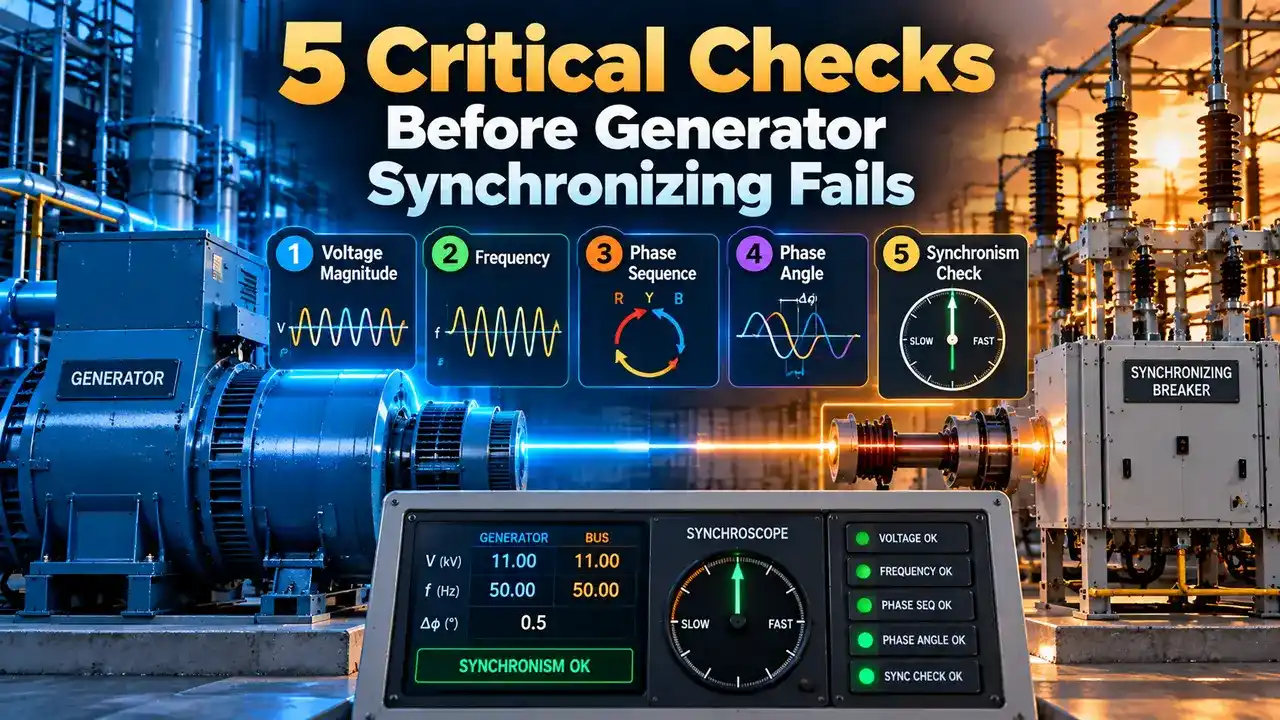
Generator Synchronizing
Generator Synchronizing is required any time a generator needs to be connected to an already energized bus, whether that bus is the utility grid or another generator already carrying load.
Four quantities must match closely before the breaker closes: voltage magnitude, frequency, phase sequence, and phase angle between the incoming machine and the live bus.
Missing any one of these turns a routine paralleling operation into a violent event, since the two voltage waveforms fight each other the instant the breaker contacts touch.
The resulting inrush current can exceed many times normal full load current for a brief moment, enough to stress windings, shafts, and couplings well beyond their designed limits.
This is exactly why synchronizing is treated as a checklist procedure rather than an instinctive judgment call, no matter how experienced the operator closing the breaker happens to be.
The same four conditions apply whether the incoming machine is a small diesel standby set or a large utility generator, only the instrumentation and the consequences of a mistake scale up with size.
Modern plants increasingly rely on Protective Relays Explained logic to block a breaker close attempt automatically if any one of the four conditions falls outside its programmed window, adding a hard limit behind the human check.
Even with that protection in place, understanding the underlying checks by hand remains essential, since relay settings themselves are only as good as the engineer who configured them.
Anyone sizing the incoming machine in the first place should already be familiar with How to Calculate Generator Size for an Industrial Load, since an undersized generator struggles to hold frequency steady long enough to synchronize cleanly.
5 Checks Before Closing the Breaker
Common Synchronizing Methods
Three lamps across the breaker contacts go completely dark at the correct closing instant, simple but imprecise at low voltage difference.
Lamps are deliberately cross connected so phase rotation errors show up clearly before the breaker is ever closed.
A dedicated meter shows both frequency difference and phase angle continuously, far more precise than watching lamps.
A relay continuously adjusts governor and voltage regulator setpoints, closing the breaker itself at the correct instant.
Reading the Synchroscope Needle
A needle rotating slowly clockwise means the incoming generator is running slightly faster than the bus, the preferred direction since it picks up load rather than being motored by it.
Understanding Beat Frequency
The rate at which the synchroscope needle rotates is called beat frequency, and it comes directly from the difference between generator and bus frequency.
This same reasoning shows up on a Single Line Diagram Symbols and How to Read One once a synchronizing scheme is drawn out, since the breaker, generator, and bus symbols all sit on that same simplified drawing.
Example:
Generator frequency = 50.2 Hz
Bus frequency = 50.0 Hz
Beat frequency = 0.2 Hz
Time for one full needle rotation = 1 divided by 0.2 = 5 seconds
A slower rotation, closer to zero Hz difference, gives the operator more time to judge the correct closing instant
Manual vs Automatic Synchronizing
| Aspect | Manual Synchronizing | Automatic Synchronizer |
|---|---|---|
| Operator involvement | Continuous, watching lamps or synchroscope | Minimal, relay handles the closing decision |
| Consistency | Varies with operator skill and fatigue | Consistent every time, within relay settings |
| Typical use | Small plants, occasional paralleling | Frequent paralleling, unattended sites |
Where Generator Synchronizing Is Used
Common Mistakes During Synchronizing
Closing on a fast needle: operators under time pressure sometimes close the breaker before the needle slows down, producing the exact inrush the whole procedure exists to avoid.
Other frequent errors include forgetting to recheck phase sequence after any rewiring work, and relying purely on voltmeters while ignoring the phase angle entirely.
A generator with a mismatched Transformer Vector Group on its step up unit can also make voltage readings look correct while phase relationships are actually off.
Skipping a documented pre synchronizing checklist in favor of memory is another common shortcut, one that tends to catch up with even experienced operators during a busy or noisy shift.
A written Generator Synchronizing checklist, signed off before every closing attempt, remains the simplest defense against exactly this kind of shortcut becoming a habit on site.
Beat Frequency Calculator
Reference Document
Watch: Generator Paralleling and Synchronization Procedure
Generator Synchronizing FAQs
Related Articles on This Site
- Alternator Working Principle Explained
- AC Motors and Generators: How Back EMF Links Them
- How to Calculate Generator Size for an Industrial Load
- Protective Relays Explained
- Single Line Diagram Symbols and How to Read One
External References
- Preparing to Synchronize a Generator to the Grid, Electrical Engineering Portal
- Synchronization, Alternating Current, Wikipedia
What We Learn Today
- Generator Synchronizing requires matching voltage, frequency, phase sequence, and phase angle before closing the breaker.
- A slowly rotating synchroscope needle gives the operator time to close at exactly the right instant.
- Closing on a fast moving needle produces the violent inrush current the whole procedure is meant to prevent.