
A small bead of ceramic whose resistance changes strongly with temperature, cheap, sensitive and everywhere in electronics.
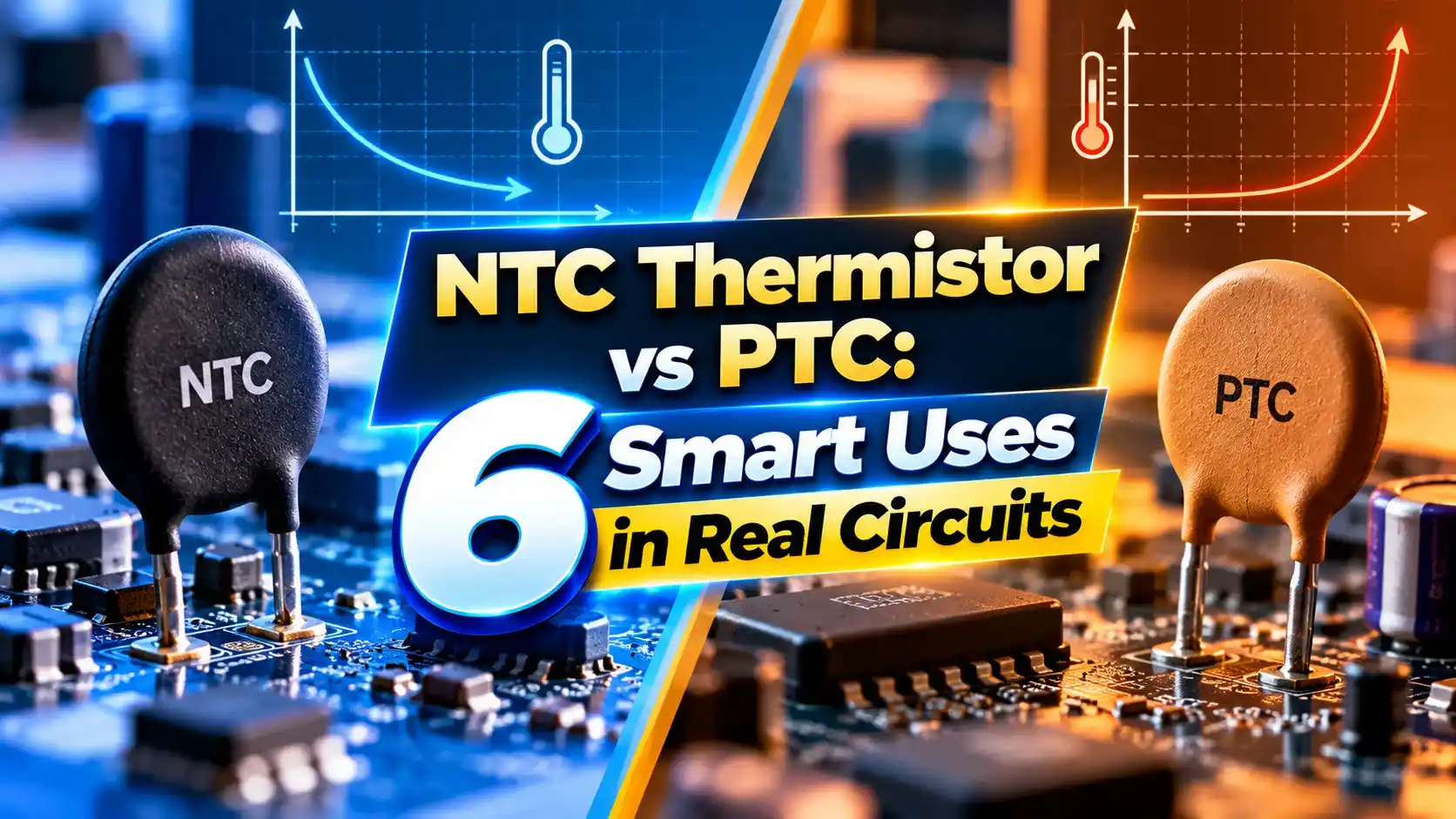
An NTC thermistor is a resistor whose resistance falls as temperature rises, while a PTC thermistor does the opposite. Their strong sensitivity makes them ideal for temperature sensing, inrush limiting and self resetting protection.
What Is an NTC Thermistor?
An NTC thermistor is a temperature sensitive resistor made from metal oxide ceramics whose resistance decreases as temperature increases. NTC stands for negative temperature coefficient, and it is one of the common types of temperature sensors.
A PTC thermistor has a positive temperature coefficient, so its resistance rises with temperature. Switching PTC types stay low until a set temperature, then jump sharply.
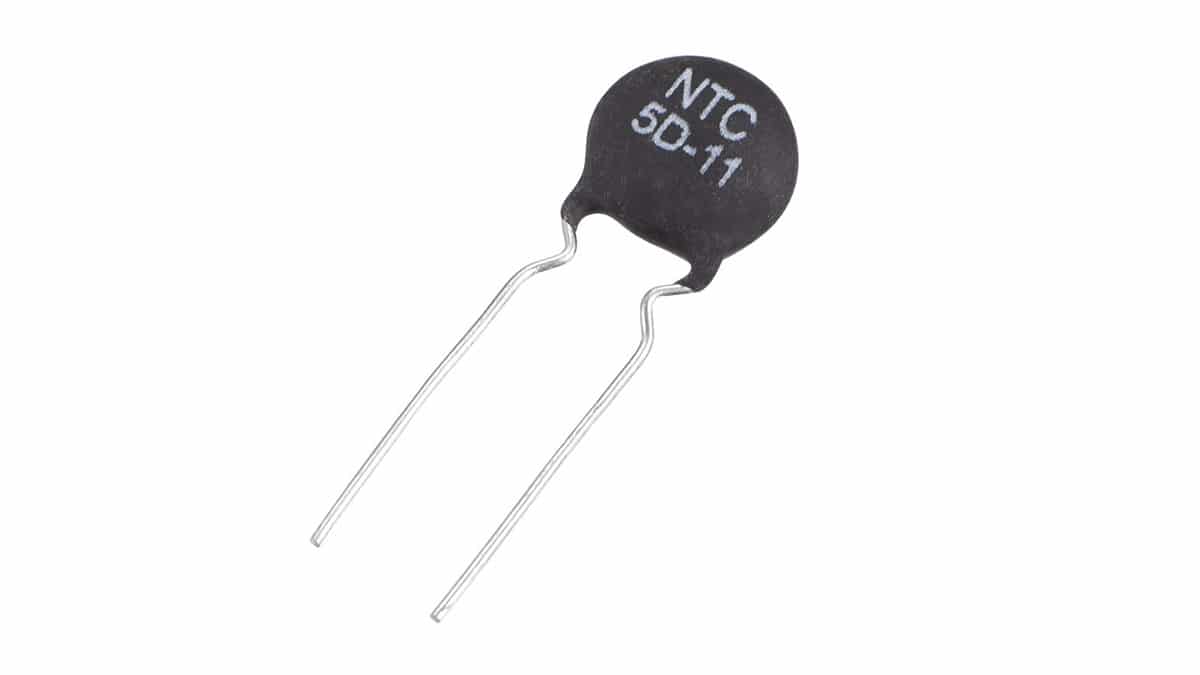
A typical sensing part is rated 10 kΩ at 25 °C, with a Beta value near 3950 K. That means a few degrees of change produce a large, easily measured change in resistance.
Compared with an RTD, a thermistor is cheaper and more sensitive but far less linear. Our guide on thermistor vs thermocouple compares it with another popular sensor.
NTC Thermistor vs PTC Behaviour
| Feature | NTC | PTC |
|---|---|---|
| Resistance with heat | Falls | Rises, often sharply |
| Typical range | About minus 55 to 200 °C | Switching around 60 to 120 °C |
| Main use | Temperature measurement | Protection and heating |
| Linearity | Nonlinear, exponential | Step like near switch point |
| Inrush role | Limits inrush current | Resets after overcurrent |
The NTC suits measurement because its curve is smooth and predictable. The switching PTC suits protection because it changes state quickly at a defined temperature.
Polymer PTC devices, called PPTC or resettable fuses, trip on overcurrent and reset when cooled. They protect USB ports and battery packs without replacement.
6 Smart Uses of an NTC Thermistor and PTC
Use 1 pairs the sensor with a fixed resistor, following the voltage divider rule. The microcontroller then converts voltage to resistance and finally to temperature.
Use 5 is common in large motors, where PTC beads in each phase connect to a thermistor relay. It complements the thermal overload relay by sensing actual winding temperature.
Beta Equation With a Worked Example
T = 1 ÷ (1 ÷ T25 + ln(R ÷ R25) ÷ B)
T in kelvin, T25 = 298.15 K
Worked example:
R25 = 10 kΩ, B = 3950 K, measured R = 5 kΩ
ln(5 ÷ 10) = minus 0.693
1 ÷ T = 0.0033540 minus 0.0001755 = 0.0031785
T = 314.6 K
T ≈ 41.5 °C
The Beta equation is accurate over a limited range around 25 °C. For wide ranges, the Steinhart Hart equation with three coefficients gives much better accuracy.
Because the curve is nonlinear, sensitivity changes with temperature. Our article on sensor linearity explains why this matters for accuracy.
Reading an NTC Thermistor With an ADC
Choosing the fixed resistor equal to R25 gives the best sensitivity near 25 °C. The ADC reading is then converted, as described in ADC working principle.
Keep the sensing current small to avoid self heating. Even a few milliwatts can raise the bead temperature and create an error.
Small beads respond quickly, while epoxy coated or probe housed parts respond more slowly. Our guide on sensor response time covers this trade off.
NTC Thermistor Selection Tips
For inrush limiting, pick an NTC with suitable cold resistance and current rating. Remember it needs time to cool before it can limit inrush again.
For PTC protection, choose the switching temperature a little above the normal maximum. Too close causes nuisance trips on hot days.
NTC Temperature Calculator
Enter a resistance above R25 to see temperatures below 25 °C. Results below zero are written with the word minus.
- High sensitivity.
- Low cost and small size.
- Fast response in bead form.
- Simple divider interface.
- Nonlinear curve.
- Limited temperature range.
- Self heating errors.
- Less stable than RTDs over years.
Vishay NTC Application Note
Thermistor Basics Video
NTC Thermistor FAQ
Related Articles
- Thermistor vs Thermocouple
- Types of Temperature Sensors
- RTD Temperature Sensor Working
- Voltage Divider Rule Explained
- Temperature Sensor Response Time
External References
- NTC Application Note, Vishay
- Thermistors Explained, Seeed Studio
- Beta and Steinhart Hart Guide, EDN
- Thermistor, Wikipedia
What We Learn Today
- NTC resistance falls and PTC resistance rises with temperature.
- The Beta equation converts resistance to temperature near 25 °C.
- NTCs measure and limit inrush, PTCs protect and self regulate.