
Every flow meter on a plant relies on some kind of sensing element underneath the electronics, and picking the wrong category for the fluid is one of the most expensive specification mistakes an engineer can make.
Types of Flow Elements fall into three broad families, differential pressure, velocity, and mass, and knowing which family a fluid actually calls for comes before any specific meter brand or model decision.
For a closer look at three specific differential pressure elements side by side, our Flow Nozzle vs Orifice Plate vs Venturi article covers that comparison in more depth.
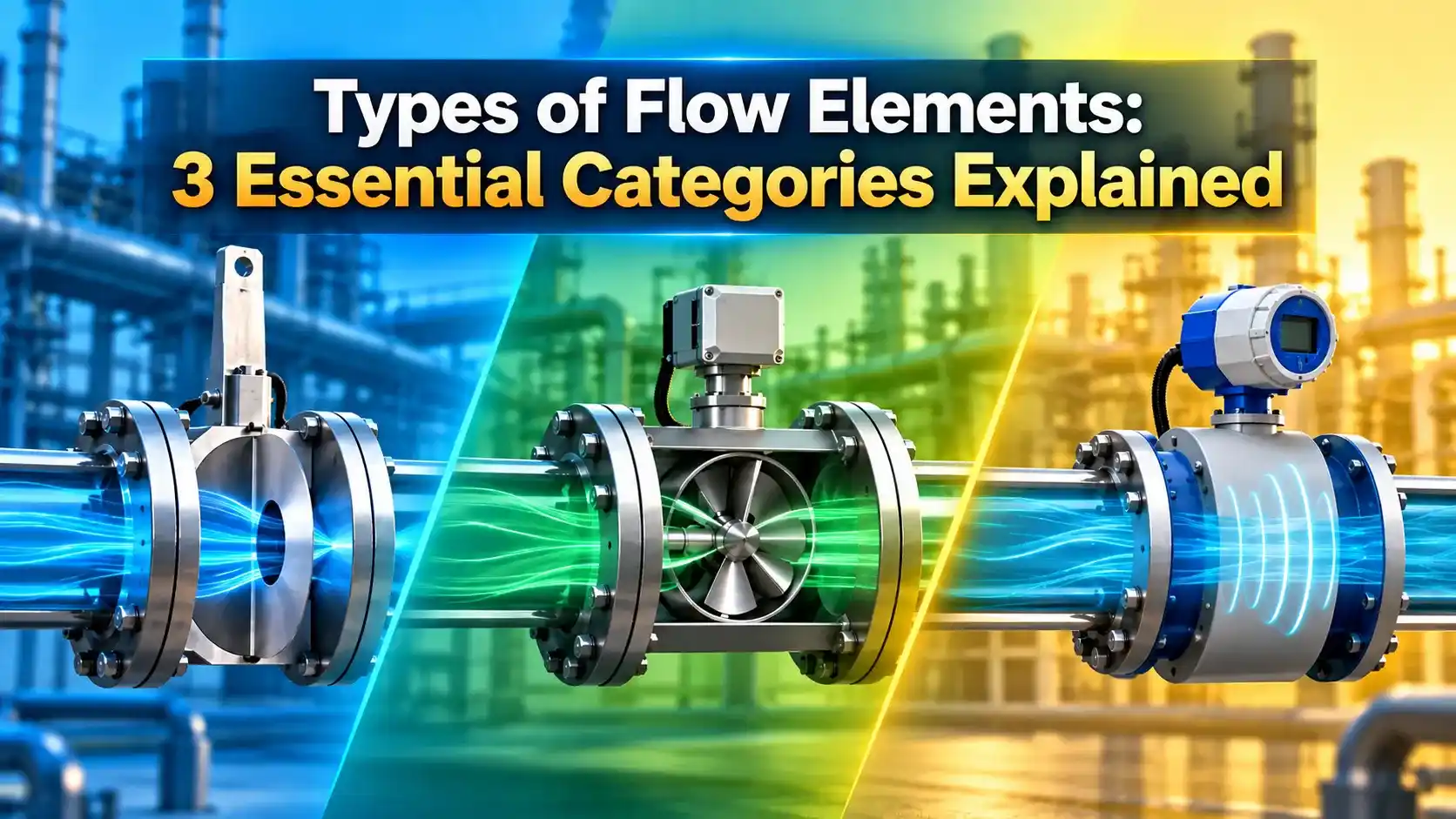
Why Types of Flow Elements Matter Before You Pick a Flow Meter
A flow element is simply the part of the meter that actually senses the flow, whether that means creating a pressure drop, reading a velocity, or detecting a mass effect directly.
Choosing the wrong category for a fluid, not just the wrong specific model, is what usually produces a meter that never reads correctly no matter how it gets calibrated.
The Three Categories of Flow Elements
Types of Flow Elements within the differential pressure family remain the most widely installed worldwide, mainly because the underlying physics has been standardized for decades under ISO 5167.
Differential Pressure Flow Elements
Averaging pitot designs, often sold under the Annubar name, extend the basic pitot concept across the pipe diameter for a more representative velocity profile on larger lines.
Installation Considerations for Differential Pressure Elements
Types of Flow Elements in this family are unforgiving of shortcuts here, since a tap placed incorrectly or a straight run that is too short quietly skews every single reading recorded afterward.
Velocity Based Flow Elements
Magnetic Flowmeter
Applies Faraday's law, generating a voltage proportional to fluid velocity, but only works on conductive liquids with no moving parts to wear out.
Ultrasonic Flowmeter
Times a sound pulse crossing the pipe or reads a frequency shift off particles, commonly cited near one percent accuracy on a clean liquid.
Turbine flowmeters round out this category, spinning a rotor at a speed proportional to velocity, delivering strong accuracy but adding a moving part that eventually needs bearing service.
Mass Based Flow Elements
Thermal mass flowmeters heat the fluid stream slightly and measure how quickly that heat dissipates, since denser or faster moving mass carries heat away more quickly than a slower stream.
Signal and Wiring Basics Across Velocity Based Elements
Confirming power and signal requirements early avoids a common late stage surprise where a chosen element needs wiring the existing junction box was never designed to supply.
Reviewing the transmitter data sheet against the actual site power budget before ordering saves a return trip to the vendor once the equipment has already arrived on site.
Common Selection Mistakes to Avoid
Most Types of Flow Elements failures traced back to the field turn out to be selection or installation mistakes rather than a genuinely defective instrument fresh out of the box.
Emerging Trends in Types of Flow Elements
Comparing Flow Element Types at a Glance
| Element Type | Category | Typical Accuracy | Pressure Loss |
|---|---|---|---|
| Orifice plate | Differential pressure | Around 1 to 2 percent installed | High |
| Venturi tube | Differential pressure | Around 1 percent | Low |
| V cone | Differential pressure | Around 0.5 percent per vendor data | Moderate |
| Magnetic | Velocity | Around 0.5 to 1 percent | None |
| Ultrasonic | Velocity | Around 1 percent clamp on grade | None |
| Turbine | Velocity | Around 0.5 to 1 percent | Moderate |
| Thermal mass | Mass | Around 1 percent of full scale | Low |
| Coriolis | Mass | Around 0.1 to 0.5 percent | Moderate |
These figures vary meaningfully by vendor, model, and installation quality, so treat this table as a starting comparison rather than a guaranteed specification for any single purchased meter.
Choosing the Right Type of Flow Element for Your Application
Working through this checklist before requesting quotes narrows most projects down to one or two realistic categories rather than an overwhelming full catalog of options.
Maintenance Patterns Worth Budgeting For
| Element | Wear Point | Typical Interval |
|---|---|---|
| Orifice plate | Edge sharpness and surface condition | Inspect every one to two years |
| Turbine meter | Rotor bearings | Inspect every one to three years |
| Magnetic meter | Liner and electrode coating | Check coating annually on dirty service |
| Ultrasonic meter | Transducer coupling | Verify signal strength annually |
Budgeting for these predictable wear points ahead of time keeps a flow measurement program from turning into a series of unplanned emergency call outs.
Reviewing that baseline on a fixed schedule, rather than only after operations raises a complaint, catches most accuracy drift while it is still minor and inexpensive to correct.
A maintenance team that treats this review as routine, the same way it treats a pump vibration check, generally spends far less on emergency flow meter replacements over the plant's operating life.
That same discipline also makes it much easier to defend a flow reading during an audit, since the documented history shows exactly when and why any change actually occurred.
Watch: Types of Flow Meters in Piping, 8 Types
Cost Differences Across the Three Categories
Lower Upfront Cost
Orifice plates, pitot tubes, and basic rotameters remain the cheapest options, favored on utility services where accuracy needs are modest.
Higher Upfront Cost
Magnetic, ultrasonic, and Coriolis designs cost more initially but often win on lifecycle cost once pressure loss and maintenance are counted.
A fair comparison always weighs installed cost against the pressure loss, maintenance, and downtime that a cheaper element quietly accumulates over its service life.
Energy cost from permanent pressure loss is easy to overlook at the specification stage, yet on a large continuously pumped line it can outweigh the entire purchase price within just a few years of continuous operation.
Types of Flow Elements Questions Engineers Ask
Related Articles on This Site
- Flow Nozzle vs Orifice Plate vs Venturi
- Orifice Plate Sizing Guide
- Orifice Plate vs Venturi Tube
- Flow Nozzle Working Principle
- How Ultrasonic Flow Meter Works
External References
What We Learn Today
- Types of Flow Elements split into differential pressure, velocity, and mass families, each relying on a different physical principle.
- Fluid cleanliness, conductivity, and available straight run length usually narrow the realistic choices down before cost even matters.
- Newer designs like V cone and Coriolis extend the classic categories with shorter installation footprints and higher accuracy.