
Table of Contents
ToggleFlow Nozzle – Accurate Flow Measurement at High Velocity
In industrial processes, measuring flow accurately is not always easy especially when fluids are moving at high velocity. Many flow elements struggle with pressure loss, wear, or unstable readings under such conditions.
This is where a Flow Nozzle becomes a reliable and practical solution.
It is a type of differential pressure flow element designed to handle high-velocity fluids with better accuracy and durability.
It is used in industries like power plants, oil & gas, and steam systems where performance and reliability are critical.
If you are working in instrumentation or process control, understanding how a flow-nozzle works can help you select the right flow measurement device for demanding applications.
Why Flow Nozzle is Used in High Velocity Applications
The main reason industries prefer a flow-nozzle is its ability to perform efficiently under tough operating conditions.
1. Designed for High Velocity Fluids
A flow-nozzle is specifically built for applications where fluid velocity is high, such as steam and gas lines. It maintains accuracy even when flow conditions are intense.
2. Lower Pressure Loss Compared to Orifice Plate
One of the biggest advantages of a flow nozzle is reduced permanent pressure loss. This helps improve overall system efficiency.
3. Better Resistance to Wear and Erosion
The internal shape of the flow nozzle minimizes direct impact from fluid particles, increasing its life span.
4. Stable and Reliable Performance
A flow-nozzle provides consistent readings even when flow conditions fluctuate, making it highly dependable.
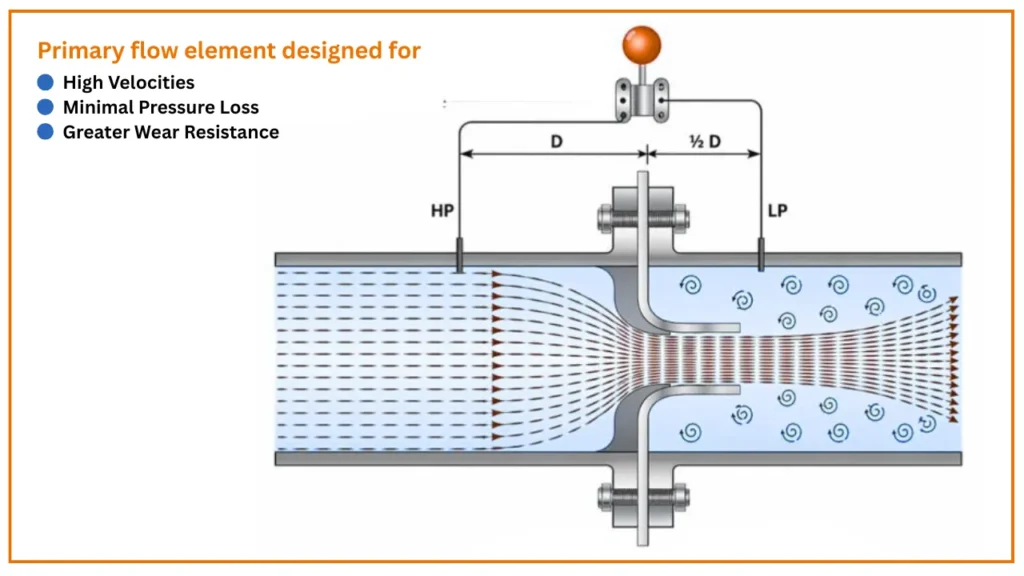
ISO 5167 Tapping Locations for Flow Nozzle
Proper installation is essential for accurate measurement using a flow-nozzle.
According to ISO 5167 standards:
1. Upstream tapping is at 1D
Here, “D” represents the pipe diameter. This point measures the high pressure side.
2. Downstream tapping is at 0.5D
This point measures the low pressure after the nozzle.
These tapping locations may slightly vary depending on the beta (β) ratio and the type of flow nozzle, but correct positioning is crucial for accurate differential pressure measurement.
Working Principle of Flow Nozzle
The working principle of a flow nozzle is based on Bernoulli’s principle.
When fluid enters the nozzle:
1. The cross-sectional area decreases
2. Fluid velocity increases
3. Pressure drops
This creates a differential pressure (ΔP) between the upstream and downstream sides of the nozzle.
A differential pressure transmitter measures this ΔP, and the flow rate is calculated using standard equations.
In simple terms:
Higher velocity → Lower pressure → Measurable ΔP → Flow rate
This is how a flow nozzle converts pressure difference into accurate flow measurement.
Key Advantage of Flow Nozzle Over Orifice Plate
One of the major differences between a flow-nozzle and an orifice plate is the inlet design.
1. Rounded Inlet Design
A flow-nozzle has a smooth, curved entry which reduces sudden flow disturbances.
2. Reduced Turbulence
This design minimizes turbulence compared to sharp-edged orifice plates.
3. Lower Energy Loss
Less turbulence means less pressure loss, improving efficiency.
4. Longer Service Life
Because of reduced wear, a flow-nozzle lasts longer in high-velocity applications.
This is why a flow-nozzle is often preferred for steam flow measurement and high-pressure systems.
Applications of Flow Nozzle in Industry
A flow-nozzle is commonly used in industries where high velocity and accuracy are required.
1. Steam flow measurement in power plants
2. High-pressure gas pipelines
3. Boiler feedwater systems
4. Oil and gas processing plants
In all these applications, the flow-nozzle provides reliable and consistent performance.
FAQs on Flow-Nozzle
1. What is a flow nozzle used for?
A flow nozzle is used to measure flow rate in high-velocity fluid applications using differential pressure. It is commonly used in steam, gas, and high-pressure systems.
2. How does a flow nozzle measure flow?
A flow-nozzle works by creating a pressure drop when fluid passes through it. This differential pressure is measured and used to calculate the flow rate.
3. What is the difference between a flow nozzle and an orifice plate?
A flow-nozzle has a rounded inlet which reduces turbulence and pressure loss, while an orifice plate has a sharp edge that causes higher energy loss and wear.
4. Where are flow nozzles commonly used?
A flow-nozzle is widely used in power plants, boiler systems, steam lines, and gas pipelines where flow velocity is high.
5. What are the tapping locations for a flow nozzle?
As per ISO 5167, a flow-nozzle typically uses pressure tapping at 1D upstream and 0.5D downstream, though this can vary slightly based on design.
6. Why is a flow nozzle suitable for high velocity flow?
A flow-nozzle is designed with a smooth profile that reduces turbulence and wear, making it ideal for high-speed fluid flow.
What we learn today?
A flow-nozzle is a flow measurement device which is a specialized solution for high-velocity applications where accuracy, durability, and efficiency are essential.
With its low pressure loss, strong resistance to wear, and stable performance, the flow nozzle remains one of the most trusted differential pressure flow elements in industrial instrumentation.
If you are a student or professional in instrumentation, mastering the concept of a flow-nozzle will give you a strong advantage in understanding real-world process measurement systems.


I hope you like above blog. There is no cost associated in sharing the article in your social media. Thanks for Reading !! Happy Learning