
A pump, compressor or turbine cannot run for long without proper lubrication. That job is handled by one packaged skid.
This guide covers its components, its API 614 heater requirements and the instrumentation that keeps it running safely.
A lube oil console does more than store oil. It filters it, cools it, heats it and monitors it, all from one packaged skid.
We will cover its main components, the API 614 immersion heater rules, the difference between a control thermostat and a protection thermostat, and the wiring practices around level interlocks.
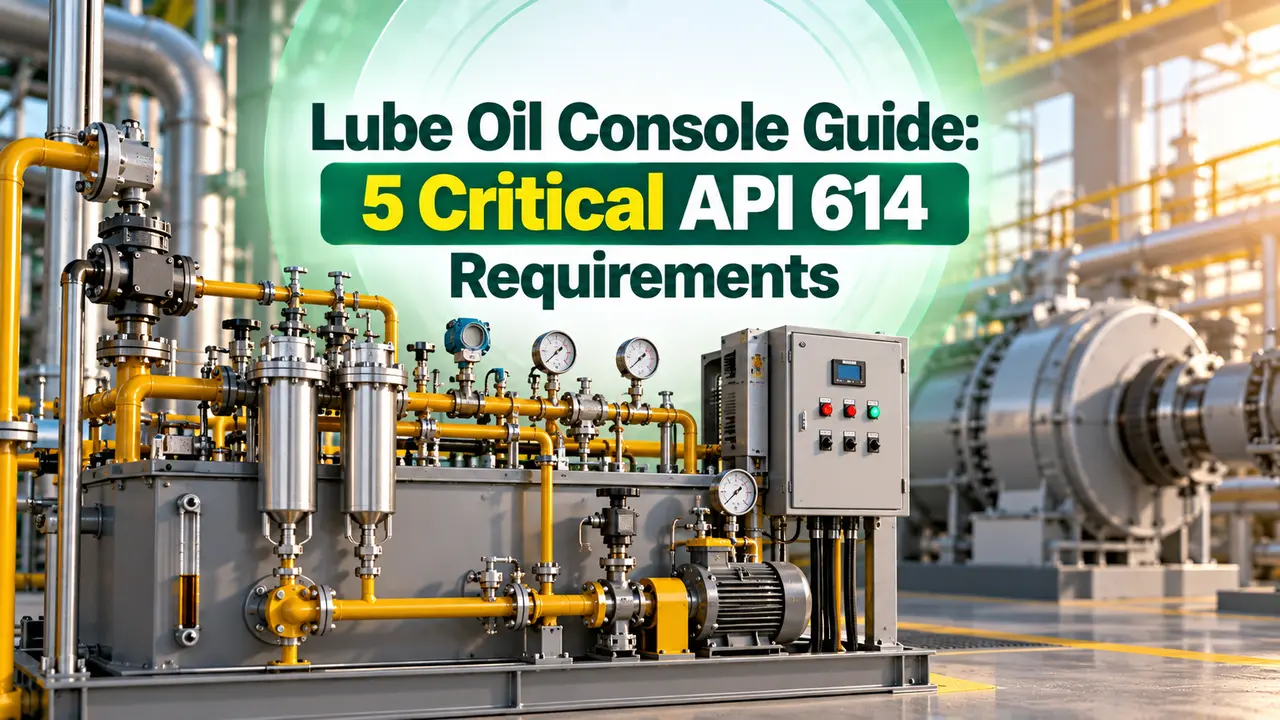
What Is a Lube Oil Console in Rotating Equipment?
A lube oil console is a complete lubrication system built as one packaged unit on a single baseplate.
It supplies oil to bearings, gears and seals on pumps, compressors and turbines, reducing friction during normal running.
Many consoles also provide hydraulic control oil for governors and actuators, alongside the pure lubrication duty.
Most vendors build these skids to the API 614 Standard, titled Lubrication, Shaft Sealing and Oil Control Systems and Auxiliaries.
The standard still allows flexibility. A vendor may offer, and a purchaser may accept, an alternative engineering solution where it makes sense.
Core Components Inside the Console
Every console shares the same basic building blocks, whichever vendor supplies it.
5 Critical API 614 Immersion Heater Requirements
API 614 Section 6.6.8 requires heating whenever the minimum site temperature falls below the oil's minimum startup temperature. Five rules then apply.
Control Thermostat vs Protection Thermostat
These two devices look similar but do very different jobs on the same heater.
| Aspect | Control Thermostat | Protection Thermostat |
|---|---|---|
| Measures | Actual bulk oil temperature | Heater element sheath temperature |
| Job | Switches the heater on and off during normal operation | Trips the heater off only during an abnormal overtemperature event |
| Location | Can be remote, away from the heater bundle | Must be integral to the heater element itself |
| Reset Behaviour | Cycles automatically, no manual reset needed | Often needs a manual reset after it trips |
A remote temperature transmitter reading the bulk oil gives a truer picture than a thermostat sitting on the element itself.
Level Interlock and Instrumentation Wiring Practices
Getting the signal wiring right matters as much as picking the right hardware. Check these points before the console ships.
Where This Type of Console Gets Used
The same basic skid design shows up across almost every rotating equipment package on a process plant.
Watch: API 614 Lube Oil System Explained
Lube Oil Console Questions Engineers Ask
Related Articles on This Site
- Temperature Switch vs Temperature Transmitter
- Level Switch Selection Guide
- Centrifugal vs Positive Displacement Pump
- Plate Heat Exchanger Working Principle
- Motor Protection Relay Types
External References
- Lube Oil Consoles, Immersion Heaters, API 614 Standard | Inst Tools
- American Petroleum Institute (API)
What We Learn Today
- A lube oil console is a packaged skid, built to API 614, that lubricates and sometimes hydraulically controls pumps, compressors and turbines.
- Immersion heaters follow five API 614 rules: limited watt density, removable design, minimum submergence, a level interlock, and two separate temperature devices.
- The control thermostat manages normal heating cycles, while the protection thermostat guards against a genuine overtemperature fault and often needs a manual reset.