
Skin temperature measurement reads the outer surface of a pipe, vessel, or tube without penetrating the wall or contacting the process fluid.
Two sensor types dominate this application: the welded thermocouple pad used in high-temperature furnace and boiler tube service, and the clamp-on or adhesive surface sensor used for portable monitoring and HVAC applications.
Skin temperature differs from process fluid temperature depending on pipe wall thickness, insulation, fluid velocity, and heat flux. Understanding this difference is essential before interpreting any surface measurement result.
We will cover how each sensor type works, what it measures, where each is the better choice, the main sources of error in surface temperature measurement, and a full comparison table to help you select the right sensor for your application.
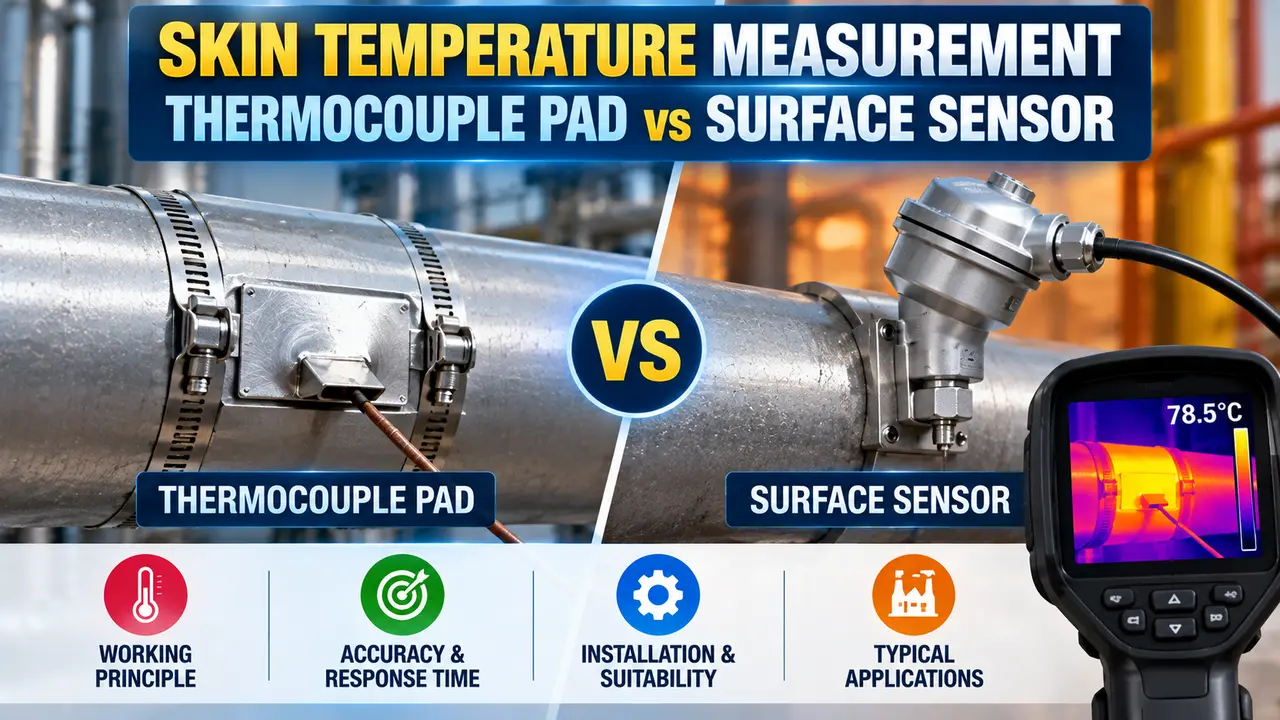
What Is Skin Temperature Measurement?
Skin temperature is the temperature at the outer surface of a pipe, vessel wall, tube, or any other solid object. It is not the same as the temperature of the fluid inside.
The difference depends on the wall material, thickness, heat flux, and any insulation on the outside.
In a well-insulated pipe carrying hot fluid, the outer skin may be near ambient temperature even when the fluid inside is at 300 degrees C.
Skin temperature measurement is used mainly for monitoring furnace tube integrity, detecting heat tracing faults on cold-service lines, energy auditing to quantify heat loss, and detecting blocked process lines.
Two Sensor Types: Thermocouple Pad vs Surface Sensor
A welded assembly where the thermocouple hot junction is held against the tube surface by a metal pad. The pad is welded to the tube and is not removable without cutting.
Used in high-temperature furnace tubes, boiler superheater tubes, reactor tubes, and any application where a permanent, high-accuracy surface measurement is required at temperatures up to 1200 degrees C.
A surface thermocouple or RTD held against the pipe by a spring clamp, worm-gear clamp, cable tie, or adhesive tape. The sensor is removable and reusable. No welding is required.
Used in HVAC monitoring, heat tracing verification, energy audits, and temporary measurement on process lines where welding is not permitted or practical.
Thermocouple Pad (Skin Thermocouple): Construction and Installation
A thermocouple pad sensor consists of a mineral insulated (MI) thermocouple cable with a flat or V-shaped metal pad welded to the sheath at the hot junction end.
The pad is designed to be welded directly to the tube or pipe surface so the thermocouple hot junction is in intimate metallic contact with the metal being monitored.
The MI cable runs from the pad along the tube surface to a head enclosure or terminal block, protected by mounting clamps welded at intervals along the tube.
An expansion loop or coil is formed in the cable to absorb the thermal movement of the tube as it heats and cools during operation.
Pad Design Types
Clamp-On and Adhesive Surface Sensors: Types and Installation
A clamp-on surface sensor uses contact pressure to hold a sensing element against the pipe outer wall.
The element is typically a Type K thermocouple probe, a PT100 RTD, or a spring-loaded thermocouple strip.
Contact quality is the critical variable in clamp-on measurement. Any air gap between the element and the surface causes the sensor to read closer to ambient than to the pipe surface.
Thermal paste applied between the sensor and the surface significantly reduces this gap error.
Clamp-On Surface Sensor Types
Measurement Error Sources in Skin Temperature Measurement
Surface temperature measurement always has higher uncertainty than an immersion thermocouple measuring the same medium directly. Understanding the error sources allows the correct mounting technique to be applied.
Thermocouple Pad vs Clamp-On Surface Sensor: Full Comparison
| Parameter | Thermocouple Pad (Skin TC) | Clamp-On / Adhesive Surface Sensor |
|---|---|---|
| Installation method | Welded pad permanently bonded to the surface | Clamped, adhesive, or magnetic contact. Removable. |
| Temperature range | Up to 1200 degrees C with MI cable and correct TC type | Typically up to 600 degrees C for clamp types; 150 degrees C for adhesive patches |
| Accuracy | Better: metallic contact eliminates gap error. Typical error 2 to 5 degrees C with heat shield | Lower: contact quality is variable. Typical error 5 to 20 degrees C without thermal paste |
| Response time | Fast (welded contact, no gap) | Varies: spring strip is fast (5 to 10 s); heavy clamp assemblies are slow (2 to 5 min) |
| Removable? | No: welded to the surface. Cutting required to remove | Yes: remove without tools or with a screwdriver |
| Requires pipe shutdown? | Yes for initial installation (welding). Removal requires shutdown | No: can be installed and removed on a live line |
| Heat shield required? | Yes in fired heater and radiant furnace service | Not typically used; insulation wrap over the sensor reduces convection error |
| Expansion loop needed? | Yes for high-temperature tube applications | Not applicable |
| Typical applications | Furnace tubes, boiler superheater tubes, reactor coils, fired heater monitoring | HVAC lines, heat tracing verification, energy audits, portable spot checks |
| Cost | Higher: bespoke welded assembly per measurement point | Lower: standard commercial product, reusable |
Selection Guide: Which Sensor Type to Use
Watch: Thermocouple Flat Surface Contact Measurement
Skin Temperature Measurement Questions Engineers Ask
Related Articles on This Site
- Thermocouple Grounded vs Ungrounded Junction Explained
- Thermocouple Polarity Identification Guide
- Thermocouple and RTD Installation Precautions
- How to Calibrate a Temperature Transmitter: Step-by-Step
- Thermocouple Transmitter Configuration: HART Setup Guide
External References
- Skin Thermocouple for Industrial Tube Surface Measurement | Tempsens
- Skin Type Thermocouple: Selection, Installation and Applications | Instrumentation Tools
What We Learn Today
- Skin temperature is the outer surface temperature of a pipe, not the process fluid temperature. Thermocouple pad sensors are welded permanently for high-temperature furnace and boiler tube monitoring. Clamp-on sensors are removable and used for HVAC and heat tracing verification.
- The main error sources are contact resistance from air gaps, conduction along the sensor cable, radiation from flames, and convective cooling by ambient air. A heat shield is mandatory in furnace service. Thermal paste and insulation wrap reduce clamp-on sensor errors.
- For furnace tubes above 600 degrees C, use Type N with V-pad design, heat shield, and expansion loop. For heat tracing and HVAC, a pipe clamp sensor with Type K thermocouple is practical. Apply thermal paste and insulation over the sensor for reliable readings.