
A combinational circuit forgets everything the instant its inputs change. This kind of circuit remembers. Here is exactly what that memory means in practice, with a live clock-triggering visualizer built right into this page.
What is a Sequential Circuit?
This type of circuit is a digital circuit whose output depends on both its current input values and the state stored from previous inputs, unlike a combinational circuit, which reacts only to whatever inputs are present right now.
That stored state lives inside memory elements, typically flip-flops, which hold a bit of binary information even after the input that set it disappears. This kind of circuit's logic actually sees two different kinds of input at once: external inputs coming from outside the circuit, and internal inputs, which are really just the circuit's own previous output feeding back in as memory.
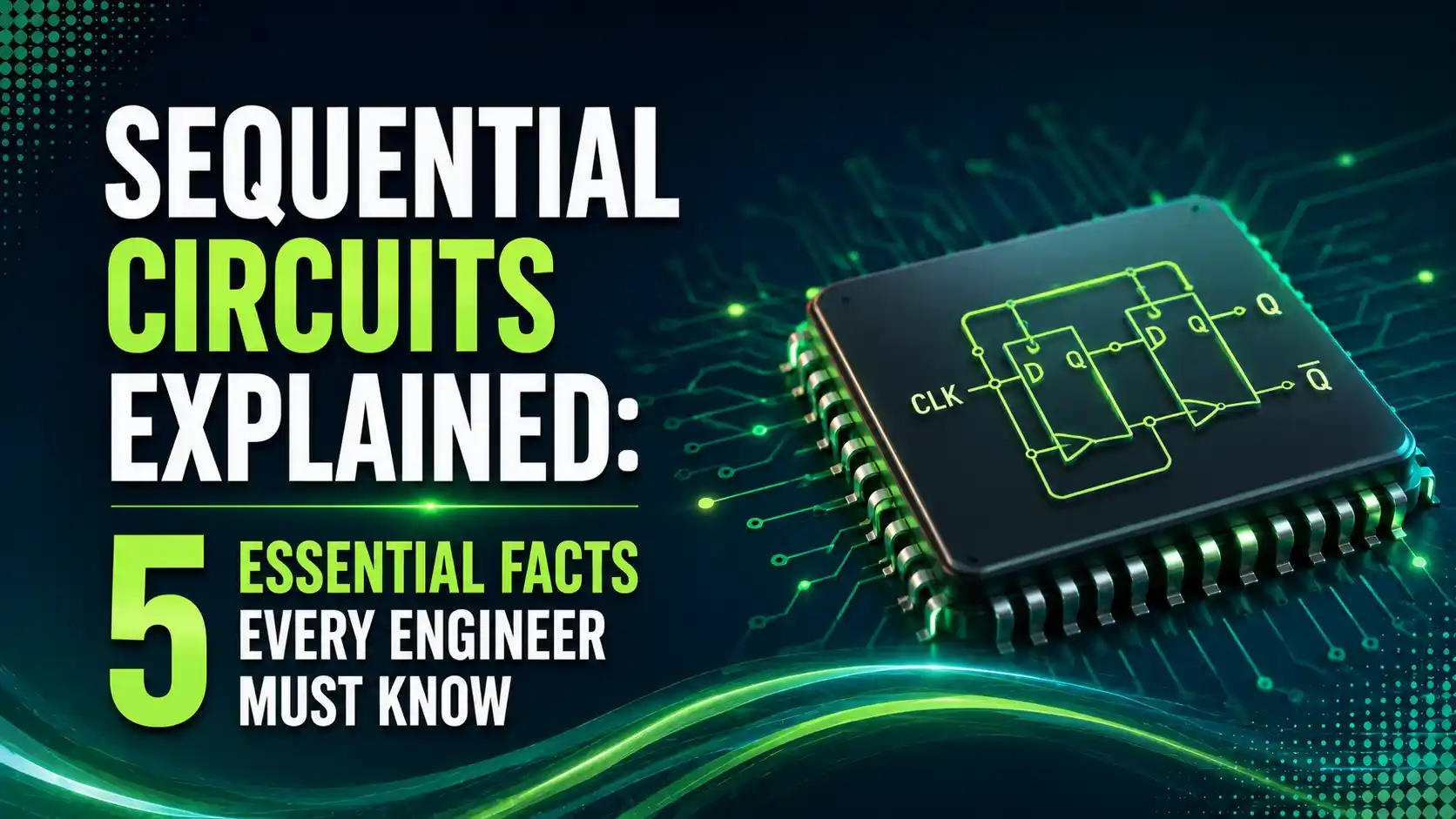
Engineers often call that feedback the "secondary input," and the corresponding signal heading back into the memory element the "secondary output."
This guide covers the five essential facts behind this circuit family, the real difference between synchronous and asynchronous designs, and exactly how level triggering differs from edge triggering.
Combinational vs Sequential Circuits
The single defining difference between these two circuit families comes down to whether memory is involved at all.
Combinational Circuit
Output depends only on the present combination of inputs. Change an input, and the output responds immediately, with no memory of what came before.
Output = f(current inputs)
Sequential Circuit
Output depends on the present inputs plus the state stored from earlier inputs. The exact same input can produce different outputs depending on history.
Output = f(current inputs, stored state)
Notice that this distinction has nothing to do with how complicated a circuit's logic gates are. A combinational circuit can still involve dozens of gates and several layers of logic, it simply never loops any output back around as an input.
The moment a design feeds its own output, or a derivative of it, back into its own input stage, that feedback path is what introduces memory and crosses the line into this second circuit family.
How State Gets Maintained
The same feedback loop repeats continuously in every circuit of this kind, regardless of how complex the design becomes.
Input Arrives
An external input reaches the circuit's combinational logic alongside the currently stored state.
Logic Combines Both
The combinational logic computes a new output based on both the fresh input and the existing memory.
New State Is Stored
The result feeds back into the memory elements, becoming the stored state for the next cycle.
5 Essential Facts About Sequential Circuits
These five facts explain almost everything a working engineer needs to know about how this circuit family actually behaves.
Output Depends on Current Input Plus Stored State
This single property is what separates this circuit family from every combinational one. The exact same set of current inputs can legitimately produce different outputs depending on what state the circuit is already holding.
Flip-Flops Provide the Memory
A flip-flop stores one bit of information and holds it steady even after the input that produced it has changed or disappeared, which is exactly the memory function a sequential circuit needs.
Asynchronous Circuits React Immediately, With a Cost
Without a clock, an asynchronous circuit updates its state the instant an input changes, making it genuinely faster. That same lack of synchronization also makes its behavior harder to guarantee and more prone to race conditions.
Synchronous Circuits Trade Speed for Predictability
A synchronous circuit only updates its state in step with a shared clock signal, which makes every state change happen at a known, predictable moment, at the cost of waiting for the next clock pulse rather than reacting instantly.
Triggering Method Decides the Exact Moment of Change
Even within synchronous design, level triggering and edge triggering respond to the clock signal completely differently, level triggering reacts throughout an entire high or low phase, while edge triggering reacts only at a single transition instant.
Synchronous vs Asynchronous, in More Depth
This classification is really about one question: does a shared clock signal control when state changes happen, or does the circuit respond to inputs the moment they arrive?
An asynchronous sequential circuit has no clock at all. Its memory elements change state the instant an input signal changes, with no waiting period of any kind. That immediacy is a genuine speed advantage, since there is never a clock pulse to wait for.
The tradeoff is stability. If inputs are not carefully controlled, multiple parts of the circuit can start changing at slightly different times relative to each other, creating race conditions where the final state depends on tiny, unpredictable timing differences. Asynchronous design is therefore reserved for situations where raw speed genuinely outweighs the extra design difficulty.
A synchronous sequential circuit instead ties every state change to a shared clock signal, a repeating square wave alternating between a high level and a low level at a fixed frequency. Because every memory element only updates in step with that same clock, the entire circuit's timing becomes predictable and easy to reason about. The output pulse produced by a clocked sequential circuit lasts exactly as long as the clock pulse driving it.
This reliability is exactly why synchronous design dominates practical digital systems, including synchronous counters, flip-flop-based registers, and Moore or Mealy state machines. It is measurably slower than an equivalent asynchronous design, but that predictability is almost always worth the tradeoff.
Try It: Clock Triggering Visualizer
Pick a triggering type to see exactly when a synchronous circuit would respond to this same clock signal.
Combinational vs Sequential: Side by Side
| Feature | Combinational Circuit | Sequential Circuit |
|---|---|---|
| Depends On | Current inputs only | Current inputs and stored state |
| Memory | None | Flip-flops or latches |
| Same Input, Same Output? | Always | Not necessarily, depends on state |
| Typical Examples | Adders, multiplexers, decoders | Counters, registers, state machines |
Where Sequential Circuits Actually Show Up
Counters and Timers
Digital clocks, frequency counters, and event counters all rely on sequential state.
Registers and Memory
Processors and RAM use sequential elements to store, transfer, and manipulate data.
State Machines
Control systems and communication protocols use Moore or Mealy machines built from sequential logic.
Every one of these three applications shares the same underlying need: a system that must remember something between one moment and the next. A traffic light controller needs to remember which phase it is currently in, a calculator needs to remember a running total, and a UART needs to remember which bit position it is currently receiving.
None of that is possible without the feedback and memory this circuit family provides.
Advantages and Limitations of Sequential Design
Why Sequential Circuits Are Indispensable
Genuine Limitations to Keep in Mind
Weighing these tradeoffs is really the entire design decision in a nutshell: reach for asynchronous logic only when raw speed is worth the added risk, and default to synchronous, clocked designs everywhere else, since predictability is usually worth far more in practice than the extra speed asynchronous logic can offer.
Download Sequential Circuit References
These two university lecture references go deeper into sequential circuit timing and triggering.
Lecture 7: Synchronous Sequential Logic
IIT Bombay CSE lecture notes on memory elements and clocking
Lecture 10: Sequential Circuits
Imperial College London EE1 Digital Electronics lecture notes
Watch: Sequential Logic Circuits Explained
This video introduces sequential logic circuits and the synchronous versus asynchronous distinction.
FAQs on Sequential Circuits
External References
- IIT Bombay, CSE, Lecture 7, Synchronous Sequential Logic
- Imperial College London, EE1, Lecture 10, Sequential Circuits
- YouTube, Introduction to Sequential Logic Circuits, Synchronous and Asynchronous Circuits Explained
What we learn today
- A sequential circuit's output depends on both current inputs and previously stored state, unlike a combinational circuit which only reacts to current inputs.
- Flip-flops provide the memory that lets a sequential circuit hold its state between input changes.
- Asynchronous circuits react immediately without a clock but risk race conditions, while synchronous circuits trade some speed for predictable, clock-timed behavior.
- Level triggering responds throughout an entire clock phase, while edge triggering responds only at a single clock transition instant.
- Sequential circuits underpin counters, registers, memory, and state machines throughout digital electronics.