
Once a Boolean function grows past five or six variables, a Karnaugh map stops being a map you can actually read. Here is exactly how the Quine-McCluskey tabulation method simplifies it instead, with a full worked example and a live term merge checker you can try right now.
What is the Quine-McCluskey Method?
The Quine-McCluskey method, also called the tabulation method, is a systematic, table-based technique for simplifying Boolean functions with many variables, arriving at the same guaranteed-minimal result a Karnaugh map would, without needing to visually spot patterns.
Developed by Willard Quine in 1952 and extended by Edward McCluskey in 1956, this method exists specifically because Karnaugh maps become genuinely impractical to read once a function passes five or six variables. Where a K-map relies on your eye recognizing adjacent groups of 1s, Quine-McCluskey replaces that visual step with a repeatable, mechanical comparison process built directly on the same Boolean algebra laws covered previously, which is exactly why it can be coded into software.
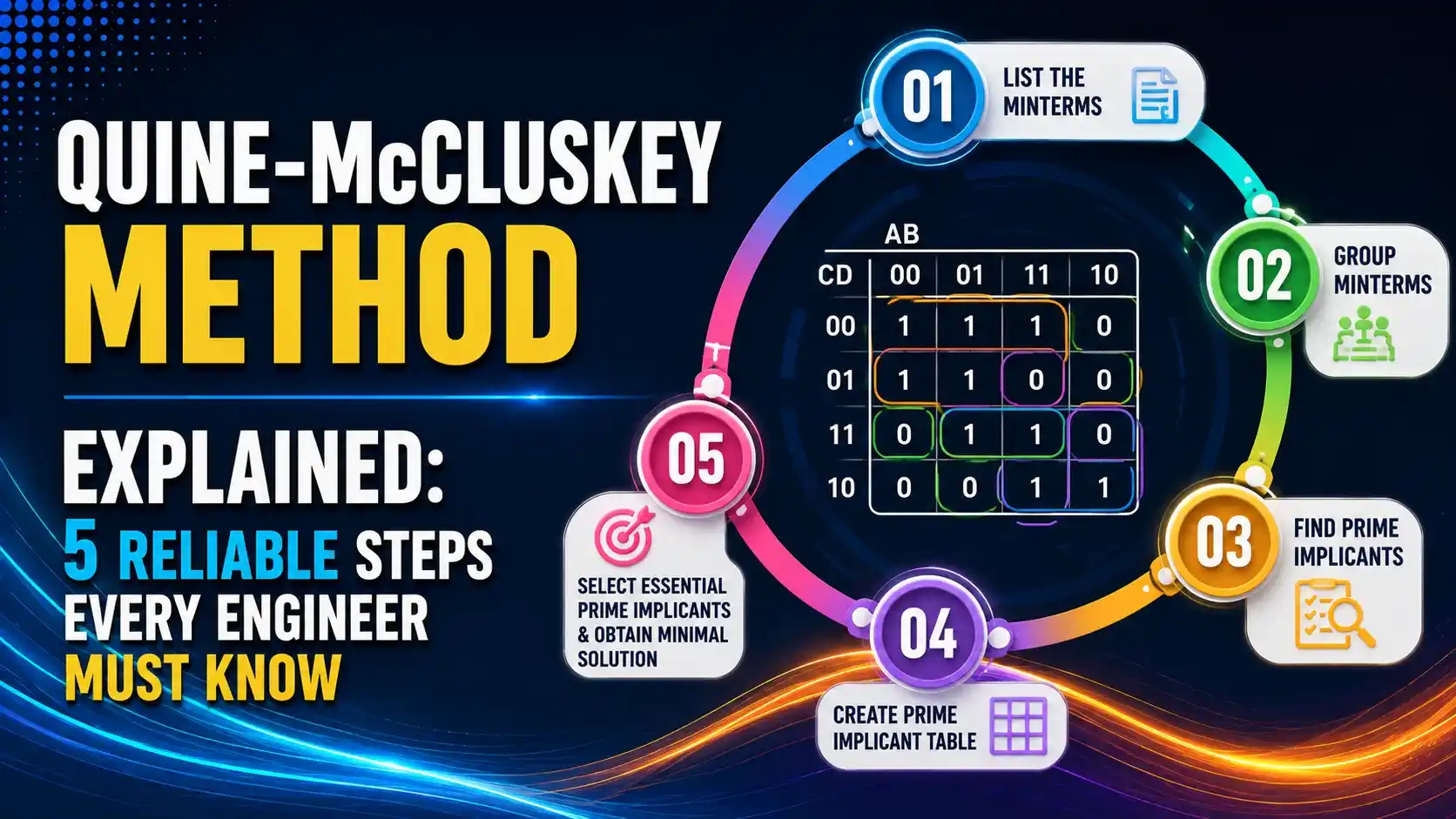
This guide covers the five reliable steps behind the method, a complete worked example using our own set of minterms, and the exact table format used to find the final simplified expression.
Key Terminology, Explained
Three terms drive this entire method, and confusing them is the single most common source of mistakes when learning it.
Implicant
Any group of minterms that can be validly combined together, whether or not it can still be combined further with something else.
Prime Implicant
An implicant that cannot be combined with any other term. This is as far as that particular group can be simplified.
Essential Prime Implicant
A prime implicant that is the only one covering a particular minterm. These must always appear in the final simplified expression.
The relationship between these three terms is really a hierarchy of increasing importance. Every prime implicant is also an implicant, but not every implicant reaches the prime stage. Likewise, every essential prime implicant is a prime implicant, but plenty of valid prime implicants never turn out to be essential, because some other prime implicant already covers every minterm they touch.
How the Tabulation Process Works
The same three-stage process applies regardless of how many variables the function has.
Group by Number of 1s
Convert every minterm to binary and sort them into groups based on how many 1 bits each one contains.
Merge Adjacent Groups
Compare terms in neighboring groups, combining any pair that differs in exactly one bit position, marking that bit with a dash.
Chart and Select
Once no more merging is possible, chart the remaining prime implicants against the original minterms and select the essential ones.
5 Reliable Steps to Master the Method
These five steps expand the process above into the exact sequence you would actually follow on paper.
Convert Minterms to Binary and Group by Ones Count
Write every given minterm in binary, then sort them into groups ordered by how many 1 bits appear, from fewest to most.
Compare Only Adjacent Groups
Only terms in neighboring groups can ever differ by exactly one bit, so comparisons are always made between one group and the very next one.
Repeat Merging Until Nothing New Combines
Each merging round produces a new table with one fewer defined bit per term. Repeat this process until an entire round produces no further valid merges.
Any Term Left Unmerged Becomes a Prime Implicant
Whenever a term cannot combine with anything in the next round, it is finalized as a prime implicant and carried forward to the chart.
Build the Chart and Select Essential Prime Implicants
Mark which prime implicants cover which original minterms. Any minterm covered by only one prime implicant makes that implicant essential, and essential implicants always belong in the final answer.
Full Worked Example
Let's simplify F(A,B,C,D) = Σm(4,8,9,10,11,12,15) completely, using the same table structure at every stage.
Table 1: Group Minterms by Number of 1s
| Group | Minterm | A | B | C | D |
|---|---|---|---|---|---|
| 1 | 4 | 0 | 1 | 0 | 0 |
| 8 | 1 | 0 | 0 | 0 | |
| 2 | 9 | 1 | 0 | 0 | 1 |
| 10 | 1 | 0 | 1 | 0 | |
| 12 | 1 | 1 | 0 | 0 | |
| 3 | 11 | 1 | 0 | 1 | 1 |
| 4 | 15 | 1 | 1 | 1 | 1 |
Table 2: Merge Pairs Differing by One Bit
| Pair | A | B | C | D |
|---|---|---|---|---|
| (4,12) | - | 1 | 0 | 0 |
| (8,9) | 1 | 0 | 0 | - |
| (8,10) | 1 | 0 | - | 0 |
| (8,12) | 1 | - | 0 | 0 |
| (9,11) | 1 | 0 | - | 1 |
| (10,11) | 1 | 0 | 1 | - |
| (11,15) | 1 | - | 1 | 1 |
Table 3: Merge Again Where Possible
| Quad | A | B | C | D |
|---|---|---|---|---|
| (8,9,10,11) | 1 | 0 | - | - |
What is happening: After Table 3, the pairs (4,12), (8,12), and (11,15) had no further matching partner with a dash in the same position, so they stop here as prime implicants alongside the quad (8,9,10,11).
A real example: The pair (4,12), written -100, means B=1, C=0, D=0 with A free to be either value, translating directly to the term BC'D'.
Why it works: Every dash represents a variable that toggles between the covered minterms without changing the output, which is exactly the variable Boolean algebra's complement law lets you eliminate from that term.
Building the Prime Implicant Chart
With four prime implicants identified, BC'D', AC'D', ACD, and AB', the chart checks which original minterms each one covers.
| Prime Implicant | 4 | 8 | 9 | 10 | 11 | 12 | 15 |
|---|---|---|---|---|---|---|---|
| BC'D' (4,12) | X | X | |||||
| AC'D' (8,12) | X | X | |||||
| ACD (11,15) | X | X | |||||
| AB' (8,9,10,11) | X | X | X | X |
Minterm 4 is covered only by BC'D', minterms 9, 10, and 15 are each covered by only one prime implicant too, so BC'D', AB', and ACD are all essential. Together those three already cover every single minterm in the original function, which means AC'D' turns out to be redundant and gets dropped entirely.
Original: F(A,B,C,D) = Σm(4,8,9,10,11,12,15)
Essential prime implicants: BC'D', AB', ACD
Simplified result: F = AB' + BC'D' + ACD
Try It: Term Merge Checker
Enter two 4-bit binary terms to see whether they combine, and what the merged result looks like.
Quine-McCluskey vs Karnaugh Map
Both methods are functionally equivalent, always arriving at the same minimal expression, but they suit different situations.
A Karnaugh map depends entirely on your eye recognizing rectangular groups of adjacent 1s, which works beautifully up to about four or five variables but becomes genuinely difficult to draw, let alone read correctly, beyond that. Quine-McCluskey trades that visual pattern recognition for a purely mechanical, repeatable comparison process. It takes longer to work through by hand for a small function, but it scales to functions with far more variables and, crucially, it can be directly implemented as a computer algorithm, since every step is a well-defined comparison rather than a judgment call about which groups look adjacent.
In practice, most engineers reach for a Karnaugh map first for anything with four variables or fewer, purely because it is faster on paper, and switch to Quine-McCluskey, or more realistically, software that implements it, once a function grows beyond what a K-map can comfortably represent.
Where This Method Actually Gets Used
Logic Synthesis Software
CAD tools use Quine-McCluskey-style algorithms internally to minimize large digital designs.
Multi-Output Circuit Design
The tabular structure extends more naturally than K-maps to functions with several shared outputs.
High-Variable-Count Functions
Any Boolean function with more than five or six variables is a natural fit for this method.
Advantages and Limitations of the Method
Why Engineers Still Rely On It
Limitations to Keep in Mind
Download Quine-McCluskey References
These two university lecture references go deeper into the tabulation method and prime implicant charts.
Quine-McCluskey Procedure Lecture Notes
University of Texas at Arlington CSE 2441 lecture notes
Quine-McClusky Minimization Procedure
Concordia University lecture notes with additional worked examples
Watch: Quine-McCluskey Tabular Method Explained
This video walks through the tabulation method with a complete worked example.
FAQs on the Quine-McCluskey Method
External References
- University of Texas at Arlington, CSE 2441, Quine-McCluskey Procedure
- Concordia University, Quine-McClusky Minimization Procedure
- YouTube, Quine-McCluskey Minimization Technique, Tabular Method
What we learn today
- The Quine-McCluskey method simplifies Boolean functions through a systematic table-based process rather than visual pattern recognition.
- Minterms are grouped by their count of 1 bits, then merged with adjacent groups whenever exactly one bit differs.
- An implicant that cannot merge further becomes a prime implicant, and the process repeats until no more merges are possible.
- A prime implicant chart identifies essential prime implicants, the terms that uniquely cover at least one original minterm.
- The method scales to functions with far more variables than a Karnaugh map can practically handle, and it converts directly into a computer algorithm.