
Table of Contents
TogglePLC Raw Count Calculation: Introduction
In industrial automation, a pressure transmitter sends a 4–20 mA signal to the PLC, but the PLC does not understand pressure directly.
PLC reads this signal as a digital value called a raw count.
To know the actual pressure, we need to convert this raw count into engineering units like bar or psi.
This step is very important for correct process monitoring and control.
In this article, we will explain PLC raw count calculation for pressure transmitters in a very simple way so that everone can easily understand and use it.
PLC Raw Count Calculator – Simple Explanation
Using simple linear scaling, a PLC-raw-count calculator helps convert raw analog values from the PLC into actual engineering units like bar, psi, or °C.
It can also do the reverse, convert engineering values back into raw counts.
When a signal like 4–20 mA or 0–10 V goes into the PLC, the analog input module converts it into digital form. This digital value is called the raw count. The exact raw count depends on a few things:
1. PLC manufacturer
Different PLC brands use different raw count ranges.
2. Analog module resolution
Higher resolution means more accurate digital values.
3. Type of input signal
Whether it is 4–20 mA or 0–10 V affects the scaling.
4. Reserved diagnostic ranges
Some part of the signal range is kept for fault detection.
The calculator works using the same scaling method that PLCs use internally, so the results are accurate, easy to understand, and simple to verify.
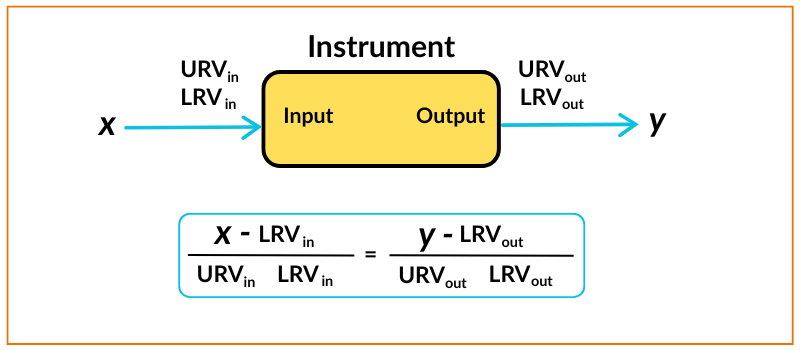
We will take an praticle example of Pressure Transmitter with:
Input Range: 0 to 1023 psi
Output: 4 to 20 mA
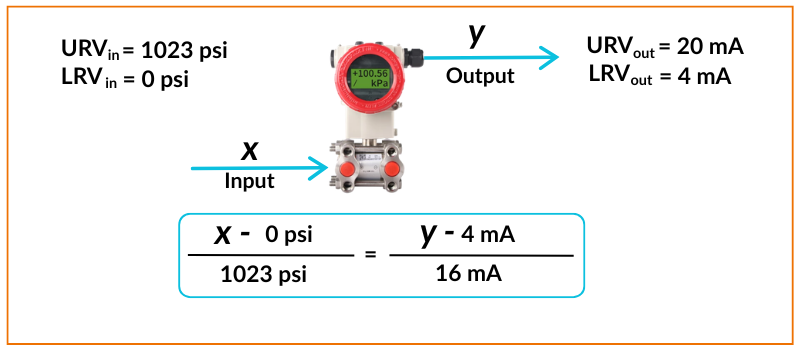
Now, If you want to measure output current of 14.7 mA from pressure transmitter then,
x = { ( 14.7 – 4 ) / 16 } * 1023 = 684.13 PSI
You can easily calculate the corresponding input pressure as 684.13 PSI.
How PLC Reads Pressure Transmitter Signal
Now let us understand this in a simple way.
A pressure transmitter is connected to the PLC through an analog input (AI) card. This transmitter sends a 4–20 mA signal based on the pressure.
Inside the AI card, there is a built-in Analog to Digital Converter (ADC). This ADC converts the 4–20 mA signal into a digital value called a raw count.
The AI card then sends this raw count to the PLC CPU.
The CPU already has important details stored, such as:
1. LRV (Lower Range Value)
2. URV (Upper Range Value)
3. Engineering units (bar, psi, etc.)
Using this information, the CPU converts the raw count into the actual pressure value (process variable). This value is then displayed on the HMI or operator screen.
Example for Better Understanding
Now consider an ADC with a 10-bit resolution, which means it gives a raw count range from 0 to 1023 for a 4–20 mA input signal.
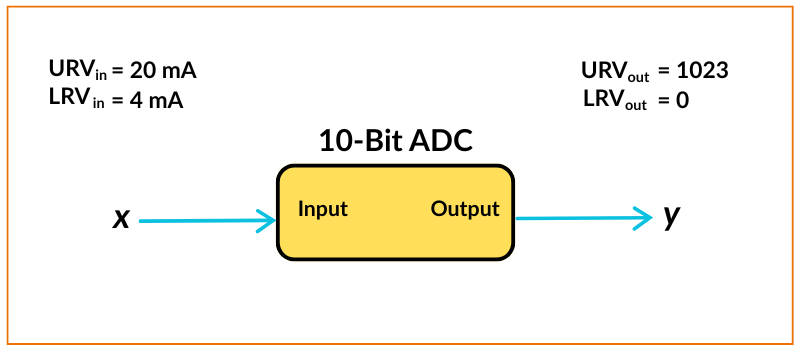
Calculate the corresponding ADC “count” output for an input signal of 6.82 mA.
Here, we are finding the ADC output in terms of count. So, the input to the AI card is “x”, and the output (raw count) is “y”, as shown in the figure below.
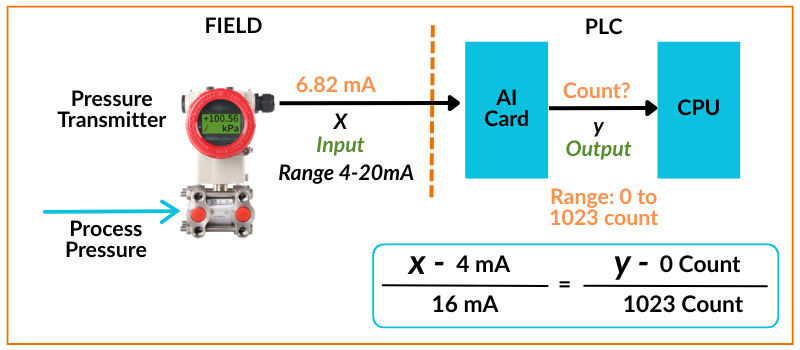
So, we can say:
- Input (x) = 6.82 mA
- Output (y) = Raw count
Since the ADC range is:
- 4 mA → 0 count
- 20 mA → 1023 count
We use linear scaling to find the result.
First, calculate the span:
- Input span = 20 – 4 = 16 mA
- Count span = 1023 – 0 = 1023
Now apply the formula:
Count y = { ( 6.82 – 4 ) / 16 } * 1023 = 180 count
So, the ADC output will be approximately:
180 counts
This is the raw digital value that the PLC receives from the analog input card.
In a PLC system, the CPU converts this raw count into the actual process value and displays it on the operator workstation or HMI.
What we learn today?
In a PLC system, the pressure transmitter sends a 4–20 mA signal, which is converted into raw counts by the analog input card.
These raw counts are then processed by the CPU using predefined values like LRV, URV, and units.
Finally, the PLC converts this data into the actual pressure value (process variable) and displays it on the HMI or operator workstation.
Understanding this simple conversion process helps engineers and technicians troubleshoot, calibrate, and work confidently with PLC-based measurement systems.


I hope you like above blog. There is no cost associated in sharing the article in your social media. Thanks for Reading !! Happy Learning