
Every conductor fights back against the current trying to flow through it, and that fight has a name: resistance. Here is exactly what resistance is, why it always turns into heat, and where the simple picture breaks down, with a live power dissipation calculator you can try right now.
What is Resistance?
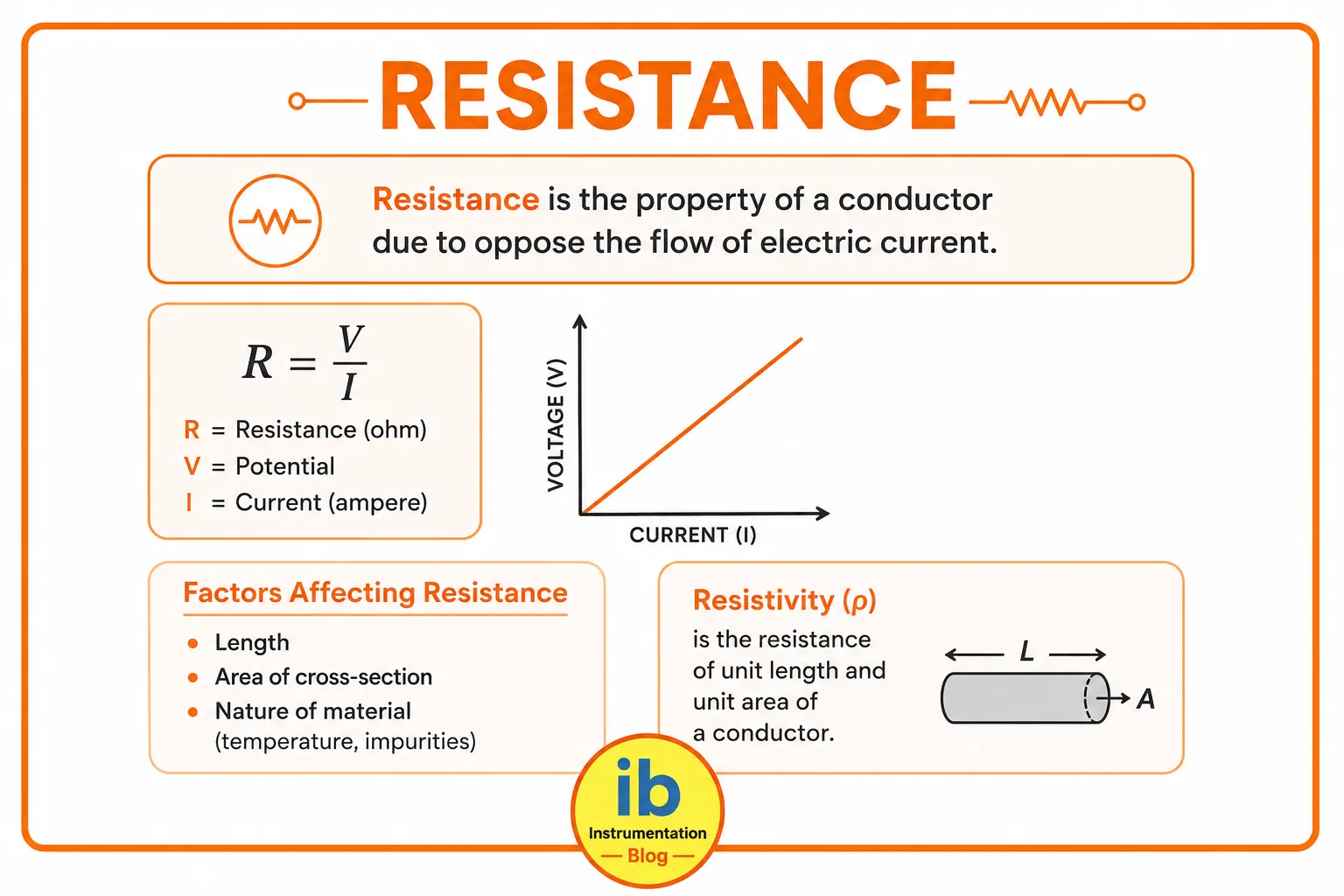
Electrical resistance is the opposition a material presents to the flow of electric current, measured in ohms, and defined by Ohm's law as R = V/I.
Every conductor has some resistance, since moving electrons constantly collide with the fixed atoms of the material they pass through. Those collisions convert electrical energy into heat, a process that underlies everything from a light bulb's filament to a space heater's coil.
Resistance is the foundation the rest of circuit theory builds on, from the Voltage Divider Rule to series and parallel circuits. It is also the real-number half of the more complete concept of impedance, which becomes necessary once AC and reactance enter the picture.
Understanding what is resistance, and where it stops behaving ideally, is the goal of this guide's three ultimate facts, from why it always dissipates energy to where the simple picture actually breaks down.
What is Resistance? How It Turns Current Into Heat
The same three-step physical process explains resistance in any conductor, from a copper wire to a heating element.
Electrons Start Moving
An applied voltage pushes free electrons through the conductor's atomic lattice.
Electrons Collide With Atoms
Moving electrons repeatedly collide with the fixed atoms of the conductor's structure.
Energy Converts to Heat
Each collision converts a small amount of electrical energy into heat, known as Joule heating.
3 Ultimate Facts About Resistance
Answering what is resistance fully means understanding these three facts, which explain almost everything a working engineer needs to know in practice.
Resistance Is the Only Opposition That Dissipates Energy
Unlike reactance, resistance genuinely consumes power, converting it permanently into heat according to P = I²R. This is exactly what separates real energy loss from the temporary energy storage of a capacitor or inductor.
Ideal Resistance Does Not Depend on Frequency
An ideal resistor's value stays the same whether the applied signal is DC or AC of any frequency, which is exactly why resistance is treated as a fixed, real number rather than a frequency-dependent quantity.
Real Resistors Deviate From Ideal at High Frequency
At high frequencies, the skin effect concentrates current near a conductor's surface, raising its effective AC resistance above its DC value. Real resistors also carry small parasitic inductance and capacitance that matter only at high frequency.
AC Resistance vs DC Resistance
The skin effect means a conductor's effective resistance is not always the same number you would measure with a simple ohmmeter.
What is happening: Direct current distributes itself evenly across a conductor's entire cross-section, but alternating current increasingly avoids the conductor's center as frequency rises.
A real example: A power cable rated for a certain DC resistance at low frequency can measure meaningfully higher resistance once carrying high-frequency AC, exactly the reasoning behind stranded and specially shaped conductors in high-frequency power applications.
Why it works: Since less of the conductor's cross-section is actually carrying current at high frequency, the effective resistance rises, even though the physical wire and its DC resistance never changed at all.

Resistance and Power Formulas
Resistance connects directly to power dissipation through three equivalent forms of the same relationship.
Ohm's law: R = V / I
Power dissipated: P = I²R = V²/R = VI
Worked example: V = 12V, I = 2A
R = 12/2 = 6Ω, P = 12 × 2 = 24W
Notice that all three power formulas describe exactly the same physical quantity, just rearranged to use whichever two variables you happen to already know. Whether you start from voltage and current, current and resistance, or voltage and resistance, the answer for power dissipated will always agree, since they are all restatements of the same underlying relationship.
Try It: Power Dissipation Calculator
Enter any two known values to find the resistance and power dissipated.
What is Resistance Compared to Reactance and Impedance
| Feature | Resistance | Reactance |
|---|---|---|
| Energy Behavior | Dissipates energy as heat | Stores and releases energy |
| Frequency Dependence | None, ideally constant | Depends directly on frequency |
| Phase Effect | Voltage and current stay in phase | Causes a 90° phase shift |
| Number Type | Real number | Imaginary component of impedance |
What is Resistance Used For? Real Applications
Heating Elements
Toasters, heaters, and stoves rely entirely on resistive heating to produce usable warmth.
Current Limiting
Series resistors protect sensitive components like LEDs from excessive current.
Voltage Division
Precision resistors set reference voltages and bias points throughout analog circuits.
Temperature Sensing
RTDs and thermistors convert temperature changes into a measurable resistance change.
Fuses and Protection
A fuse's resistive element is engineered to overheat and break the circuit during a fault.
Shunt Resistors
Precision low-value resistors let instruments measure current by measuring a tiny voltage drop.
What ties all six of these applications together is a genuine appreciation for resistance's dual nature: it is sometimes the useful, intended effect, as in a heater or a current-sensing shunt, and sometimes an unwanted but unavoidable side effect that a design simply has to account for, as in the resistive losses along a long transmission line.
What is Resistance Good For: Advantages and Limitations
Why Resistance Is So Foundational
Limitations to Keep in Mind
None of these limitations make resistance a flaw in circuit design, they are simply the physical price of the same mechanism that makes resistance so useful in the first place. A material that resisted current without any energy cost at all would also be a material that could not heat a room, limit a current, or divide a voltage predictably.
Download Resistance References
These two academic references go deeper into what is resistance, resistivity, and Ohm's law fundamentals.
MIT 8.02T Chapter 6: Current and Resistance
Official MIT physics course notes covering resistance and resistivity
OpenStax College Physics: Electric Current, Resistance, and Ohm's Law
Open textbook chapter with worked resistance and power examples
Watch: Electrical Resistance Explained
This video explains what causes resistance and the variables that affect it.
FAQs on What is Resistance
These questions about what is resistance come up constantly in electronics fundamentals coursework.
External References
- MIT 8.02T, Chapter 6, Current and Resistance
- OpenStax College Physics, Electric Current, Resistance, and Ohm's Law
- All About Circuits, Resistors, Ohm's Law
- YouTube, Electrical Resistance Explained
What we learn today
- Resistance is the opposition a material presents to current flow, defined by Ohm's law as R = V/I.
- Resistance is the only circuit opposition that genuinely dissipates energy, converting it permanently into heat.
- Ideal resistance does not depend on frequency, unlike reactance, which changes directly with it.
- Real resistors deviate from this ideal picture at high frequency due to the skin effect and parasitic reactance.
- Resistance forms the real-number foundation that reactance and impedance build directly upon.