
Resistance alone cannot explain how an AC circuit really behaves, since capacitors and inductors add both extra opposition and a phase shift that plain resistance never produces. Here is exactly what impedance is, with a real diagram and a live magnitude and phase calculator you can try right now.
What is Impedance?
Impedance is the total opposition an AC circuit presents to current flow, combining resistance and reactance into a single complex quantity with both magnitude and phase.
Impedance extends the familiar idea of resistance into the AC world, adding in the frequency-dependent effects of reactance from capacitors and inductors. Where a DC circuit only ever needs Ohm's law with real numbers, an AC circuit needs impedance's complex-number form to correctly capture both how much current is opposed and how far out of step it falls with voltage.
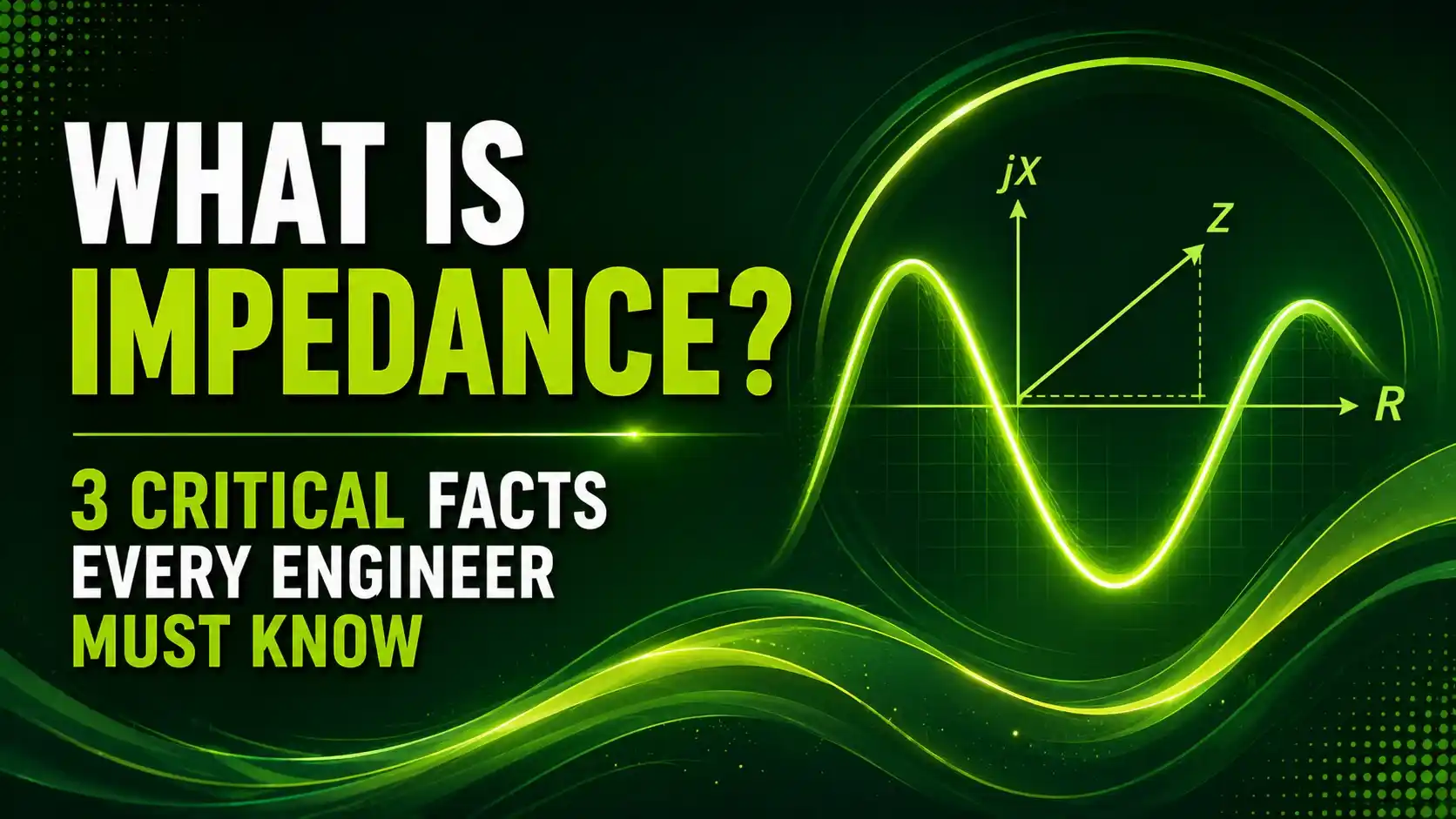
Understanding what is impedance fully means grasping the three critical facts covered in this guide, from why it is a complex number to what happens at the special frequency called resonance.

How Impedance Combines Resistance and Reactance
The same three-step logic explains impedance in any AC circuit, from a simple filter to a full power system.
Resistance Sets the Real Part
Every resistive element contributes a fixed, frequency-independent real component to the total opposition.
Reactance Sets the Imaginary Part
Every capacitor and inductor contributes a frequency-dependent imaginary component instead.
The Two Combine Into Impedance
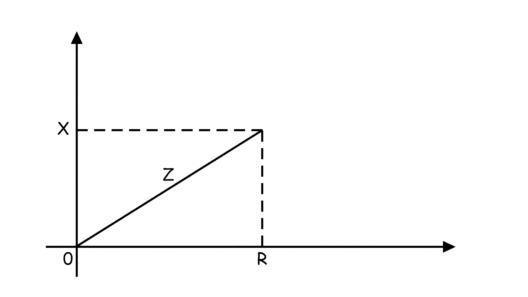
Adding the real and imaginary parts together produces the complex impedance, Z = R + jX.
3 Critical Facts About Impedance
Answering what is impedance fully means understanding these three facts, which explain almost everything a working engineer needs to know in practice.
Impedance Is a Complex Quantity, Not Just a Number
Unlike plain resistance, impedance has both magnitude and phase. It is written as Z = R + jX, with resistance forming the real part and reactance forming the imaginary part.
Magnitude and Phase Both Matter
The magnitude, |Z| = √(R² + X²), tells you how strongly current is opposed. The phase angle, θ = arctan(X/R), tells you how far current shifts out of step with voltage.
At Resonance, Impedance Becomes Purely Resistive
When inductive and capacitive reactance become numerically equal, they cancel exactly, leaving impedance equal to resistance alone, with zero phase shift between voltage and current.
Impedance and Resonance
A series RLC circuit's impedance changes dramatically as frequency sweeps through its resonant point.
This resonant dip is not just a mathematical curiosity, it is exactly what lets a radio tuner select one station out of dozens crowding the airwaves. By adjusting a variable capacitor until the circuit's resonant frequency matches the desired station's carrier frequency, that one station's signal meets minimum impedance and maximum current, while every other frequency sees a much higher impedance and gets suppressed.
What is happening: Below resonance, capacitive reactance dominates. Above resonance, inductive reactance dominates. Only at the single resonant frequency do the two exactly cancel.
A real example: A series RLC circuit with R = 10Ω, at resonance, presents an impedance of exactly 10Ω, identical to a plain resistor, even though it still physically contains an inductor and capacitor.
Why it works: Since inductive reactance is positive and capacitive reactance is negative in the complex representation, they subtract from each other, and at the resonant frequency that subtraction reaches exactly zero.
Impedance Formulas
Impedance reduces to two essential formulas: one for its complex form, one for its magnitude.
Complex form: Z = R + jX
Magnitude: |Z| = √(R² + X²)
Phase angle: θ = arctan(X/R)
Worked example: R = 30Ω, X = 40Ω
|Z| = √(30² + 40²) = 50Ω, θ = arctan(40/30) = 53.1°
Try It: Impedance Magnitude and Phase Calculator
Enter a resistance and reactance value to find the impedance magnitude and phase angle.
Impedance Compared to Resistance and Reactance
| Feature | Impedance | Resistance | Reactance |
|---|---|---|---|
| Number Type | Complex | Real | Imaginary component |
| Frequency Dependence | Depends on frequency via reactance | None, ideally constant | Changes directly with frequency |
| Phase Effect | Combines both effects | No phase shift | 90° phase shift |
| Applies To | AC circuits specifically | Both AC and DC circuits | AC circuits specifically |
What is Impedance Used For? Real Applications
Impedance Matching
Matching source and load impedance maximizes power transfer in RF and audio systems.
Speaker and Headphone Design
Audio equipment is rated by impedance to ensure compatible amplifier pairing.
Power Grid Analysis
Transmission line impedance determines voltage drop and power loss over long distances.
Bioimpedance Measurement
Medical devices measure tissue impedance to assess body composition and hydration.
Antenna Design
Antenna impedance must match the feedline impedance to avoid reflected signal loss.
Impedance Spectroscopy
Measuring impedance across a frequency sweep reveals material and battery characteristics.
Battery impedance spectroscopy deserves special mention, since it has become an increasingly important diagnostic tool. By sweeping a small test signal across a range of frequencies and recording the resulting complex impedance at each point, engineers can estimate a battery's remaining capacity, internal degradation, and even predict early signs of failure, all without ever fully discharging the cell.
What is Impedance Good For: Advantages and Limitations
Why Impedance Is So Powerful
Limitations to Keep in Mind
None of this diminishes just how central the concept has become. Once you can comfortably answer what is impedance for a given circuit at a given frequency, nearly every AC design problem, from filter response to power transfer, reduces to straightforward algebra on complex numbers rather than solving differential equations from scratch.
Download Impedance References
These two academic references go deeper into what is impedance and complex AC circuit analysis.
Reactance and Impedance: AC Voltage and Current
San Jose State University course supplement deriving impedance from first principles
AC Reactance and Impedance Tech Note
Michigan State University tech note with worked impedance calculations
Watch: Resistance vs Reactance vs Impedance Explained
This video clarifies the relationship between resistance, reactance, and impedance.
FAQs on What is Impedance
These questions about what is impedance come up constantly in AC circuit fundamentals coursework.
External References
- San Jose State University, Reactance and Impedance, AC Voltage and Current
- Michigan State University, Tech Note 221b, AC Reactance and Impedance
- Electrical4U, Electrical Impedance: What is it?
- YouTube, Resistance Vs Reactance Vs Impedance Explained
What we learn today
- Impedance is the total AC opposition to current, combining resistance and reactance as a complex number, Z = R + jX.
- Impedance has both magnitude and phase, unlike plain resistance, which has only magnitude.
- Impedance magnitude is found as the square root of resistance squared plus reactance squared.
- At resonance, inductive and capacitive reactance cancel exactly, leaving impedance equal to pure resistance.
- Impedance reduces automatically to plain resistance whenever reactance is zero, including for any DC circuit.