
A bimetallic strip bending inside a wall unit and a microcontroller reading a thermistor inside a process oven both count as a thermostat, yet they work in almost completely different ways.
Thermostat Working Principle depends on which of four main types is involved, mechanical, electronic, smart, or industrial process, and each one senses and switches temperature in its own way.
This ties closely into general temperature sensing technology, since every thermostat needs some way to actually detect temperature before it can act on it.
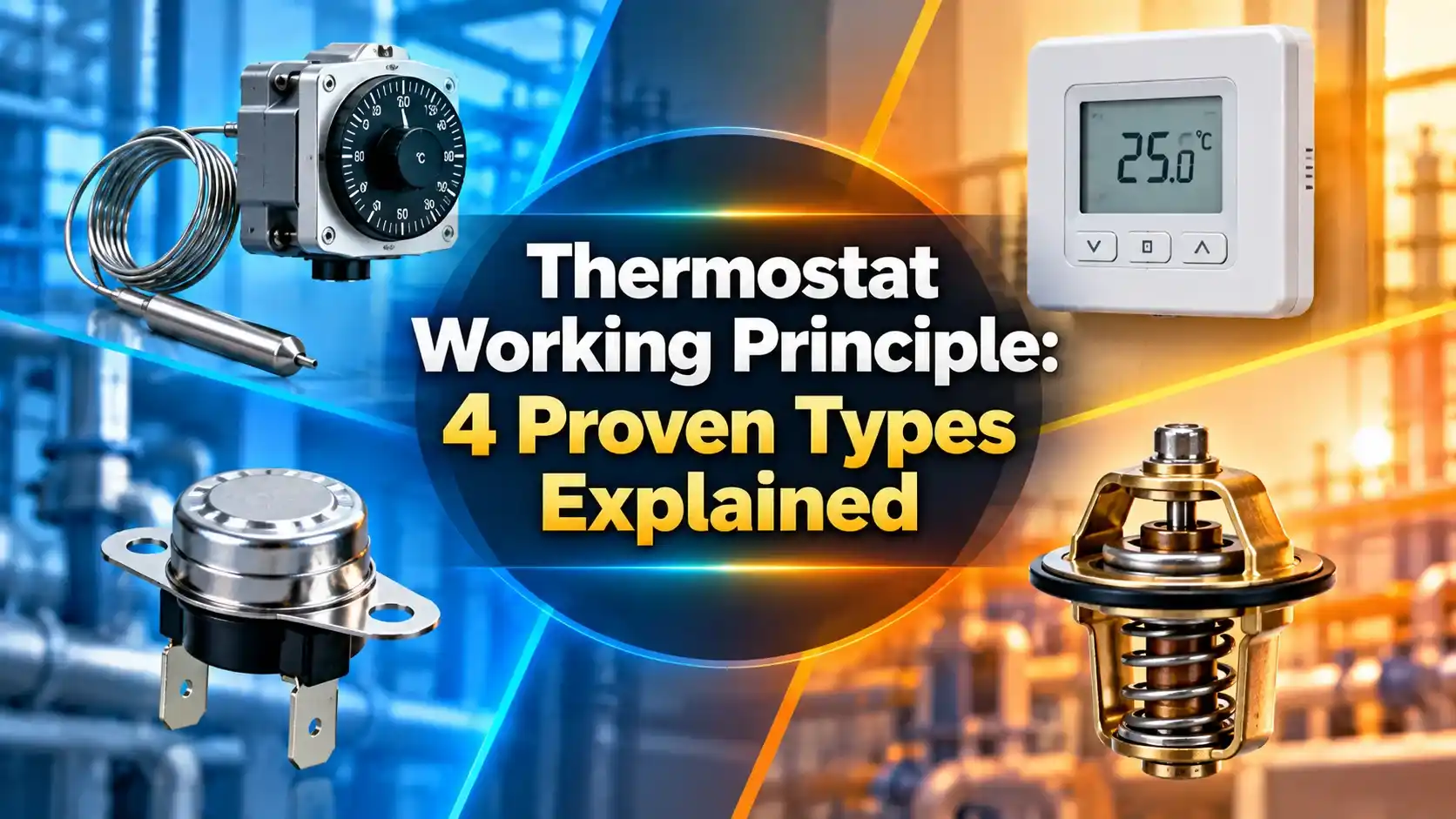
Thermostat Working Principle
A thermostat senses temperature and switches a heating or cooling load on or off to hold that temperature near a chosen setpoint, and it does this using one of four common designs.
The four types covered below are mechanical thermostats, electronic thermostats, smart thermostats, and industrial process thermostats, each explained with its own sensing method and typical use.
1. Mechanical Thermostats
A mechanical thermostat uses a bimetallic strip, two metals with different thermal expansion rates bonded together into a single strip.
A liquid filled thermostat works on the same expansion idea, using a sealed liquid or gas that expands with temperature to actuate a mechanical switch instead of a bending strip.
Advantages
Simple, inexpensive, and needs no external power, since the strip itself both senses temperature and switches the contact.
Limitations
Lower accuracy than an electronic sensor, and the strip can fatigue or corrode over years of repeated bending.
These tradeoffs explain why mechanical thermostats still show up on low cost appliances and older buildings, even though electronic designs have largely taken over new residential installations.
Understanding this first type well makes the remaining three types of Thermostat Working Principle much easier to follow, since each later design solves the same basic problem with more capable hardware.
2. Electronic Thermostats
An electronic thermostat replaces the bimetallic strip with a thermistor or an RTD, then lets a small circuit decide when to switch the load.
Thermistor Based
A resistance that drops sharply with rising temperature, cheap and fast responding but accurate over a narrower range.
RTD Based
A platinum element with resistance rising linearly with temperature, more stable and accurate across a wider range.
A microcontroller reads the sensing element, compares the result against a setpoint, and switches a relay or triac to the heating or cooling load accordingly.
Electronic thermostats generally offer tighter, more consistent switching than a mechanical unit, since a microcontroller can apply a precise differential rather than depending on physical strip fatigue and tolerance over time.
That consistency is a big part of why electronic units have become the default choice for most new residential heating and cooling installations sold today.
3. Smart Thermostats
None of these features change the underlying sensing method, they simply make it easier for an occupant to interact with the same thermistor or RTD based system already at work.
A homeowner upgrading from a basic electronic model to a smart one is really buying convenience and data, not a fundamentally more accurate way of measuring temperature in the room.
4. Industrial Process Thermostats
An industrial process thermostat is built for tighter tolerances than a room unit, typically using an RTD or thermocouple wired into a PLC or DCS control loop.
| Factor | Room Thermostat | Industrial Process Thermostat |
|---|---|---|
| Typical sensor | Bimetallic strip or thermistor | RTD or thermocouple |
| Control style | Simple on off with a differential | Often proportional or full PID control |
| Integration | Standalone wall unit | Wired into a PLC or DCS control loop |
| Accuracy needs | Comfort level, a few degrees | Tight tolerance for process quality and safety |
Thermostat Working Principle in this fourth type almost always means proportional or PID control feeding a process controller, not the simple snap action switching found on a home wall unit.
Choosing the fourth type, an industrial process thermostat, over a simpler comfort grade unit depends entirely on how tightly the process actually needs to hold temperature, not on cost alone.
Plant engineers usually settle this by reviewing the process tolerance sheet first, then matching the sensing element and control style to that tolerance rather than picking a thermostat on price.
How On Off Control Works
This differential applies to all three of the wall mounted types above, mechanical, electronic, and smart, while industrial units often use proportional or PID control instead.
Thermostat Working Principle for on off control comes down to balancing this one tradeoff correctly, since neither a very narrow nor a very wide differential suits every application equally well.
Comparing All Four Types at a Glance
| Type | Sensing Element | Best Suited For |
|---|---|---|
| Mechanical | Bimetallic strip or liquid fill | Simple, low cost appliances and older buildings |
| Electronic | Thermistor or RTD | Modern residential heating and cooling |
| Smart | Thermistor or RTD plus software | Connected homes wanting scheduling and reports |
| Industrial Process | RTD or thermocouple | Tight tolerance manufacturing and process control |
Thermostat Working Principle stays consistent within each type, sense temperature, compare to a setpoint, switch a load, but the sensing hardware and control sophistication climb steadily from mechanical through industrial.
Picking the right one of the four types for a given job comes down to matching accuracy needs, budget, and control style rather than defaulting to whichever unit happens to be on hand.
Signs a Thermostat Is Failing
Knowing which of the four types is installed immediately narrows down which of these failure modes are actually plausible before any troubleshooting even begins.
Thermostat Safety Standards
Equipment integrating a thermostat for safety critical temperature limiting, not just comfort control, should confirm compliance with the relevant standard for its market before deployment.
Regardless of type, a thermostat used for a genuine safety limiting function, not just comfort, should carry documentation proving it meets the applicable standard for its market.
Watch: How Does a Bimetal Thermostat Work
Thermostat Working Principle FAQs
Related Articles on This Site
- Thermal Effect on Sensors, Zero and Span Shift
- Temperature Sensor Failure Warning Signs
- Types of Temperature Calibrators
- Peltier Effect
- Dry Block Calibrator
External References
What We Learn Today
- The four main thermostat types are mechanical, electronic, smart, and industrial process, each sensing temperature differently.
- Wall mounted thermostats use a differential to avoid rapid cycling right at the setpoint.
- Industrial process thermostats typically use RTDs or thermocouples with proportional or PID control, unlike a simple on off room unit.