
Thyristors ramp the motor voltage smoothly, cutting inrush current, mechanical shock and pump water hammer.
A soft starter reduces the voltage applied to an induction motor during starting, then raises it smoothly to full voltage. This cuts the starting current and torque surge that stress motors, couplings and the supply network.
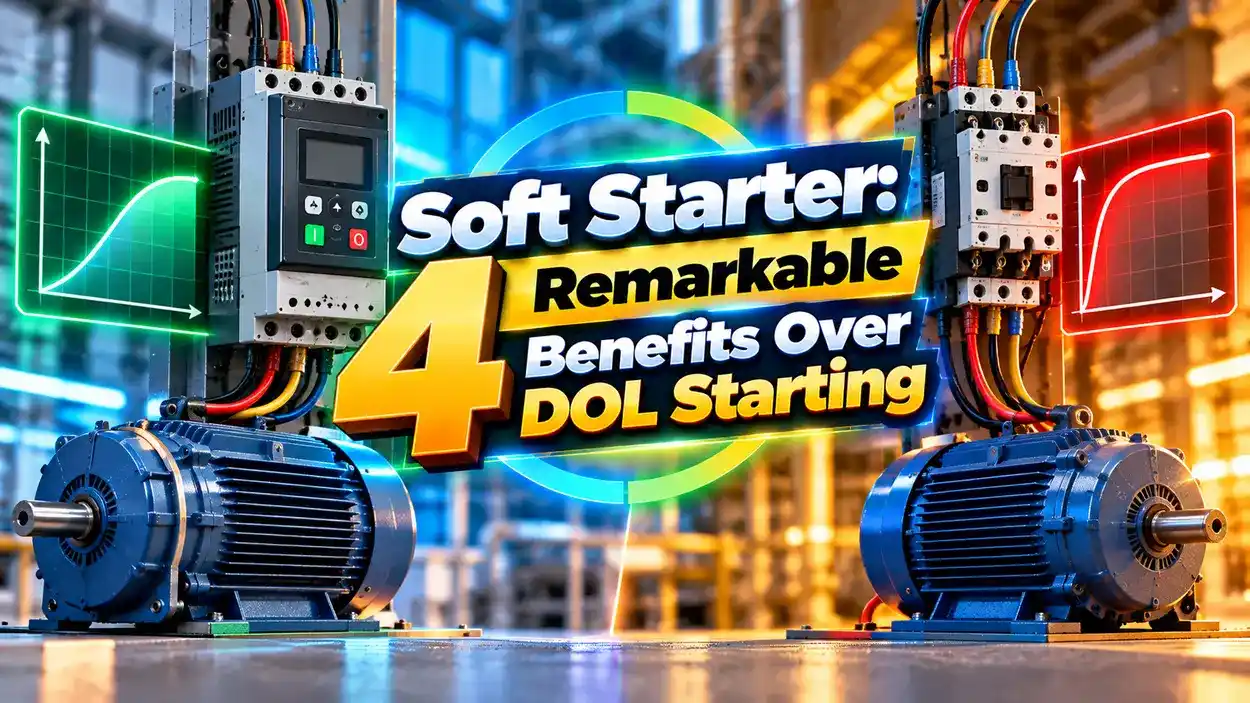
What Is a Soft Starter?
A soft starter is an electronic motor starter that uses pairs of thyristors to control the voltage applied to an AC induction motor during starting and stopping. It sits between the supply and the motor, much like the starters compared in motor starting methods.
A direct on line start draws a large inrush current and gives a sudden torque kick. ABB notes that DOL current is usually 6 to 8 times rated current, and can reach 14 times in some motors.
This type of starter typically limits starting current to about 3 to 5 times rated current. The motor still reaches full speed, just more gently.
Unlike a VFD, it does not change frequency, so it cannot control running speed. It only shapes the start and the stop.
How SCR Voltage Control Works
Each phase has two SCRs connected in reverse parallel, one for each half cycle. By delaying the firing point, the controller lets through only part of each sine wave, lowering the RMS voltage.
As the start progresses, the firing angle advances and more of each wave passes. At the end of the ramp, the SCRs conduct fully and a bypass contactor usually closes.
The bypass removes SCR losses during running, which reduces heat in the panel. Our guide to thyristors and triacs explains why SCRs drop about one to two volts while conducting.
4 Remarkable Benefits of a Soft Starter
Benefit 3 is a big reason reduced voltage starters are common on pumping stations. A sudden stop can create pressure waves described by the Joukowsky equation.
Benefit 1 helps plants on weak supplies or diesel generators, where a DOL start would cause lights to flicker and contactors to drop out.
Starting Current and Torque Formula
Start torque = DOL torque × (V ÷ Vn)²
Worked example at 50 percent voltage:
DOL current = 6 × FLC
DOL locked rotor torque = 180 percent FLT
Start current = 6 × 0.5 = 3 × FLC
Start torque = 180 × 0.5² = 180 × 0.25
Start torque = 45 percent of full load torque
Torque falls with the square of voltage, while current falls only in proportion. This is the main limit of any reduced voltage starter.
If the load needs more than 45 percent torque to break away, the motor will not accelerate at this voltage. Heavy loads such as crushers need a higher initial voltage or a VFD.
Soft Starter vs DOL vs Star Delta vs VFD
| Feature | DOL | Star Delta | Soft Starter | VFD |
|---|---|---|---|---|
| Starting current | 6 to 8 × FLC | About 2 to 3 × FLC | About 3 to 5 × FLC | About 1 to 1.5 × FLC |
| Starting torque | Full | About one third | Adjustable, reduced | Full at low speed |
| Speed control | No | No | No | Yes |
| Soft stop | No | No | Yes | Yes |
| Cost | Lowest | Low | Medium | Highest |
Star delta also cuts current, but its sudden changeover creates a second current and torque peak. Our article on DOL vs star delta explains that transition.
The electronic starter gives a smooth, adjustable ramp without that transition. A VFD gives the best start of all but costs more and adds harmonics.
Electronic Starter Control Types
SCRs in two phases, the third phase is direct.
SCRs in all three phases for balanced current.
Holds current at a set limit during start.
Controls motor torque for a linear speed rise.
ABB also describes inside delta connection, where the unit carries only about 58 percent of line current. This allows a smaller unit for delta connected motors.
For heavy duty starts such as crushers, mills and long conveyors, ABB advises choosing one size larger. Check the motor full load current before selecting.
Where Reduced Voltage Starters Are Used
Pumps are the most common case, especially centrifugal pumps with low starting torque. Their load torque rises with speed, which suits reduced voltage starting.
Most units include built in motor protection similar to a thermal overload relay. They also detect phase loss, stall and overtemperature.
Reduced Voltage Start Calculator
Compare the torque result with the load breakaway torque. If it is lower, raise the initial voltage setting.
- Lower inrush and voltage dips.
- Smooth mechanical start.
- Soft stop for pumps.
- Compact and lower cost than a VFD.
- No speed control while running.
- Reduced torque during start.
- SCR heat without a bypass.
- Some harmonics during ramp.
ABB Softstarter Handbook PDF
Reduced Voltage Starting Video
Soft Starter FAQ
Related Articles
- Motor Starting Methods Compared
- DOL vs Star Delta Starter
- VFD Working Principle
- Silicon Controlled Rectifiers
- Motor Control Center Explained
External References
- Softstarter Handbook, ABB
- Soft Starter 101, Plant Engineering
- What Is a Soft Starter, GES
- Motor Soft Starter, Wikipedia
What We Learn Today
- This starter uses SCRs to ramp motor voltage smoothly from a reduced level.
- Current falls with voltage, but torque falls with the square of voltage.
- Choose it for pumps, fans and conveyors where speed control is not required.