
Choosing between these two starting methods comes down to motor size, available fault current, and how much starting torque the driven load actually needs.
DOL vs Star Delta Starter is a question of simplicity versus reduced starting current, a direct on line starter connects the motor straight to full voltage, while a star delta starter briefly reduces voltage during acceleration.
Both rely on the same underlying induction motor behavior during acceleration, just applied differently.
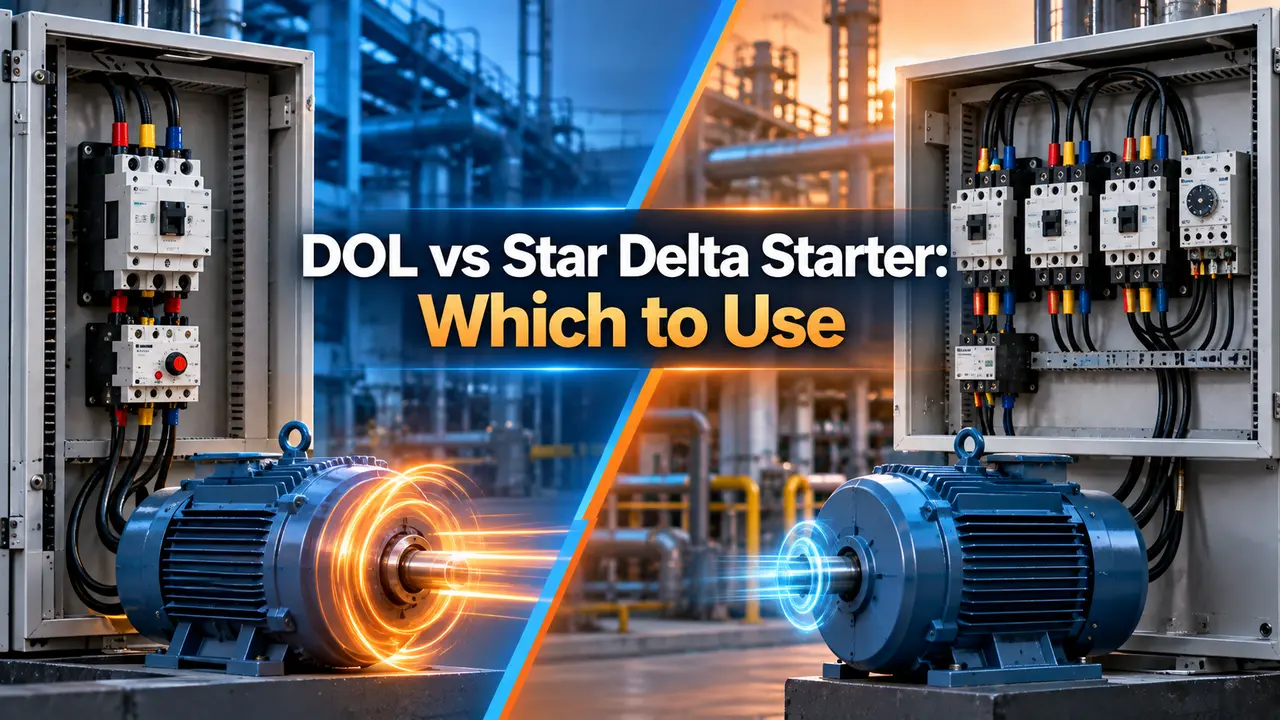
DOL vs Star Delta Starter: The Basics
A direct on line starter connects the motor windings straight to full line voltage the instant it is switched on, giving full starting torque but also the highest possible inrush current.
A star delta starter connects the windings in star configuration first, reducing the voltage each winding sees to about 58 percent of line voltage, then switches to delta once the motor is up to speed.
That single winding connection change is the entire difference between the two approaches, yet it has a significant impact on both starting current and available torque.
How the Contactors Actually Connect
Three contactors work together to make this happen, a main contactor feeds the winding terminals, a star contactor briefly ties the far ends of all three windings together, and a delta contactor later reconfigures those same connections.
Only two of the three contactors are ever closed at once in a standard open transition design, with a short break between opening the star contactor and closing the delta contactor.
Why Reducing Voltage Reduces Current
Starting current in an induction motor is roughly proportional to the applied voltage, so dropping to 58 percent voltage during the star connection cuts the line current to about a third of what direct on line would draw.
The tradeoff is that starting torque falls to roughly a third as well, since torque in an induction motor scales with the square of applied voltage, which limits star delta starting to loads that do not need high torque at zero speed.
Side by Side Comparison
| Property | DOL Starter | Star Delta Starter |
|---|---|---|
| Starting current | 6 to 8 times full load current | 2 to 3 times full load current |
| Starting torque | 100 percent of rated torque | About 33 percent of rated torque |
| Motor leads needed | 3 leads | 6 leads, both ends of each winding |
| Typical motor size | Small motors, usually under 5 kW | Medium to large motors, several kW and up |
When to Use Each Method
Nameplate Clues That Guide the Decision
A motor nameplate showing a dual voltage rating, such as 230/400 volts with six terminals in the connection box, signals that the reduced voltage method is physically possible for that machine.
A nameplate showing only three terminals and a single voltage rating means the winding is only brought out for a direct connection, ruling out the reduced voltage option entirely regardless of how appealing it might seem on paper.
Contactor and Overload Relay Sizing
A direct connection needs one contactor and a single overload relay sized directly to the motor's full load current, making the control circuit relatively straightforward to specify.
A reduced voltage arrangement needs three contactors, a timer relay, and an overload relay sized for the lower current the motor draws while running in delta, which is roughly 58 percent of what it would draw connected directly.
Getting that overload sizing wrong is a common installation error, since simply matching the relay to nameplate current without accounting for the connection method leaves the motor under protected.
The Transition Moment
Switching from star to delta creates a brief transient current spike as the motor's magnetic field re establishes itself in the new connection, timed by a relay to occur once the motor is close to full speed.
Setting that timer too short means the transition happens before the motor has accelerated enough, producing a transient nearly as severe as the direct method would have caused in the first place.
Utility and Generator Supply Considerations
A weak utility connection, or a plant running on a standby generator during an outage, may simply be unable to tolerate the inrush current a large motor would draw connecting directly.
In these situations, the reduced voltage method becomes less a preference and more a requirement, since the alternative is a voltage dip severe enough to disturb other equipment on the same supply.
Some utilities specify a maximum allowable starting current for any single load above a certain size, effectively mandating a reduced voltage or electronic starting method regardless of what the plant would otherwise prefer.
Where Soft Starters and VFDs Fit In
A solid state soft starter or a variable frequency drive can achieve smoother starting than either classic method, controlling current and torque electronically rather than through a fixed mechanical connection change.
These modern alternatives cost more than a simple contactor arrangement, which is exactly why the two traditional approaches remain common on smaller and less critical motors even today.
Standards and Nameplate References
IEC 60947 4 1 covers contactors and motor starters broadly, setting performance and testing requirements that manufacturers of both starter types must meet before labeling equipment for industrial use.
National wiring rules also typically require a rated data plate on the starter enclosure showing the connection type, maximum motor rating supported, and the applicable standard, which helps a technician years later confirm what they are working with.
Keeping this documentation on file alongside single line diagrams makes future troubleshooting faster, whichever of the two approaches a given starter panel was built to support.
DOL vs Star Delta Starter: Quick Verdict
DOL Starter
Simple, cheap, full torque, but the highest inrush current of any common starting method.
Star Delta Starter
Lower inrush current, more wiring and cost, reduced torque during the star phase.
Neither wins outright, the right pick between the direct and reduced voltage methods depends entirely on motor size, load torque needs, and what the electrical supply can tolerate.
Comparing Total Installed Cost
A direct starter needs only one contactor, one overload relay, and simple three wire motor cabling, keeping both equipment cost and panel space to a minimum.
A reduced voltage panel needs three contactors, a timer, additional wiring terminals for six motor leads, and typically a larger enclosure to fit everything, adding meaningfully to both material and labor cost.
For a small motor, that added cost rarely pays for itself in reduced electrical stress, which is exactly why the simpler method dominates below a certain horsepower threshold in most plants.
Common Mistakes to Avoid
Troubleshooting Common Starting Faults
A motor that hums but never accelerates past the star phase usually points to a timer set too short, a mechanically overloaded shaft, or a driven load with more starting torque demand than the reduced voltage method can supply.
A loud bang or visible arcing during the star to delta transition often means the timer let the motor coast too long before switching, allowing its rotating magnetic field to fall out of step with the supply before delta engages.
Checking actual motor current with a clamp meter during both the star and delta phases quickly confirms whether the observed behavior matches the expected roughly three to one current ratio between the two connections.
Watch: DOL and Star Delta Wiring Explained
DOL vs Star Delta Starter FAQs
Related Articles on This Site
- Motor Starting Methods Compared
- Induction Motor Slip Explained
- Motor Full Load Current, FLC
- VFD Working Principle Explained
- Thermal Overload Relay Explained
External References
What We Learn Today
- The direct method gives full torque but the highest inrush current of the two.
- The reduced voltage method cuts current to about a third, at the cost of reduced starting torque.
- Motor size, load torque, and supply strength decide which method actually fits a given application.