Sensor Selection Criteria: 6 Essential Factors to Weigh

Share:
Instrumentation
Sensor Selection Criteria: 6 Essential Factors to Weigh

The best performing sensor on paper is not automatically the right choice for a given process.

Here are the six factors worth weighing first, and why chasing top accuracy everywhere quietly drains a maintenance budget.

Sensor Selection Criteria Accuracy Reliability Range

Sensor Selection Criteria come down to a simple tradeoff, better performance almost always costs more to buy and more to maintain, so the goal is matching a sensor to what the process actually needs.

Hello everyone, today we are going to learn the main Sensor Selection Criteria engineers weigh before specifying a device, and why the highest performing option is not always the correct one.

We will cover accuracy, repeatability, range, reliability, linearity, and cost, along with process environment protection, response time, and safety considerations that apply across almost any sensor type.
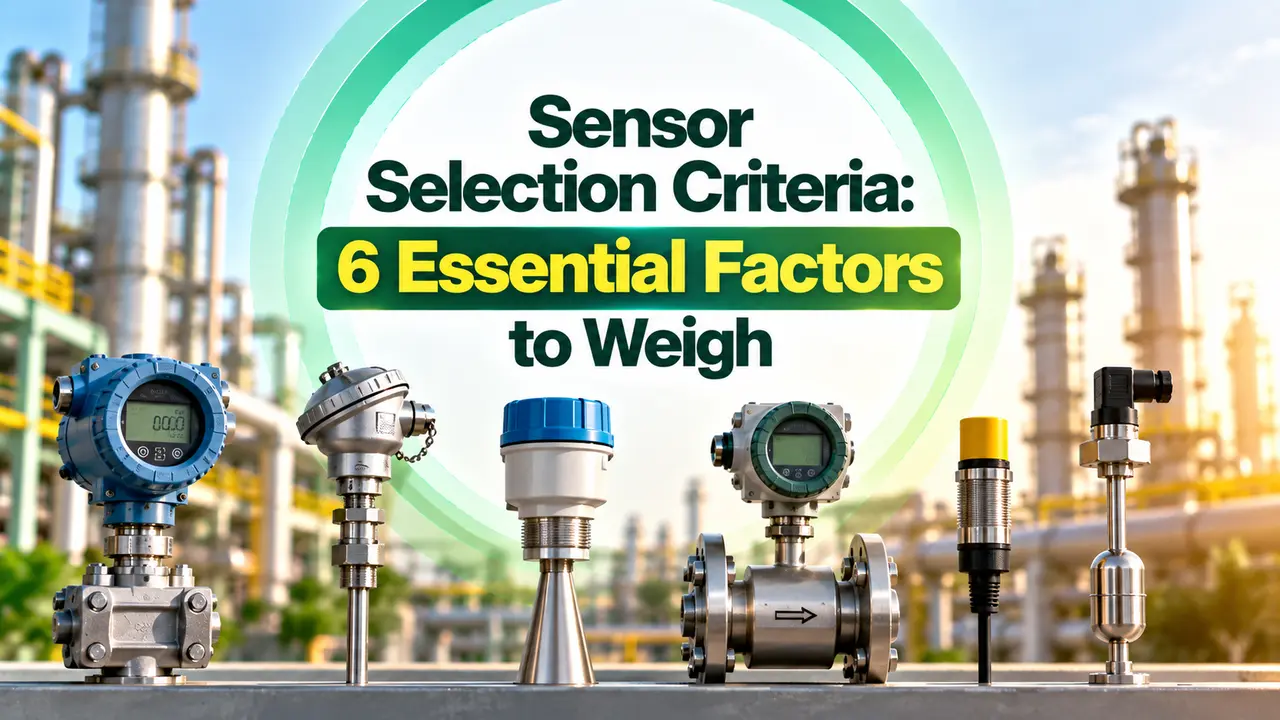
Sensor Selection Criteria

6 Core Sensor Selection Criteria to Weigh First

The greater the performance requirement, the higher the purchase and maintenance cost, so these six factors are usually weighed together rather than one at a time.

1
Accuracy
How closely a measured value matches the true value, usually stated as a maximum error in engineering units or as a percentage of range.
2
Repeatability
How consistent the same measurement comes out across repeated trials under identical conditions, approached from the same direction each time.
3
Range
The lower and upper measurement limits a sensor covers, with wider ranges generally trading away some accuracy and reproducibility.
4
Reliability
The probability a sensor keeps performing correctly over its intended service period, more critical wherever a failure risks safety or product quality.
5
Linearity
How closely the sensor's output tracks a straight line against the true process variable across its full range.
6
Cost
Total cost across purchase, installation, wiring, documentation, operation, and every year of maintenance over the sensor's working life.
Did You Know
A sensor's own linearity error can often be corrected mathematically after the fact, a square root correction for an orifice flow meter or a polynomial fit for a thermocouple, so nonlinearity alone is rarely a reason to reject an otherwise good sensor.
Advertisement

Reproducibility vs Repeatability, and Why the Difference Matters

These two terms sound alike but answer different questions, and mixing them up leads to specifying the wrong test during vendor evaluation.

Repeatability

Consistency across a short run of consecutive measurements taken close together, under conditions that are essentially unchanged from one reading to the next.

Reproducibility

Consistency over a much longer operating period, folding in hysteresis, dead band, and long term drift alongside repeatability itself.

A sensor can repeat well over five minutes on a test bench yet drift badly over six months in service, which is exactly why reproducibility, not just repeatability, belongs in a real selection decision.

Matching Sensor Range to the Actual Process

General Rule
A wider range typically means poorer accuracy and reproducibility at any single point.
Practical Habit
Choose the smallest range that still comfortably covers the process requirement.
Readable Spans
Prefer a round span, such as 250 to 350 degrees Celsius, over an awkward one like 250 to 318.
Related Reading
Once a range is set, converting it correctly into a signal is covered separately in our scaling guide.

Sensor range decisions connect directly to the linear scaling formula covered in sensor scaling in instrumentation, since the chosen span becomes the zero and full scale points used in that formula.

Advertisement

Process Environment Protection Affects Response Time Too

How a sensor is protected from the process it measures changes both its durability and how quickly it responds to a real change.

Protection TypeExamplesEffect on Response
Direct ContactOrifice plates, level floatsFastest response, material selection becomes critical
Sheath ProtectionThermocouples, pressure diaphragmsSlower response, better protection from the process
Sample ExtractionOn stream analyzersLongest delay, suited to hostile or delicate applications

A control loop that needs a fast reaction time generally cannot tolerate a sample extraction analyzer's delay, no matter how accurate that analyzer is once its reading finally arrives.

Advertisement

Dynamics, Maintenance, and Safety Considerations

1
Control applications need minimal sensor delay, while long term trend monitoring can tolerate a slower response.
2
On stream analyzers typically carry the highest ongoing maintenance effort and cost of any sensor category.
3
In a flammable gas area, the sensor design must prevent the power source, oxidant, and gas from ever meeting at once.
4
A duplicate or backup sensor can prevent a single point failure from forcing an unplanned process shutdown.

Safety rated sensors for flammable atmospheres follow the same hazardous area logic covered in our broader pressure sensor specifications content, and level specific tradeoffs are covered separately in how to select the right level sensor.

Tip
Rank the criteria that matter for a specific application before comparing vendor datasheets. A sensor that wins on accuracy but loses badly on maintenance cost is not automatically the better choice once the full service life is priced in.

Sensor Selection Criteria Questions Engineers Ask

Why not always choose the most accurate sensor available?
Higher accuracy generally costs more to buy and to maintain, so the goal is matching performance to what the process actually needs.
What is the difference between repeatability and reproducibility?
Repeatability covers a short run of close together readings, while reproducibility covers consistency over a much longer operating period.
Why does a wider sensor range reduce accuracy?
A wider span spreads the same error tolerance across more of the scale, which generally worsens both accuracy and reproducibility.
Is nonlinearity always a reason to reject a sensor?
No, many nonlinear responses can be corrected mathematically afterward, so linearity alone rarely disqualifies an otherwise suitable sensor.
Why does response time matter for sensor selection?
A control loop needing a fast reaction cannot tolerate a slow sample extraction analyzer, regardless of how accurate that reading eventually is.

Related Articles on This Site

External References

Advertisement

What We Learn Today

  • Sensor Selection Criteria always trade performance against cost, the best sensor on paper is not always the right one.
  • Repeatability and reproducibility answer different questions, a short run test is not the same as long term drift.
  • Range, environment protection, response time, and safety all deserve a check before price ever enters the decision.
I hope you like above blog. There is no cost associated in sharing the article in your social media. Thanks for reading!! Happy Learning!!

Leave a Reply

Your email address will not be published. Required fields are marked *