
Most plants are not choosing one over the other from a blank slate, they are figuring out how to keep working PROFIBUS devices running while PROFINET takes over new sections of the network.
A quick comparison table explains that PROFINET runs over Ethernet and PROFIBUS runs over RS485, but it does not explain how a plant actually gets from one to the other without a shutdown.
This guide skips the basic side by side comparison, already covered in our full PROFINET communication guide, and goes straight into proxy gateways, coexistence architecture, and migration planning.
Profibus vs Profinet is really a question of physical layer and migration strategy, PROFIBUS running deterministic serial communication over RS485 and PROFINET running the same real time principles over standard Ethernet, but the practical challenge most plants face is bridging existing PROFIBUS devices onto a PROFINET network through proxies without an expensive rip and replace shutdown.
Plenty of plants run both protocols side by side for years rather than switching over in a single weekend, since a working PROFIBUS segment rarely gets ripped out just because PROFINET exists.
The bridge connecting them, a PROFINET proxy, is where the real engineering decisions live, not in the basic frame format comparison.
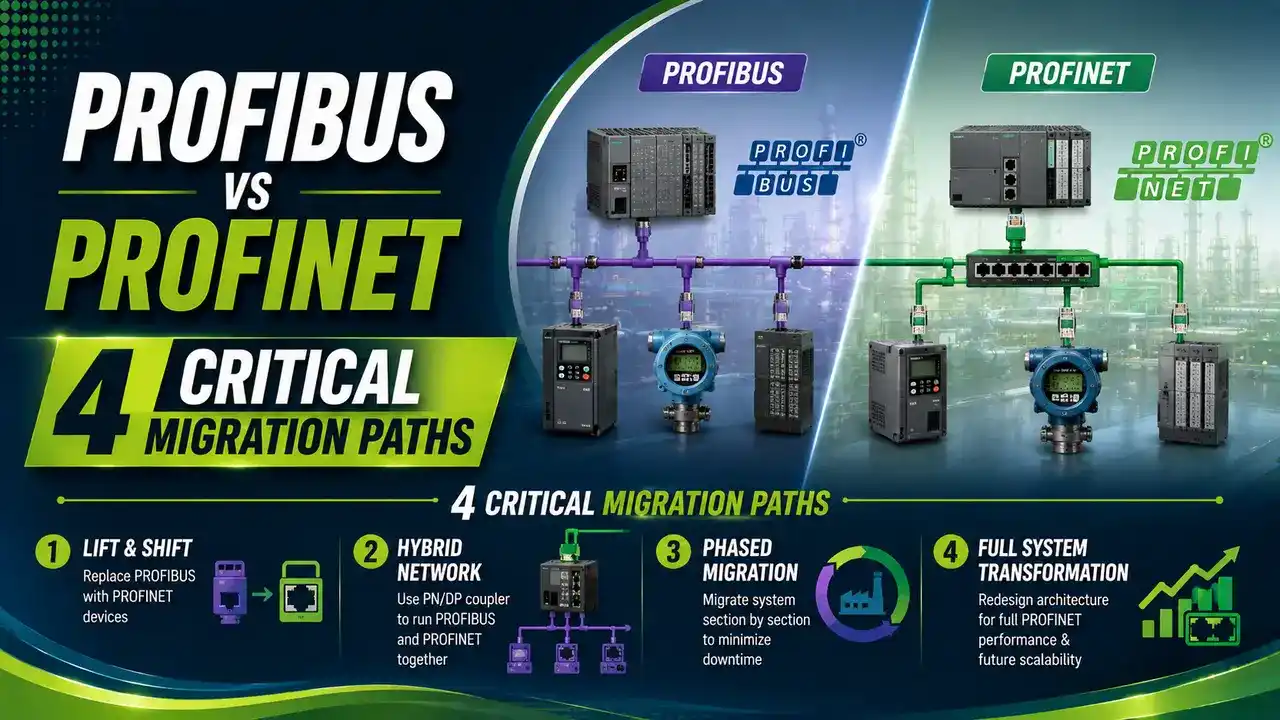
This article covers that bridge in depth: how a proxy represents PROFIBUS devices on a PROFINET network, coexistence architecture options, and a calculator for sizing proxy segments on a real migration plan.
A Quick Orientation Before the Migration Details
| Aspect | PROFIBUS | PROFINET |
|---|---|---|
| Physical layer | RS485 serial, or PA for hazardous areas | Standard Ethernet |
| Typical station limit | Around 31 per RS485 segment without a repeater | Practically unlimited, switch based network |
| Determinism | Cyclic token passing | RT and IRT communication classes |
| Legacy status | Mature, still common in existing plants | Modern standard for new installations |
For the complete breakdown of PROFINET communication classes, network topology, and a full comparison table against PROFIBUS and EtherNet/IP, our PROFINET Communication Guide already covers that ground. What follows here goes past that comparison into how the two protocols actually meet during a real migration.
How a PROFINET Proxy Bridges PROFIBUS Into the Network
A PROFINET proxy sits between the two worlds, appearing to the PROFINET controller as one ordinary device while acting as the master toward every PROFIBUS device behind it.
A well built proxy carries more than raw input and output values across the bridge. It also maps alarms, diagnostic information, and even network health status, following a standardized data map rather than a vendor specific workaround.
That standardization matters, since a plain gateway typically only moves I/O data and quietly drops the diagnostic context an operator relies on for troubleshooting.
Coexistence Architecture: Running Both Networks Together
Most real migrations are brownfield projects, upgrading an existing plant rather than building a new one from scratch, and two coexistence paths are common.
Step wise migration keeps existing PROFIBUS segments running behind proxies while new sections of the plant get PROFINET native devices, letting upgrades happen during planned downtime instead of a full shutdown.
Rip and replace swaps everything at once, gaining every PROFINET benefit immediately, but at the cost of a much larger single disruption to production.
Proxy Segment Calculator
Enter the total number of existing PROFIBUS devices and the practical device limit per segment to estimate how many proxy gateways a migration plan needs.
Two Migration Scenarios Worked Through
A plant with 60 existing PROFIBUS devices and a practical 31 device limit per segment needs 2 proxy gateways to bring everything onto the PROFINET network.
ceil(60 / 31) = 2
Result = 2 proxy gateways needed
A larger plant with 120 devices on the same 31 device segment limit needs 4 proxy gateways, since three segments would only cover 93 devices.
ceil(120 / 31) = 4
Result = 4 proxy gateways needed
Four Practical Migration Paths
Keep PROFIBUS PA in Hazardous Areas
Ethernet cabling is not rated for many hazardous zones, so PROFIBUS PA behind a proxy often stays the right call there long term.
Native PROFINET for New Lines
Any brand new production line gets PROFINET native devices from day one, no proxy needed since nothing legacy exists yet.
Proxy Bridge for Working Segments
A functioning PROFIBUS segment gets a proxy rather than a rip out, preserving working hardware while joining the PROFINET network.
Scheduled Downtime Cutover
Segments due for hardware refresh get switched to native PROFINET during planned maintenance windows, not as an emergency change.
Profibus to Profinet Migration Do's and Don'ts
✓ Do
- Use a proxy for a working PROFIBUS segment rather than ripping it out ahead of schedule
- Confirm the proxy maps alarms and diagnostics, not just I/O values, before relying on it
- Keep PROFIBUS PA in hazardous areas where Ethernet cabling is not a rated option
- Plan segment sizing around the practical device limit, not just the theoretical maximum
✗ Don't
- Assume every legacy protocol has a standardized proxy, some only have vendor specific gateways
- Schedule a full rip and replace without weighing the coexistence alternative first
- Treat a proxy segment's device count as unlimited, RS485 electrical limits still apply behind it
- Ignore diagnostic data loss risk when a plain gateway is used instead of a standardized proxy
Resources on Profibus to Profinet Migration
Profibus vs Profinet Questions Engineers Ask
External References
- PI North America: PROFIBUS to PROFINET, Migration Strategies
- PROFINET University: PROFINET Proxies and Gateways
What We Learn Today
- A PROFINET proxy represents an entire PROFIBUS segment as a single device, translating I/O, alarms and diagnostics.
- Most real migrations are brownfield coexistence projects, not a single rip and replace event.
- Proxy segment size is still bounded by the underlying RS485 electrical limit, practically around 31 devices.
- PROFIBUS PA often stays the right choice in hazardous areas, since standard Ethernet is not rated for them.