
Foundation Fieldbus Explained: H1 Bus, Function Blocks, and When to Use It
Instead of one wire per instrument running all the way back to a control room, Foundation Fieldbus puts up to 32 devices on a single twisted pair, and lets some of the thinking happen right out in the field.
Foundation Fieldbus is a digital communication protocol built specifically for process industries, replacing point-to-point 4-20 mA wiring with a single multidrop bus and pushing real control logic out into the field devices themselves. This guide covers H1 physical layer basics, function blocks, and where it fits against Modbus and HART.
What is Foundation Fieldbus?
Foundation Fieldbus (FF) is an open, all-digital, two-way communication protocol developed by the Fieldbus Foundation specifically for process automation, standardized under IEC 61158. Unlike traditional 4-20 mA analog signals, which require a dedicated pair of wires running from every single instrument back to the control system, Foundation Fieldbus connects multiple devices onto one shared twisted-pair cable, called a segment, that carries both communication and power.
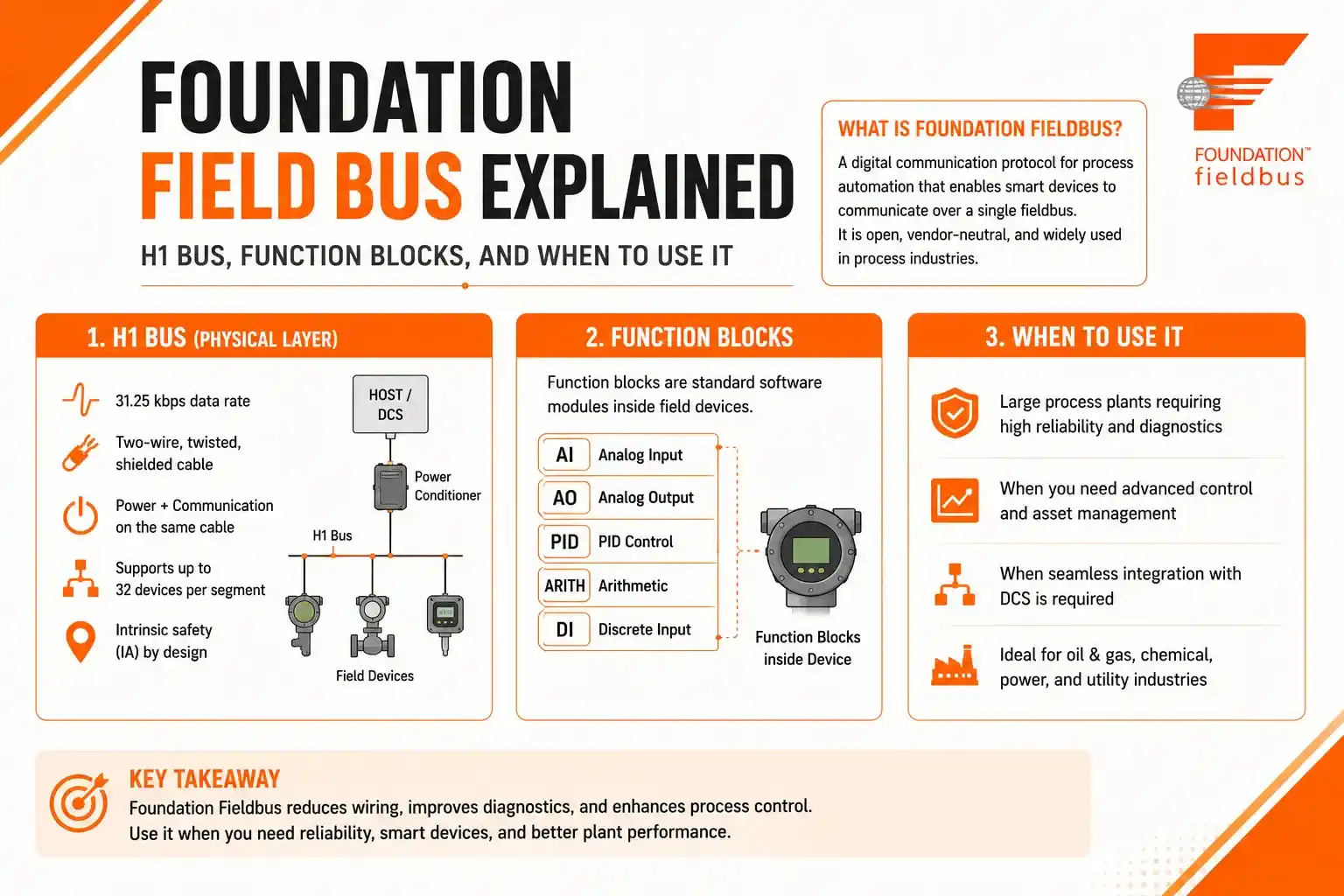
The protocol comes in two forms. H1, the version used at the field device level, operates at 31.25 kbit/s over twisted-pair cable. HSE (High Speed Ethernet) operates at 100 Mbit/s or faster and is used to connect controllers, linking devices, and higher-level systems, essentially acting as the backbone that ties multiple H1 segments together.
Real Life Example
Think of old 4-20 mA wiring like giving every employee in a company their own dedicated phone line straight to the CEO's desk, one wire, one connection, no sharing. Foundation Fieldbus is more like a modern office intercom system where many people share the same line, each identified by name rather than which physical wire they happen to be plugged into. And because some of those employees are actually capable of making routine decisions themselves, without checking with the CEO every single time, the whole office runs faster and the CEO's desk isn't overwhelmed with every tiny decision.
H1 Physical Layer at a Glance
Function Blocks and Control in the Field
Foundation Fieldbus organizes device behavior into function blocks, standardized software modules that each perform one specific job, such as Analog Input (AI), Analog Output (AO), or PID control. A pressure transmitter and a magnetic flow meter both use a common AI block for their measured value, while device-specific behavior is handled by a separate Transducer Block tailored to that particular sensing technology.
Because function blocks can run inside the field devices themselves, not just inside a central controller, Foundation Fieldbus enables genuine control in the field. A transmitter and a valve positioner can execute an entire PID loop between themselves out on the bus, continuing to control the process even if communication with the host system is temporarily lost. Scheduling of this communication is managed by a Link Active Scheduler (LAS), which resides in the host or one of the field devices and coordinates precisely timed, deterministic execution.
Foundation Fieldbus vs Other Protocols
| Feature | Foundation Fieldbus H1 | HART | Modbus |
|---|---|---|---|
| Signal Type | Fully digital | Digital over analog 4-20mA | Fully digital |
| Devices per Segment | Up to 32 | Typically 1 (or 15 multidrop) | Up to 247 (RS-485) |
| Control in the Field | Yes, native function blocks | No | No |
| Typical Use | Continuous process control | Smart transmitter diagnostics | SCADA and general device integration |
| Complexity and Cost | Higher | Low, backward compatible with 4-20mA | Low to moderate |
Foundation Fieldbus, Modbus, and HART all continue to coexist in modern plants rather than one fully replacing the others, since each fits a different mix of cost, device density, and control sophistication.
Applications of Foundation Fieldbus
Refining and Petrochemicals
Heavy process industries rely on FF for continuous control and device diagnostics at scale.
Power Generation
Boiler and turbine auxiliary systems use FF segments to reduce wiring complexity.
Pharmaceutical Manufacturing
Batch and continuous processes benefit from rich diagnostic data and device status reporting.
Food and Beverage
Growing FF adoption supports process consistency and traceability requirements.
Nuclear Facilities
High device diagnostics and interoperability support stringent safety documentation needs.
Chemical Processing
Distributed control in the field improves resilience against host communication interruptions.
When to Choose Foundation Fieldbus
✅ Good Fit When
- The plant has a high density of instruments in one process area
- Control in the field and device-level redundancy against host loss matter
- Rich diagnostics and device health data justify the added engineering cost
- New greenfield construction allows planning FF segments from the start
❌ Reconsider When
- The application is simple point measurement with no need for advanced diagnostics
- Budget and engineering resources are tightly constrained
- Existing 4-20 mA or HART infrastructure already meets the application's needs
- Plant staff lack Foundation Fieldbus commissioning and troubleshooting experience
Foundation Fieldbus: Video Walkthrough
Frequently Asked Questions About Foundation Fieldbus
- Wikipedia, Foundation Fieldbus
- FieldComm Group, FOUNDATION Fieldbus Technology Explained
- RealPars, What Is Fieldbus?
What We Learn Today
- Foundation Fieldbus H1 connects up to 32 devices on one twisted-pair segment carrying both data and power
- Function blocks standardize device behavior, letting different manufacturers' devices interoperate on the same bus
- Control in the field lets devices execute control loops locally, improving resilience against host communication loss
- Foundation Fieldbus shares its physical layer with Profibus PA, but uses entirely different higher-level logic
- Foundation Fieldbus, HART, and Modbus each remain the better fit for different applications rather than one replacing the others