
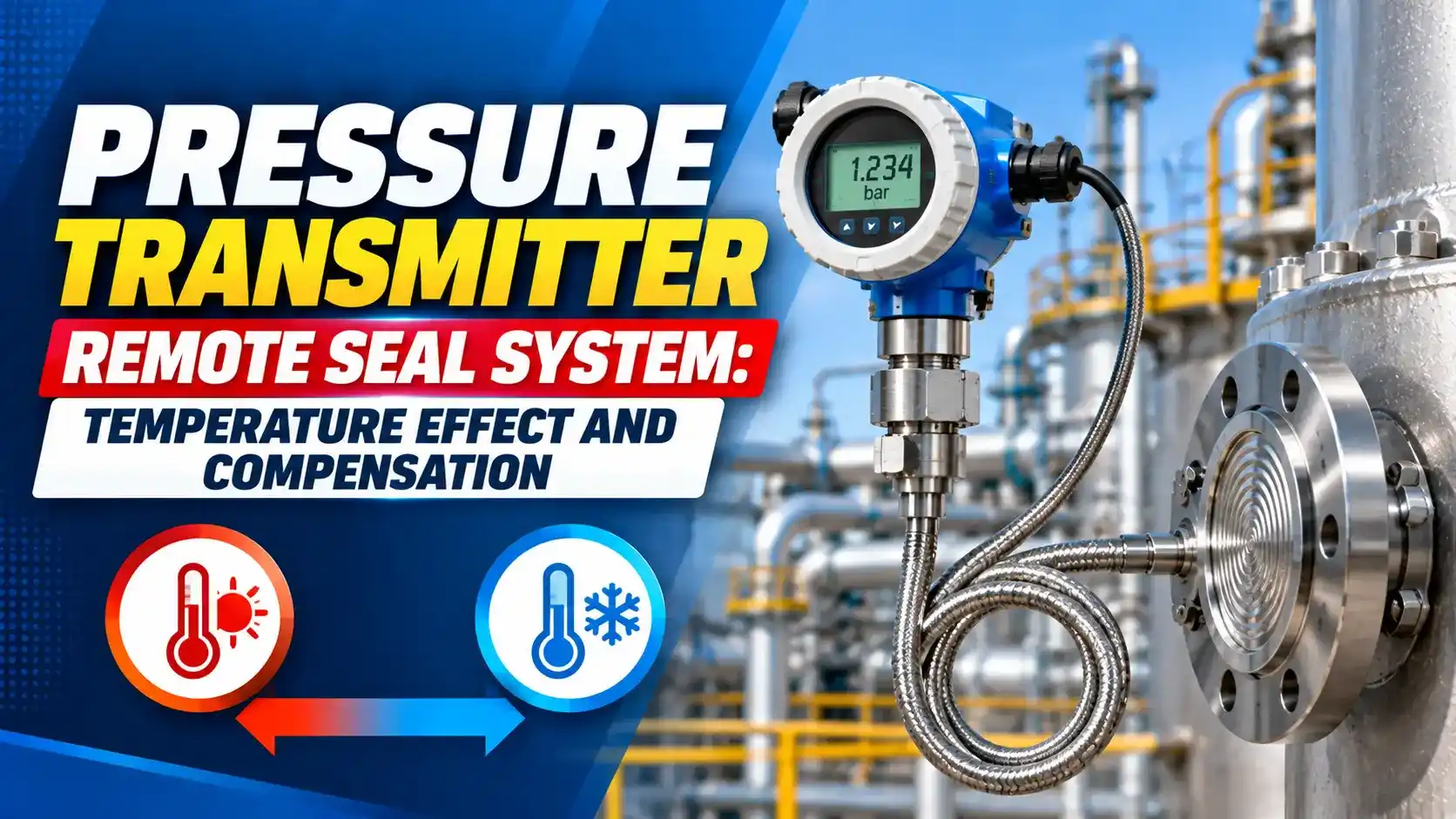
A the system isolates a pressure transmitter from the process fluid using a flexible diaphragm and a capillary tube filled with hydraulic fill fluid.
This protects the transmitter from corrosive, viscous, or high-temperature process fluids. However, the capillary fill fluid expands with ambient temperature, causing a significant measurement error.
This guide covers how a this seal system works, why the temperature effect occurs, how to calculate it, and what engineering choices reduce it.
In a remote seal system, the capillary fill fluid changes volume with temperature. This volume change applies a pressure to the transmitter sensing element that does not come from the process. The result is a false reading that tracks ambient temperature, not process pressure.
How the Remote Seal System Works
A pressure transmitter normally connects directly to the process via an impulse line. When the process fluid is corrosive, viscous, or prone to plugging, a direct impulse line is not practical.
A remote seal system solves this with a diaphragm seal at the process connection and a capillary tube filled with hydraulic fill fluid linking it to the transmitter. Click any term to expand.
Why Temperature Causes a Remote Seal Measurement Error
Fill fluid expands when temperature rises. In a sealed system, this expansion pushes against the transmitter sensing diaphragm, producing a pressure signal indistinguishable from a real process change.
Error magnitude depends on three factors: the thermal expansion coefficient of the fill fluid, the total fill fluid volume (capillary length and diameter), and the stiffness of the sensing element.
A stiffer element resists deflection, so more expansion appears as pressure error. A more compliant element absorbs some expansion, reducing the error.
β: volumetric thermal expansion coefficient of fill fluid (per °C)
V_cap: total fill fluid volume in the capillary and seal cavity (cm³)
ΔT: temperature change (°C)
C_element: compliance of the transmitter sensing element (cm³/Pa)
Practical approximation used in engineering:
ΔP_error ≈ β × ΔT × (capillary length × capillary cross-section area) × (1 / element stiffness factor)
For silicone DC200 fill, β ≈ 0.00096 per °C.
A 5 m capillary at 2 mm ID: V_cap ≈ 5 × π/4 × (0.002)² × 100 = 1.57 cm³
For ΔT = 10°C: volume change = 0.00096 × 1.57 × 10 = 0.0151 cm³
This volume change against a typical stiff element produces roughly 3 to 8 mbar of zero error.
Fill Fluid Selection for Capillary Systems
| Fill Fluid | Thermal Expansion Coefficient (β) | Temperature Range | Best For |
|---|---|---|---|
| Silicone DC200 (standard) | 0.00096 per °C | minus 40°C to 200°C | General service, most process temperatures. Most widely used remote seal fill fluid. |
| Glycerine/water (80/20) | 0.00045 per °C | minus 10°C to 120°C | Low temperature error applications. Preferred when ambient temperature variation is large. Not suitable below minus 10°C (freezing point). |
| Silicone DC704 (high temp) | 0.00078 per °C | minus 40°C to 315°C | High-temperature process connections above 200°C. Steam service, reactor hot-side seals. |
| Halocarbon (Fluorolube) | 0.00080 per °C | minus 18°C to 175°C | Oxygen service where silicone fill is prohibited due to combustion risk. |
| Propylene glycol/water | 0.00050 per °C | minus 45°C to 150°C | Cryogenic and low-temperature service. Lower expansion than silicone. |
| Food-grade silicone (H1) | 0.00095 per °C | minus 40°C to 200°C | Food, pharmaceutical, and potable water applications where fluid contact with product is possible. |
How to Reduce the Temperature Error
Four practical approaches reduce the temperature-induced error in a remote seal system. In practice, multiple approaches are combined for the most demanding applications.
| Approach | How It Reduces the Error | Limitation |
|---|---|---|
| Use equal capillary lengths (DP systems) | If both high-side and low-side capillaries are identical in length, diameter, and fill fluid, and at the same ambient temperature, their thermal expansions cancel at the DP transmitter. Zero error is eliminated. | Only works for differential pressure systems. Does not help gauge or absolute remote seal transmitters. Requires the two capillaries to experience the same ambient temperature. |
| Select low-expansion fill fluid | Glycerine/water or propylene glycol fill has roughly half the thermal expansion of silicone. Directly reduces ΔP_error by the ratio of β values. | Narrower operating temperature range. Higher viscosity at low temperatures slows system response. |
| Minimise capillary length and volume | Shorter capillary = less fill fluid volume = less volume change per degree. Reducing capillary from 10 m to 3 m cuts the error by 70%. | Not always possible due to installation geometry. Requires transmitter to be mounted close to the process. |
| Mount transmitter in a temperature-stable location | If the transmitter and capillary are in a climate-controlled room or shaded instrument enclosure, ΔT is small. Error is proportional to ΔT, so minimising temperature variation directly minimises error. | Requires longer capillary to reach a stable-temperature location, which conflicts with minimising capillary length. |
Remote Seal Temperature Error Calculator
Watch: Remote Seal DP Level Transmitter with Capillary: Full Guide
Remote Seal System Questions
External References
- Remote Seals: Beyond the Basics | Emerson Rosemount (Technical Article)
- Diaphragm Seal Systems: Fill Fluids and Temperature Effects | WIKA
What We Learn Today
- A remote seal system isolates a pressure transmitter from the process using a flexible diaphragm and a capillary filled with hydraulic fill fluid. The transmitter never contacts the process fluid.
- Temperature-induced error occurs because fill fluid expands with temperature and pushes against the transmitter sensing element, creating a false pressure signal (zero shift).
- Error magnitude depends on fill fluid thermal expansion coefficient (β), capillary volume, temperature change (ΔT), and element stiffness.
- For DP remote seal systems: use equal capillary lengths on both sides so temperature errors cancel at the differential element. This is the most effective single compensation technique.
- Lowest thermal expansion fill fluids: glycerine/water (β ≈ 0.00045 per °C) and propylene glycol/water (β ≈ 0.00050 per °C). Standard silicone DC200: β ≈ 0.00096 per °C.
- Additional error reduction: minimise capillary length, mount the transmitter in a temperature-stable location, and combine fill fluid selection with equal capillary lengths for demanding applications.