
Every PLC, HMI, servo drive, and sensor in a plant depends on one component that rarely gets a second look until it fails. This guide covers why power supplies age, why that aging matters more than ever in modern automation, and exactly when to swap the unit before it takes a line down. In short, this is your practical guide to power supply aging in automation.
A power supply rarely fails all at once. It drifts, degrades, and quietly loses margin for months or years before the day it finally trips a line, and by then it usually gets blamed on the wrong component. That slow drift is the real story behind power supply aging in automation.
A typical automation panel runs dozens of devices, PLCs, HMIs, servo drives, and relays, all depending on one part that gets almost no attention once it is installed. Heat, electrical stress, vibration, dust, and general wear slowly break down its internal components until it can no longer hold a stable output. That slow breakdown is what engineers mean by power supply aging in automation.
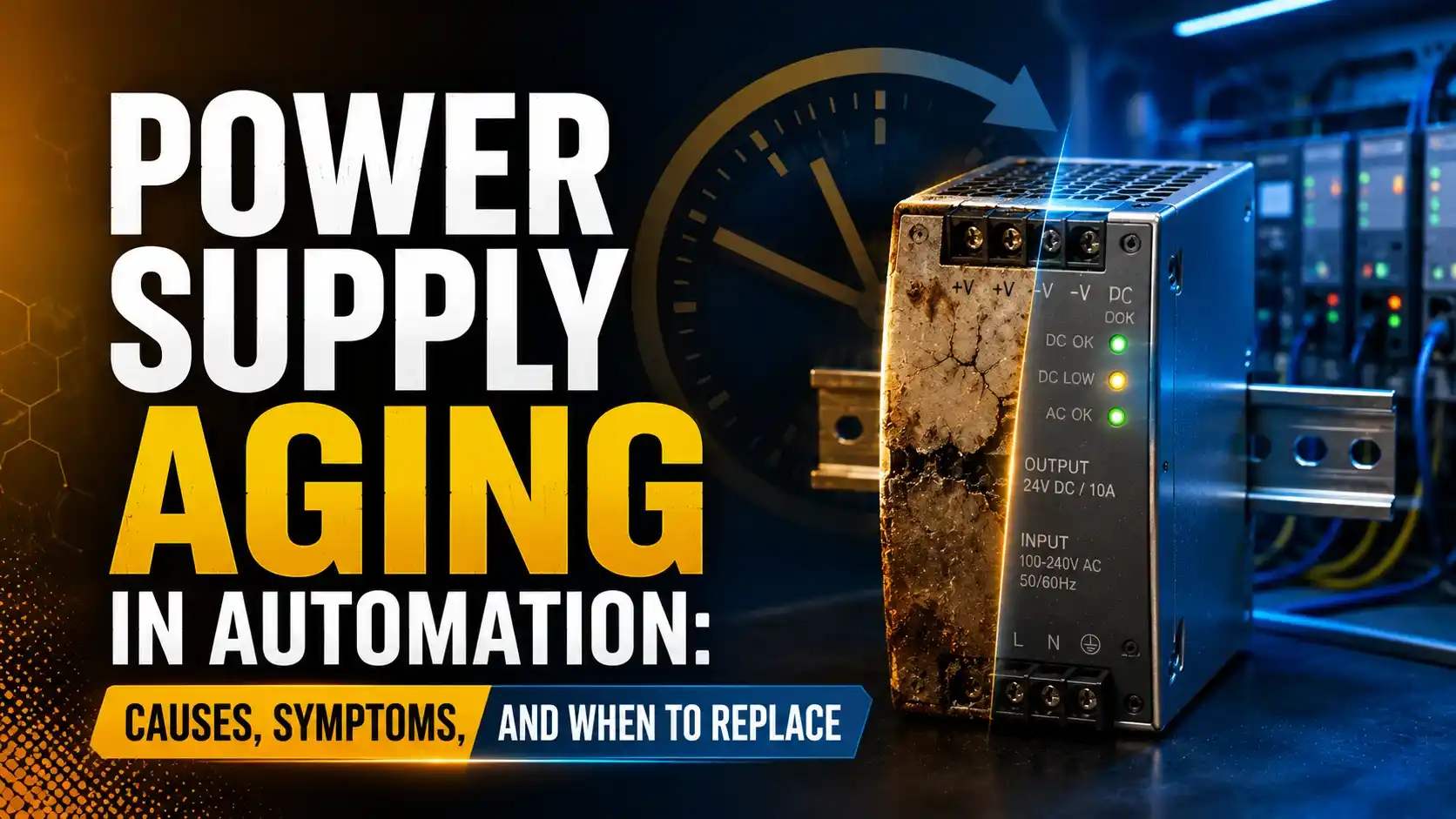
This guide walks through the five main reasons a power supply ages, why that aging is becoming a bigger risk as automation grows more sensitive and more interconnected, and the checklist to use before an aging unit takes an entire line down with it. Understanding power supply aging in automation this way makes the warning signs much easier to catch early.
What Causes a Power Supply to Age
Power supply failure is rarely one single event. It is usually the slow combination of environment, operating stress, and ordinary component wear. Here are the five factors that drive most of power supply aging in automation.
| Aging Factor | What Happens Inside the Unit | Warning Signs |
|---|---|---|
| Capacitor wear | The electrolytic capacitor that filters the output slowly loses electrolyte to evaporation, so capacitance falls and internal resistance rises, the single biggest driver of power supply aging in automation | More ripple on the output, a slower response to load changes, extra heat, and sudden or intermittent shutdowns |
| Continuous thermal stress | Heat inside a crowded cabinet weakens capacitor electrolyte, shortens the life of switching transistors, and degrades solder joints and wire insulation, a major accelerant of power supply aging in automation | A unit that runs consistently hotter than its neighbors, especially where cooling fans or vents are blocked |
| Electrical noise and surges | Voltage spikes, harmonics, high frequency noise, and transient surges from motors and welding equipment stress the rectifier diodes, MOSFETs, and capacitors | Random, unexplained shutdowns with no clear trigger |
| Dust, moisture, and vibration | Dust acts as an insulating blanket that traps heat, moisture corrodes terminals and tracks, and vibration loosens connectors and solder joints, all classic contributors to power supply aging in automation | Rising intermittent faults, especially in marine and heavy machinery settings |
| Long operational life | Continuous duty cycles fatigue capacitors and switching components, wear out fans, and put the PCB base material through repeated thermal cycling | Visible signs of aging typically start appearing after 5 to 10 years in service |
A rough rule used across the capacitor industry is that every 10 degree C rise above rated temperature can cut a capacitor's working life roughly in half. Poor ventilation or a failed cooling fan quietly doubles the aging rate long before anyone notices, which is exactly why power supply aging in automation so often catches teams by surprise.

Why This Is Becoming a Bigger Problem in Modern Automation
Power supply aging in automation is not new. What has changed is how much damage an aging unit can now do before anyone notices.
Modern devices are far more sensitive to voltage
PLCs, HMIs, servo drives, VFDs, sensors, and SCADA systems can all react to the smallest deviation. A small ripple or dip can make a PLC reboot on its own, trigger an overcurrent or encoder error on a servo drive, send faulty readings from a sensor, or drop a communication module entirely. This is one of the clearest signs of power supply aging in automation.
Downtime now costs far more than it used to
Manufacturing lines, food processing plants, packaging operations, marine and offshore systems, and pharmaceutical production all run on tight margins. Because so many devices now share one supply, a single aging PSU can take down several connected machines at once, leading to lost batches, shipment delays, labor inefficiency, and rework. This is exactly why power supply aging in automation now costs so much more than it used to.
Plants are more electrified and more dependent on clean power
Servo systems, smart sensors, high speed communication, IoT gateways, AI based monitoring, and digital safety systems all need a clean, stable DC supply. One aging PSU feeding several of these can cause unlogged communications, network interruptions, PLC module faults, and safety relay malfunctions. Rising electrification is a major reason power supply aging in automation now carries so much more risk.
PSU problems are frequently misdiagnosed
A power supply that fails gradually produces symptoms that look unrelated to power at all. Teams often replace sensors, rewrite PLC logic, or swap servo drives and motors before anyone checks the supply feeding all of them, wasting time and money while the real fault stays in place. Misdiagnosis like this is one of the costliest patterns in power supply aging in automation.
When Should You Replace an Aging Power Supply
These are the warning signs that consistently show up across power supply aging in automation.
Repeated Faults
Recurring drive or PLC faults with no other clear cause, a classic sign of power supply aging in automation.
Unstable Readings
Analog signals that drift or jitter without a process reason.
Overheating
The unit running noticeably hotter than similar units nearby.
Fan Failure
A cooling fan that has slowed, stopped, or gone noisy.
Voltage Drift
Output voltage drifting away from its rated setpoint, a hallmark of power supply aging in automation.
Rising Ripple
Ripple noise on the output that keeps climbing over time.
Age Past 7 Years
Especially in harsh, hot, or vibration heavy environments.
Common Misdiagnoses to Avoid
These habits make the difference between catching power supply aging in automation early and chasing the wrong fix for weeks.
✔ Do
- Check the PSU output voltage and ripple first, before touching anything downstream, whenever power supply aging in automation is suspected
- Log voltage and ripple trends over time to catch slow drift early
- Note the PSU age and duty cycle when a fault pattern looks electrical
- Treat repeated faults across several different devices as a sign of power supply aging in automation
✘ Don't
- Replace sensors before confirming the supply voltage is stable, since power supply aging in automation is often the real culprit
- Rewrite PLC logic to work around instability instead of fixing its source
- Swap servo drives or motors without first measuring the PSU output, a step that rules out power supply aging in automation
- Keep rechecking wiring when the fault pattern already points to power
FAQs on Power Supply Aging
These are the questions that come up most often about power supply aging in automation.
External References
These sources go deeper into the science behind power supply aging in automation.
- Electrolytic Capacitors Determine the Lifetime of a Power Supply, XP Power
- Lifetime of Aluminum Electrolytic Capacitors, Nippon Chemi-Con
- Electrolytic Capacitor Life Calculator, EEPower
What we learn today
- Power supply aging in automation comes from five overlapping causes: capacitor wear, continuous heat, electrical noise, dust and moisture and vibration, and simple long service life.
- Modern PLCs, HMIs, servo drives, and sensors are far more voltage sensitive than older equipment, so small PSU instability now causes visible faults sooner.
- Because so many devices share one supply, power supply aging in automation can now take down several connected machines instead of just one.
- PSU aging is frequently misdiagnosed as a sensor, PLC, or drive problem, which wastes time and money while the real cause stays in place.
- Watch for repeated faults, unstable readings, overheating, fan failure, voltage drift, rising ripple, or age past 7 years, and plan replacement every 5 to 10 years to stay ahead of power supply aging in automation.