
A large motor started direct on line pulls several times its running current, and every other load on the bus feels the sag.
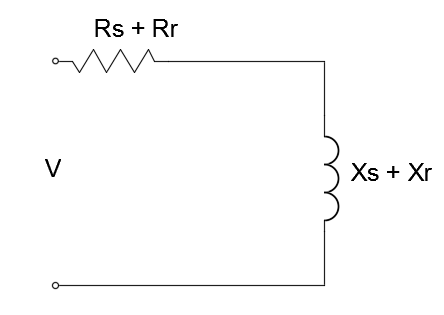
When an induction motor starts, it draws a high, low power factor current until it reaches speed. That current flows through the source impedance and pulls down the bus voltage for seconds.
Why a Voltage Dip Happens at Start
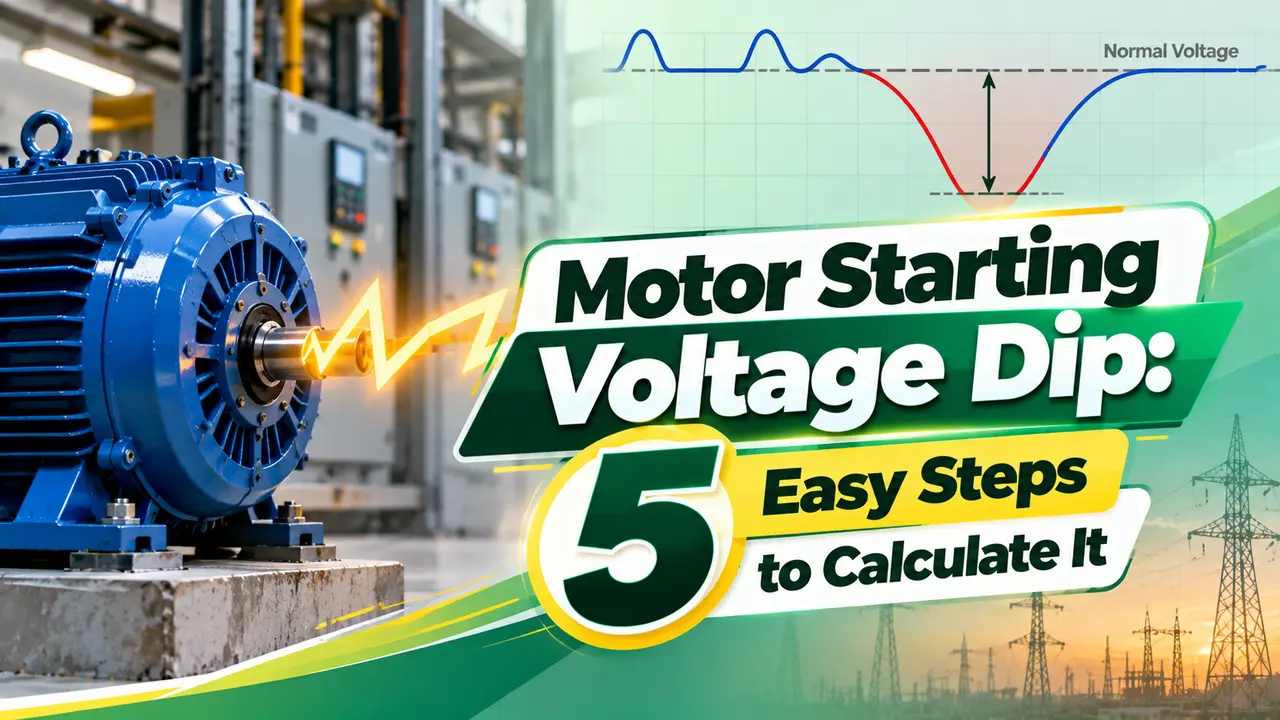
The motor starting voltage dip is the temporary fall in bus voltage while a large motor accelerates. Voltage Disturbance notes that a direct on line start draws 5 to 10 times full load current at a power factor of only about 10 to 30 percent, so the drop across transformer and cable reactance is large.
The dip lasts until the rotor reaches speed and current falls to its running value. Our induction motor guide explains why rotor current is so high at standstill.
Lights dim, contactors chatter and drives may trip on undervoltage. In weak systems the motor itself may fail to accelerate.
The same physics appears in any voltage sag event, but motor starts are predictable and can be calculated in advance.
Acceptable Dip Limits
| Item | Typical Limit | Reason |
|---|---|---|
| Motor terminals during start | About 80 percent of rated | Enough torque to accelerate |
| AC control devices | 85 percent to pick up | Contactors and relays must close |
| Contactor dropout | 60 to 70 percent | Below this, running loads drop out |
| Other buses, occasional start | Dip of 10 to 15 percent | Avoid visible disturbance |
| Frequent starts | Dip of 3 to 5 percent | Flicker limits |
The CED Engineering course recommends about 80 percent terminal voltage during starting. It also notes that AC control devices need 85 percent of rated voltage to pick up.
Sites with sensitive electronics often set tighter limits. Check the utility rules at the point of common coupling as well.
5 Easy Steps to Calculate the Dip
Motor full load current and locked rotor multiple come from the nameplate or code letter, see motor full load current. Source strength links to the short circuit fault current.
This simple method assumes an infinite upstream grid and ignores preload. It is accurate enough for screening, and detailed studies use software.
Worked Example
Transformer 1000 kVA, impedance 6 percent
kVA sc = 1000 ÷ 0.06 = 16667 kVA
Motor 150 kW, efficiency × PF = 0.82, LRC = 6 × FLC
Rated kVA = 150 ÷ 0.82 = 183 kVA
kVA start = 6 × 183 = 1098 kVA
Dip = 1098 ÷ 17765 × 100 ≈ 6.2 percent at the transformer bus
Add the cable drop between the bus and motor terminals, calculated with starting current and a low power factor. Use the voltage drop calculation method with the locked rotor current.
On a generator, use its subtransient reactance instead of transformer impedance. The dip is usually much larger, which is why generator sizing depends on the biggest motor.
Starting Methods That Reduce the Dip
Line current falls to about one third during start.
Tapped voltage, adjustable starting current.
Thyristors ramp voltage smoothly.
Starts near rated current with full torque.
Compare these options in motor starting methods compared and DOL vs star delta. Reduced voltage methods also reduce starting torque, so check the load can still accelerate.
A VFD gives the smallest motor starting voltage dip, since current stays near rated from zero speed.
Other Ways to Strengthen the Bus
Cable sizing for motors must consider both running current and starting drop, as shown in cable sizing for motor feeders.
Voltage Dip Calculator
Try a 500 kW motor on the same transformer to see the dip pass 15 percent. That is the point where a soft starter or VFD becomes worth the cost.
- Calculate dips before buying motors.
- Check both bus and terminal voltage.
- Include cable drop at starting current.
- Use reduced voltage starters where needed.
- Ignoring generator reactance.
- Starting several motors together.
- Forgetting contactor dropout levels.
- Using running PF for starting drop.
CED Motor Starting Analysis PDF
Voltage Drop at Start Video
Motor Starting Voltage Dip FAQ
Related Articles
- Motor Starting Methods Compared
- DOL vs Star Delta Starter
- Voltage Drop Calculation
- Motor Full Load Current
- Voltage Sag, Swell and Flicker
External References
- Motor Starting Analysis, CED Engineering
- Voltage Sag due to Induction Motor Starting, Voltage Disturbance
- Motor Soft Starter, Wikipedia
What We Learn Today
- Starting current at low PF pulls down bus voltage.
- Dip percent equals starting kVA over starting plus source kVA.
- Reduced voltage starters and stronger sources keep dips within limits.