
Sizing transformers, generators and incomers on connected load alone wastes money, while sizing too small causes trips.
A maximum demand calculation estimates the highest load a plant will actually draw, rather than simply adding every nameplate rating. It is the starting point for sizing transformers, generators, cables and main breakers.
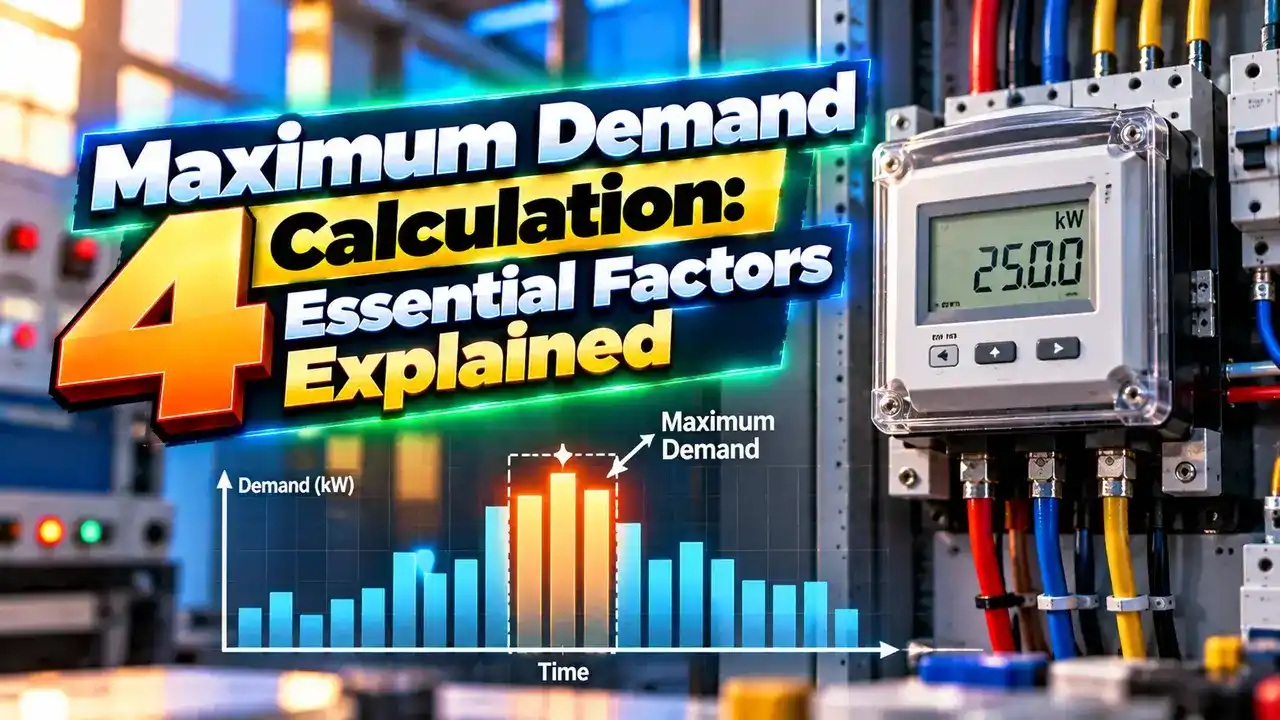
What Is Maximum Demand Calculation?
Maximum demand calculation is the process of estimating the peak kW or kVA an installation will draw during normal operation. It accounts for the fact that not every load runs at full power at the same time, as explained in kW, kVA and kVAR basics.
Connected load is the sum of all nameplate ratings. Maximum demand is almost always lower, because motors run below full load and many loads operate at different times.

ELEK notes that not all individual equipment in an installation will operate at full load simultaneously. Standards such as BS 7671 and AS/NZS 3000 give tables for typical diversity.
The result feeds directly into transformer kVA rating and generator selection. A realistic figure avoids both oversizing and nuisance tripping.
4 Essential Factors in Load Estimation
Demand and utilization factors reduce individual loads, while diversity reduces the combined total. Load factor does not size equipment but shows how well capacity is used.
A high load factor means equipment runs close to its peak most of the time. That improves the economics of transformers and energy contracts.
How the Factors Fit Together
Motor loads usually start from their full load current or kW rating. Standby motors are left out if they never run together with duty units.
Lighting, sockets, HVAC and process loads each get their own factor because their usage patterns differ. Grouping them clearly makes the calculation easy to review.
Maximum Demand Calculation Formula With Example
Maximum demand = Sum of group demands ÷ Diversity factor
kVA = kW ÷ Power factor
Worked example:
Motors 200 kW × 0.8 = 160 kW
Lighting 50 kW × 0.9 = 45 kW
Sockets 60 kW × 0.5 = 30 kW
Sum = 235 kW, diversity = 1.2
Maximum demand = 235 ÷ 1.2 = 195.8 kW
At 0.85 power factor = 230.4 kVA
With future growth of about 20 percent, the designer might select a 315 kVA transformer instead of 250 kVA. Always state the growth margin in the design basis.
The same kVA figure helps with generator sizing, although motor starting may then decide the final size.
Typical Demand Factors by Load Type
| Load Type | Typical Demand Factor | Reason |
|---|---|---|
| Continuous process motors | 0.8 to 0.9 | Run near full load |
| Lighting | 0.9 to 1.0 | Often all on together |
| General sockets | 0.3 to 0.5 | Rarely fully loaded |
| HVAC | 0.7 to 0.9 | Depends on season |
| Welding outlets | 0.3 to 0.5 | Intermittent use |
| Standby equipment | 0 | Not counted with duty units |
These are typical design values, not fixed rules. Plant experience and metered data are always better than generic tables.
For existing plants, a few weeks of logged demand gives the most reliable figure. Energy meters with 15 or 30 minute demand intervals record exactly what the utility bills.
Where the Result Is Used
Incoming feeders are then sized using cable size for load current methods. The demand figure also sets the ratings in the single line diagram.
Declaring too high a contract demand costs money every month. Declaring too low leads to penalties when demand exceeds the limit.
Checking Demand on an Existing Plant
For an existing plant, measured data beats any table. Install a power analyzer on the incomer for at least two to four weeks and record kW, kVA and power factor in 15 minute intervals.
Compare the recorded peak with the design maximum demand calculation. A large gap usually means demand factors were too generous or loads have changed since the original design.
Metering also reveals harmonic loading and poor power factor. Both affect transformer heating, as discussed in power quality issues from VFDs.
Maximum Demand Calculator
Add future load as a separate line so the margin stays visible. Round up to the next standard equipment rating.
- Right sized transformers and generators.
- Lower capital and energy costs.
- Correct incomer and cable ratings.
- Realistic utility contract demand.
- Adding every nameplate without factors.
- Counting standby units as running.
- Ignoring future expansion.
- Using generic factors for unusual loads.
Maximum kVA Demand Reference Guide
Maximum Demand and Diversity Video
Maximum Demand Calculation FAQ
Related Articles
- Transformer kVA Rating Calculation
- Generator Size for Industrial Load
- Power Factor, kW, kVA and kVAR
- Electrical Energy Consumption Calculation
- Load Flow Analysis for Industrial Plants
External References
- Estimation of Actual Maximum kVA Demand, Electrical Installation Guide
- Maximum Demand Tables, ELEK Software
- How to Calculate Maximum Demand and Diversity, Pro Certs
- Demand, Diversity, Utilization and Load Factor, EEP
What We Learn Today
- Peak demand is lower than connected load because loads rarely run at full power together.
- Demand factor reduces groups, diversity reduces the system total.
- Divide the final kW by power factor and add growth margin before sizing equipment.