
A pressure transmitter on hydrogen service can drift slowly for months and then fail with a bulged, cracked diaphragm. Knowing how atomic hydrogen passes through metal, and which diaphragm materials stop it, saves repeated replacements and false process readings.
Hydrogen atoms are small enough to pass straight through a thin metal diaphragm and collect as gas inside the fill fluid. This guide explains the mechanism, the warning signs and the proven fixes, from gold plating to ceramic sensors.

What Is Hydrogen Permeation?
Hydrogen permeation is the slow diffusion of hydrogen atoms through the thin metal isolating diaphragm of a pressure transmitter or diaphragm seal, into the fill fluid sealed behind it. Once inside, the atoms recombine into hydrogen gas that cannot escape, and the trapped gas upsets the pressure reading of the pressure transmitter.
A normal oil filled sensor relies on an incompressible liquid to carry pressure from the diaphragm to the sensing element, as described in piezoresistive and capacitive pressure sensors. A gas bubble in that liquid is compressible, so the transmitter no longer behaves as it did on the calibration bench.
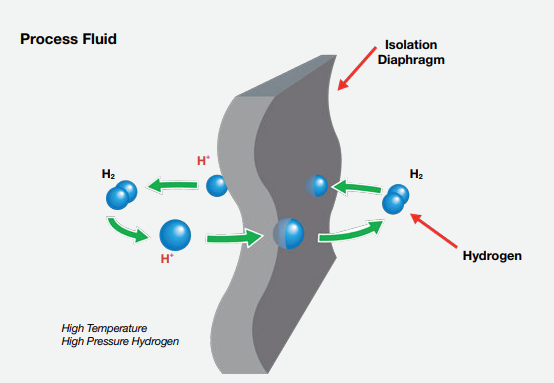
Hydrogen permeation is usually gradual, which makes it dangerous. The loop keeps working and only a careful comparison shows that the zero has walked away from the truth.
How Hydrogen Gets Through a Steel Diaphragm
Hydrogen molecules are too large to enter a metal lattice, but at high pressure and temperature they split into single atoms on the metal surface. Ashcroft explains that hydrogen permeation happens when these ions penetrate the diaphragm and reform as bubbles.
Yokogawa states that the rate of hydrogen permeation depends on diaphragm temperature, hydrogen concentration and the diaphragm metal. The engineer controls two of them, temperature and material.
Hydrogen does not have to be in the process stream as a gas to cause damage. Galvanic corrosion and acid attack on the wetted metal can generate atomic hydrogen right at the diaphragm surface.
Where Hydrogen Permeation Happens in Plants
Many of these points use differential pressure transmitters for flow and level, and sealed systems with long capillaries, so hydrogen permeation can affect several loops at once.
Symptoms: Zero Drift and the Jiffy Pop Failure
Yokogawa describes two stages of damage. In the minor stage the zero and span shift, so the transmitter drifts, much like the general causes covered in pressure transmitter zero shift.
In the severe stage of hydrogen permeation the gas pushes the diaphragm outward until it cracks and leaks fill fluid. Yokogawa and Endress+Hauser both call this the Jiffy Pop effect.
A span error often appears with the zero error, because a bubble changes how the diaphragm deflects. The pattern looks similar to pressure transmitter span drift, but it keeps growing in one direction.
5 Proven Fixes for Hydrogen Permeation
A dense gold layer on the wetted face blocks most hydrogen atoms from entering the base metal.
Longer impulse lines, capillaries or cooling elements keep the diaphragm cooler and slow diffusion.
Hastelloy C 276 with chromium oxide passivation, 316L or A286 resist hydrogen better than some alloys.
Hard nitride or similar coatings block atoms without the soft gold layer.
A ceramic cell has no oil fill and hydrogen does not diffuse through the ceramic membrane.
Yokogawa recommends Hastelloy C 276 with chromium oxide passivation for low hydrogen occurrence, a gold plated diaphragm for high occurrence and thicker gold for very high concentration. For hydrofluoric acid service it specifies gold plating on Monel diaphragms.
ABB offers a different barrier, a superhard nanostructured coating of titanium and silicon nitrides, 3 to 5 µm thick, on a 316L diaphragm. ABB positions it as a lower cost alternative to gold and reports diaphragm flexibility from minus 100 °C to 600 °C.
Ask the vendor for the gold thickness and the plating area in writing on the datasheet. A plated diaphragm that leaves the weld ring or process flange bare still lets hydrogen reach the fill fluid.
Why a Gold Plated Diaphragm Works
Gold has very low solubility for hydrogen and does not readily split H2 molecules on its surface, so a continuous film blocks hydrogen permeation at the source. The layer is only a few micrometres thick, so the diaphragm still flexes normally.
| Diaphragm Option | Hydrogen Resistance | Main Limitation | Typical Use |
|---|---|---|---|
| 316L stainless steel | Moderate | Permeates when hot | Cool hydrogen gas |
| Hastelloy C 276 with CrO | Good for low H2 | Not enough for high H2 | Standard wetted parts |
| A286 alloy | Good, high strength | Cost, limited sizes | Very high pressure gas |
| Gold plated 316L or Hastelloy | Very good | Soft layer scratches easily | High hydrogen service |
| Ceramic dry cell | Excellent | Lower pressure range | Low and medium pressure gas |
Gold is soft and scratches easily. Treat a plated seal like any other diaphragm seal and never touch the wetted face with tools.
Drift Formula for a Suspect Transmitter
To judge a suspect transmitter, express the as found zero error as a percentage of span and divide it by the months in service. Hydrogen permeation shows a steady one way rate, while ordinary drift tends to wander.
Zero error in units = percent error ÷ 100 × calibrated span
Drift rate = percent error ÷ months in service
Example:
Span = 100 bar, output at zero pressure = 4.32 mA, 6 months in service
Error = (4.32 minus 4) ÷ 16 × 100 = 2.00 percent
Error in units = 2.00 ÷ 100 × 100 = 2.00 bar
Rate = 2.00 ÷ 6 = 0.33 percent per month, above a 0.5 percent limit
Read the output with the transmitter isolated, vented to atmosphere and at stable temperature, otherwise the check includes thermal effects described in pressure transmitter temperature effect.
Zero Drift Rate Calculator
Second Worked Example: DP Level on a Separator
A DP transmitter on a hot hydrotreater separator has a span of 2500 mm water column. After 10 months it reads 4.48 mA with both sides equalised and vented, so the error is 0.48 ÷ 16 × 100 = 3.00 percent, or 75 mm.
The rate is 3.00 ÷ 10 = 0.30 percent per month, always upward, while the low side seal is fine. That points to hydrogen permeation on the hot high side, not the ordinary drift discussed in DP level transmitter calibration.
Re zeroing hides the fault but does not stop hydrogen permeation. Replace the seal with a gold plated one or move it away from the heat, then log the next as found reading.
Detecting Hydrogen Permeation in the Field
- Trend the as found zero at every calibration and plot it against time.
- Compare redundant or voting transmitters on the same service.
- Check for a steady one direction shift that grows after hot periods.
- Look for a span error that appears together with the zero error.
- Inspect removed diaphragms for bulging, wrinkles or a domed shape.
- Watch for sluggish or noisy response that suggests gas in the fill.
- Record process temperature and hydrogen content at the tapping.
HART communication makes hydrogen permeation trending easy without opening the loop. A device described in what is a smart transmitter also stores the last trim date.
Endress+Hauser points out that a ceramic pressure cell is dry, and hydrogen molecules do not diffuse through a ceramic membrane. With no fill fluid, there is no liquid in which gas bubbles can collect.
Selection Guide for Hydrogen Service Transmitters
Ashcroft recommends at least 316L stainless steel for hydrogen, and A286 diaphragms for applications above 5,000 psi, noting that A286 keeps its structural integrity up to 20,000 psi. See also high pressure transmitter selection.
The rules in fill fluid selection for diaphragm seals still apply on hydrogen duty. A smaller fill volume leaves less room for gas to collect.
Mount the transmitter away from hot vessels with a sensible length of impulse line, so the diaphragm runs much cooler than the process. A cooler diaphragm slows diffusion and extends the life of a standard diaphragm.
- Stable zero and span over long service.
- Fewer diaphragm failures and fill fluid leaks.
- Longer calibration intervals and less rework.
- Reliable readings for control and safety loops.
- Gold plating adds cost and needs careful handling.
- Coatings are vendor specific options.
- Ceramic cells have lower maximum pressure.
- Cooler mounting adds impulse line issues.
Yokogawa Hydrogen Permeation Application Note
Gold Plated Diaphragm Video
Hydrogen Permeation FAQ
It is the diffusion of hydrogen atoms through the thin metal diaphragm into the fill fluid behind it. The atoms then recombine into gas that cannot pass back out.
The trapped gas makes the fill compressible and pushes on the diaphragm from inside. The result is zero and span drift and, in severe cases, a cracked diaphragm.
Hydrogen molecules split into single atoms on a hot metal surface under pressure. These atoms are the smallest of all and move between the metal grains quite easily.
Once they reach the oil side they join again into ordinary gas molecules. Those molecules are too large to travel back through the metal, so the trapped gas volume keeps growing over time.
It is the severe stage of damage, where collected gas pushes the isolation diaphragm outward like a balloon. The name comes from a popcorn pan whose foil lid swells as it heats.
The bulged diaphragm eventually cracks and leaks fill fluid into the process. At that point the transmitter reading is useless and the whole unit must be replaced.
Gold has very low solubility for hydrogen and does not split H2 molecules easily on its surface. A continuous layer therefore stops most atoms before they reach the base metal.
Yokogawa offers 3 and 10 micrometre plating, with the thicker layer for higher concentration. The layer is thin enough that the diaphragm still flexes normally.
Yokogawa lists three factors, namely diaphragm temperature, hydrogen concentration and the diaphragm metal. Engineers can control temperature and material, but they can rarely change the hydrogen concentration of the process.
Keeping the diaphragm cooler slows diffusion strongly, so mounting location matters a great deal. Choosing gold plating or a better alloy then reduces the rate even further for the most demanding duties.
Trend the as found zero at every calibration and look for a steady shift in one direction. Compare redundant transmitters and note whether the error grows after hot periods.
A span error that appears together with the zero error is another clear warning sign. Removed diaphragms that look domed, wrinkled or bulged outward confirm the diagnosis.
Endress+Hauser explains that hydrogen molecules do not diffuse through a ceramic membrane. The cell is also dry, so there is no fill fluid where gas could collect.
Ceramic cells therefore suit low and medium pressure gas service very well. For very high pressure ranges, metal diaphragms with gold plating or special barrier coatings remain the usual choice.
Related Articles
- Pressure Transmitter Zero Shift
- What Is a Diaphragm Seal
- Fill Fluid Selection for Diaphragm Seals
- High Pressure Transmitter Selection
- Pressure Transmitter Span Drift
External References
- Hydrogen Permeation Application Note, Yokogawa
- How Does Hydrogen Permeation and Embrittlement Affect Pressure Transducers, Ashcroft
- Hydrogen Embrittlement, Wikipedia
What We Learn Today
- Hydrogen permeation lets single hydrogen atoms diffuse through a metal diaphragm, where they form trapped gas bubbles that shift the zero and span of the transmitter.
- A gold plated diaphragm, cooler mounting, a better alloy, a nitride coating or a dry ceramic cell are the five practical ways to slow or stop the damage.
- Trend the as found zero at every calibration, because a steady drift in one direction that grows after hot periods is the classic early warning sign.