
Table of Contents
Toggle7 Industrial Automation Sensors and Their Applications
Industrial automation has transformed the way factories, processing plants, and manufacturing facilities operate. Modern automated systems rely on accurate and reliable data to control machines, improve efficiency, and maintain product quality. At the heart of these systems are sensors.
Sensors are often called the “eyes and ears” of industrial automation because they continuously monitor physical conditions and provide real-time information to control systems such as PLCs, DCS, SCADA systems, and industrial computers.
Without sensors, automation systems would be unable to detect changes in processes, monitor equipment performance, or ensure safe operation.
In this article, we will explore the seven most important industrial automation sensors and understand their functions, applications, and benefits.

What Are Industrial Automation Sensors?
Industrial automation sensors are devices that detect physical changes in the environment and convert them into electrical signals that can be interpreted by control systems.
These sensors measure various parameters such as:
1. Position
2. Presence of objects
3. Pressure
4. Temperature
5. Level
6. Flow
7. Speed and Position
The information collected helps automated systems make decisions without human intervention.
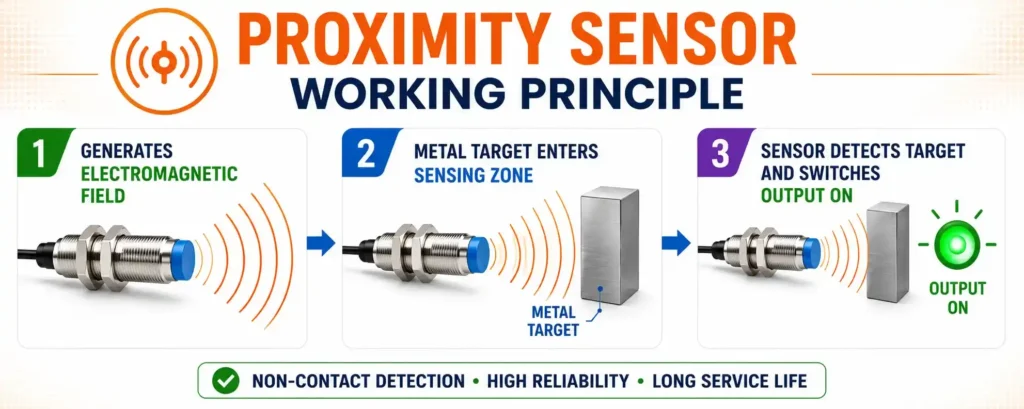
1. Proximity Sensor
A proximity sensor detects the presence or absence of an object without physical contact.
These sensors are widely used in industrial automation because they provide fast and reliable object detection.
Common Types
- Inductive Proximity Sensors
- Capacitive Proximity Sensors
Applications
- Object detection on conveyor belts
- Machine positioning
- Counting products
- End-of-stroke detection
- Safety interlocks
Benefits
- No mechanical wear
- Long service life
- High reliability
- Fast response time
2. Photoelectric Sensor
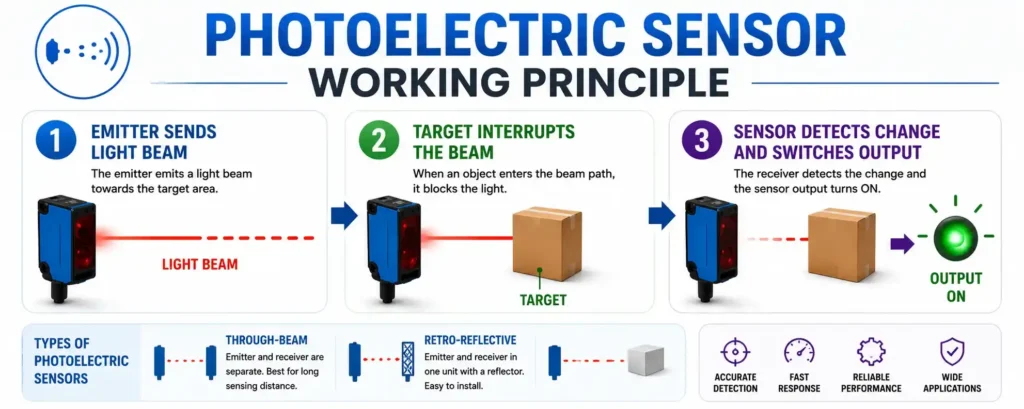
A photoelectric sensor uses light to detect the presence, absence, or movement of an object.
These sensors can detect objects over longer distances than proximity sensors and are suitable for both metallic and non-metallic targets.
Common Types
- Through-Beam
- Retro-Reflective
- Diffuse Reflective
Applications
- Packaging machines
- Conveyor systems
- Product counting
- Label detection
- Automated sorting systems
Benefits
- Long sensing distance
- High accuracy
- Suitable for various materials
- Quick detection speed
3. Pressure Sensor
A pressure sensor measures the pressure of gases or liquids and converts it into an electrical signal.
Pressure monitoring is critical in many industrial processes to ensure equipment operates safely and efficiently.
Common Types
- Gauge Pressure Sensors
- Absolute Pressure Sensors
- Differential Pressure Sensors
Applications
- Hydraulic systems
- Pneumatic systems
- Tank monitoring
- Pump protection
- Process control
Benefits
- Improves safety
- Prevents equipment damage
- Enhances process efficiency
- Enables predictive maintenance

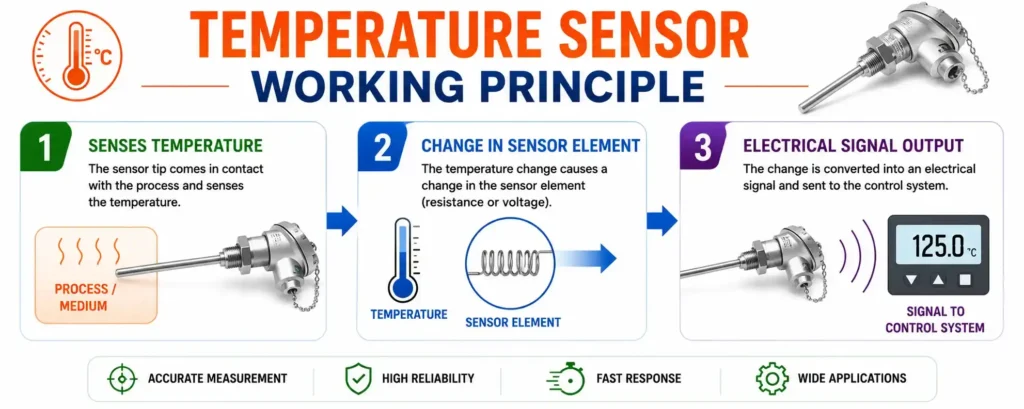
4. Temperature Sensor
Temperature sensors monitor the temperature of equipment, fluids, and industrial processes.
Temperature is one of the most commonly measured variables in industrial environments.
Common Types
- RTD Sensors
- Thermocouples
- Thermistors
Applications
- Boilers
- Heat exchangers
- Chemical processing
- Food and beverage production
- HVAC systems
Benefits
- Improved product quality
- Better process control
- Equipment protection
- Energy savings
5. Level Sensor
Level sensors measure the amount of liquid or solid material present inside a tank, vessel, or silo.
Accurate level measurement helps prevent overflow, dry running, and inventory losses.
Common Types
- Float Level Sensors
- Ultrasonic Level Sensors
- Capacitive Level Sensors
Applications
- Water treatment plants
- Chemical storage tanks
- Oil and gas facilities
- Food processing plants
- Inventory management systems
Benefits
- Better inventory control
- Reduced process interruptions
- Improved safety
- Lower maintenance costs

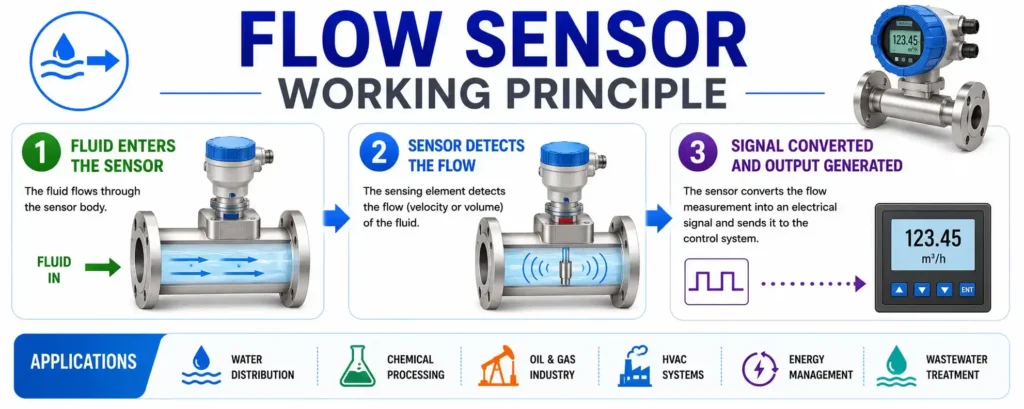
6. Flow Sensor
Flow sensors measure the movement of liquids, gases, or steam through a pipeline.
Flow measurement is essential for process control, consumption monitoring, and efficiency improvement.
Common Types
- Electromagnetic Flow Meters
- Turbine Flow Meters
- Ultrasonic Flow Meters
Applications
- Water distribution systems
- Chemical processing
- Energy management
- Oil and gas production
- Wastewater treatment
Benefits
- Accurate process monitoring
- Reduced waste
- Improved efficiency
- Better resource management
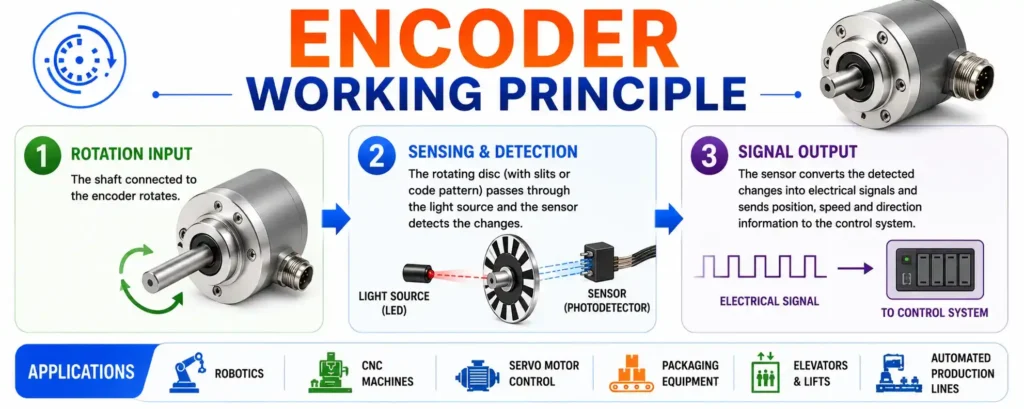
7. Encoder
An encoder measures the position, speed, and direction of rotating machinery.
Encoders play a critical role in motion control and robotics applications.
Common Types
- Incremental Encoders
- Absolute Encoders
Applications
- Robotics
- CNC machines
- Packaging equipment
- Servo motor control
- Automated production lines
Benefits
- Precise motion control
- Improved machine accuracy
- Increased productivity
- Better automation performance
Why Are Sensors Important in Industrial Automation?
Sensors provide the data required for intelligent decision-making in automated systems.
Some major advantages include:
- Improved operational efficiency
- Enhanced process accuracy
- Increased workplace safety
- Reduced downtime
- Lower maintenance costs
- Better product quality
- Higher productivity
As Industry 4.0 and Industrial IoT continue to expand, sensors are becoming even more important for smart manufacturing and predictive maintenance strategies.
Frequently Asked Questions (FAQs)
1. What are the most common sensors used in industrial automation?
The most common industrial automation sensors are proximity sensors, photoelectric sensors, pressure sensors, temperature sensors, level sensors, flow sensors, and encoders.
2. Why are sensors important in automation systems?
Sensors provide real-time process information that allows control systems to make automatic decisions, improving efficiency, safety, and productivity.
3. What is the difference between a proximity sensor and a photoelectric sensor?
A proximity sensor detects nearby objects without contact, while a photoelectric sensor uses light to detect objects over longer distances.
4. Which sensor is used to measure liquid level in tanks?
Level sensors such as ultrasonic, float, radar, and capacitive level sensors are commonly used for tank level measurement.
5. What type of sensor is used for temperature measurement?
RTDs, thermocouples, and thermistors are the most widely used temperature sensors in industrial applications.
6. What is the purpose of a flow sensor?
A flow sensor measures the flow rate of liquids, gases, or steam in pipelines and process systems.
7. Where are pressure sensors used?
Pressure sensors are used in hydraulic systems, pneumatic systems, process plants, pumps, compressors, and tank monitoring applications.
8. What is an encoder in automation?
An encoder is a sensor that measures position, speed, and direction of rotating equipment such as motors and shafts.
What we learn today?
Industrial automation sensors are essential components of modern manufacturing and process industries. From detecting object presence with proximity sensors to measuring flow, pressure, temperature, and level, these devices provide the critical data needed for automation systems to function effectively.
Understanding the role of each sensor helps engineers, technicians, and students select the right technology for their applications. As factories continue to become smarter and more connected, the demand for reliable and accurate sensors will continue to grow.


I hope you like above blog. There is no cost associated in sharing the article in your social media. Thanks for Reading !! Happy Learning