
A century-old Bourdon tube and a modern piezoresistive chip solve the exact same problem in completely different ways. Here is how each one actually works, where each one wins, and how to pick between them.
Mechanical pressure sensors translate pressure into a physical movement you can read directly on a dial. Electronic pressure sensors convert that same pressure into an electrical signal instead.
Both approaches have stayed in active use for a reason. Picking between them usually comes down to whether a job needs a simple local reading or a signal that can travel, log, and feed a control system.
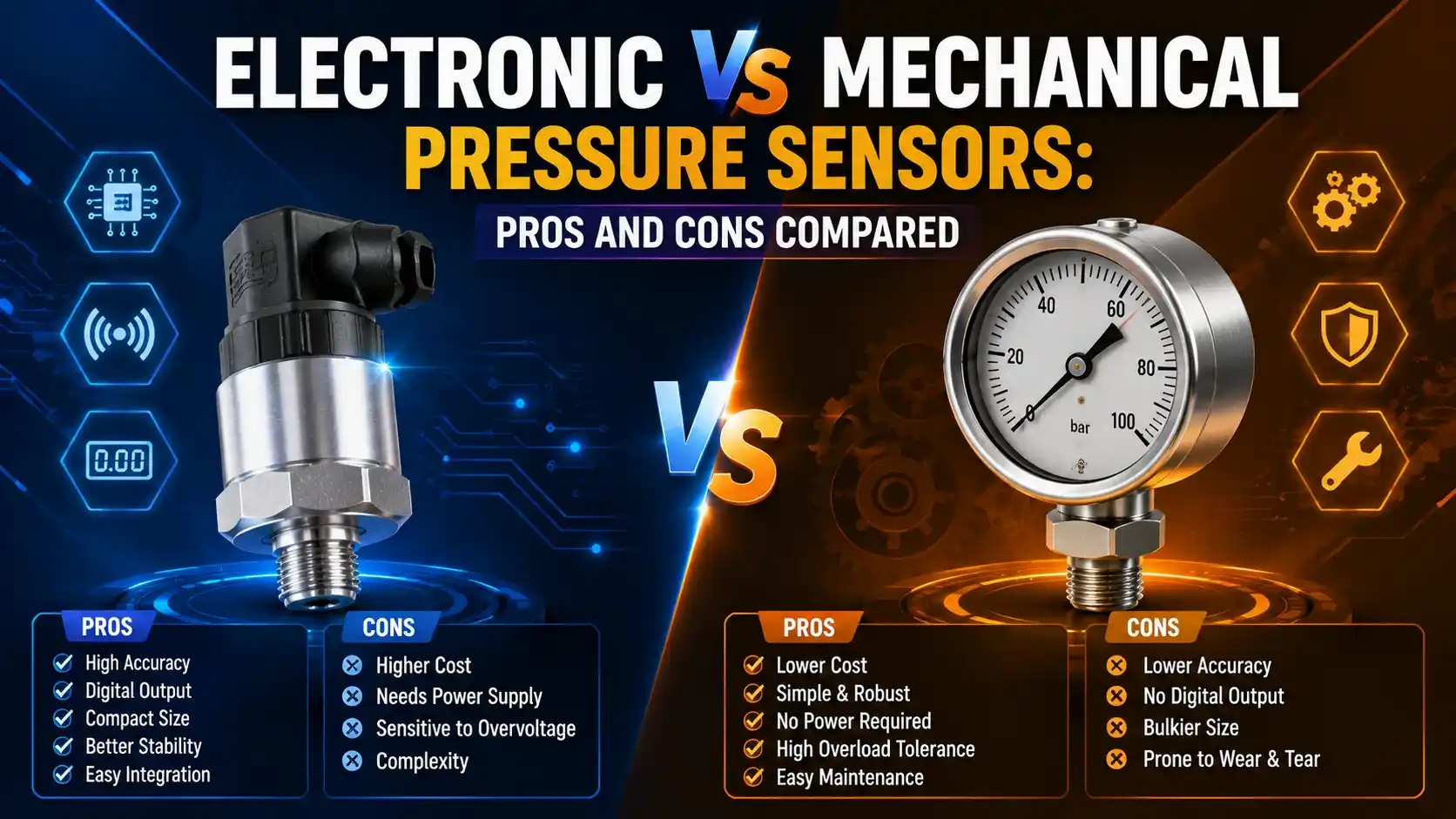
Mechanical Pressure Sensors
Self-contained devices that turn pressure directly into a physical movement, displayed on a dial. No power, no wiring, no signal, just a needle and a scale.
Electronic Pressure Sensors
Also called transducers or transmitters. They convert pressure into an electrical signal that can travel to a control room and feed data systems.
Neither approach is inherently better. A modern process plant genuinely needs both types working side by side, often at the very same location.
How Mechanical Pressure Sensors Work
The Bourdon tube is the classic example, and its design has barely changed in over a century.
Pressure Input
Process fluid or gas enters the sensor.
Bourdon Tube
A sealed, C-shaped or spiral tube tries to straighten as pressure rises inside it.
Linkage System
Levers and gears connect to the tube's free end and amplify its small movement.
Pointer and Dial Scale
The amplified movement rotates a pointer across a calibrated scale.
Diaphragm and bellows sensors work on the same core idea, a flexible element physically displaces under pressure, and that displacement becomes the reading.
How Electronic Pressure Sensors Work
Two sensing principles dominate electronic pressure measurement: piezoresistive and capacitive.
Pressure Input
Process medium presses against a flexible diaphragm.
Piezoresistive Strain Gauges
Gauges bonded to the diaphragm change resistance as it stretches or compresses.
Wheatstone Bridge
The resistance change unbalances the bridge circuit, producing a small output voltage.
Signal Conditioning
The weak signal is filtered, linearized, temperature-compensated, and amplified.
Output Signal
The conditioned signal becomes a standard 4-20mA, voltage, or digital output such as HART.
A capacitive sensor follows nearly the same path, but the diaphragm acts as one plate of a capacitor instead of carrying strain gauges. Pressure changes the gap to a fixed plate, a capacitance-to-voltage circuit measures that shift, and the signal is conditioned the same way.
Pros and Cons of Mechanical Pressure Sensors
Advantages
Limitations
Pros and Cons of Electronic Pressure Sensors
Advantages
Limitations
Electronic vs Mechanical Pressure Sensors: Head-to-Head
| Feature | Electronic Sensor | Mechanical Sensor |
|---|---|---|
| Power Requirement | Requires external power | Self-powered |
| Accuracy and Precision | High | Lower |
| Output | Electrical: 4-20mA, voltage, digital | Visual dial reading |
| Remote Monitoring | Yes, via signal transmission | No |
| Data Logging | Easily integrated | Manual recording only |
| Advanced Features | Programmable alarms, digital comms | None |
| Initial Cost | Higher | Lower |
| Durability | Good, but electronics can be sensitive | Very robust mechanically |
| Main Weakness | Electrical noise, temperature extremes | Overpressure, vibration, wear |
| Ideal For | Process control, automation, data analysis | Local indication, remote or hazardous areas |
Where Each Type Actually Gets Used
Mechanical Sensors
- Local pressure indication on pumps, compressors, and filters
- Hydraulic and pneumatic systems needing a simple visual check
- Remote oil and gas wellheads where power is unavailable
- Fire suppression systems and portable gas cylinders
- A redundant, fail-safe backup to an electronic sensor
Electronic Sensors
- Closed-loop process control in chemical plants and refineries
- HVAC systems monitoring and controlling air and fluid pressure
- Aerospace applications measuring altitude and cabin pressure
- Medical devices like ventilators and blood pressure monitors
- Automotive oil, fuel, and tire pressure monitoring
A common pattern in real plants is to use both together: an electronic transmitter feeds the control system continuously, while a nearby mechanical gauge gives an operator an instant local check without needing power or a screen.
Where Pressure Sensing Is Heading
The overall trend favors smarter, more connected electronic sensors, driven largely by the rise of IIoT.
Wireless Sensors
Removing wiring entirely makes deployment cheaper and easier across more applications.
Onboard Diagnostics
Smart sensors increasingly flag developing problems before they cause failures.
Miniaturization
MEMS technology keeps producing smaller, more efficient, more affordable sensors.
AI-Driven Analysis
Real-time AI analysis of pressure data supports sharper predictive maintenance and optimization.
None of this makes the mechanical gauge obsolete. Its simplicity, reliability, and complete independence from power keep it firmly in the instrumentation toolbox for straightforward, localized readings.
FAQs on Electronic vs Mechanical Pressure Sensors
What we learn today
- Mechanical pressure sensors convert pressure into a physical movement read directly on a dial, with no power needed.
- Electronic pressure sensors convert pressure into an electrical signal using piezoresistive or capacitive sensing elements.
- Mechanical sensors win on cost, robustness, and power independence, but lose on accuracy and remote capability.
- Electronic sensors win on accuracy, remote transmission, and data logging, but need power and cost more upfront.
- The choice comes down to the application: local, simple, unpowered readings favor mechanical, while automation and data-driven control favor electronic.