
AI is no longer a separate application sitting on top of enterprise systems, it is turning into a layer that plants and IT departments both have to design around from the start.
AI and Automation together are reshaping how plant floor data, IT systems, and business decisions connect, and the plants that treat this as infrastructure rather than a tool will be the ones that scale it safely.
AI and Automation are converging into a single operating layer that spans the sensor floor, the control system, and the enterprise cloud, and getting the governance and reliability boundaries right matters more than the AI model itself.
If you want the plant floor specific view, how AI is showing up directly inside PLC, SCADA, and DCS systems, our AI in PLC, SCADA and DCS article covers that ground in detail.
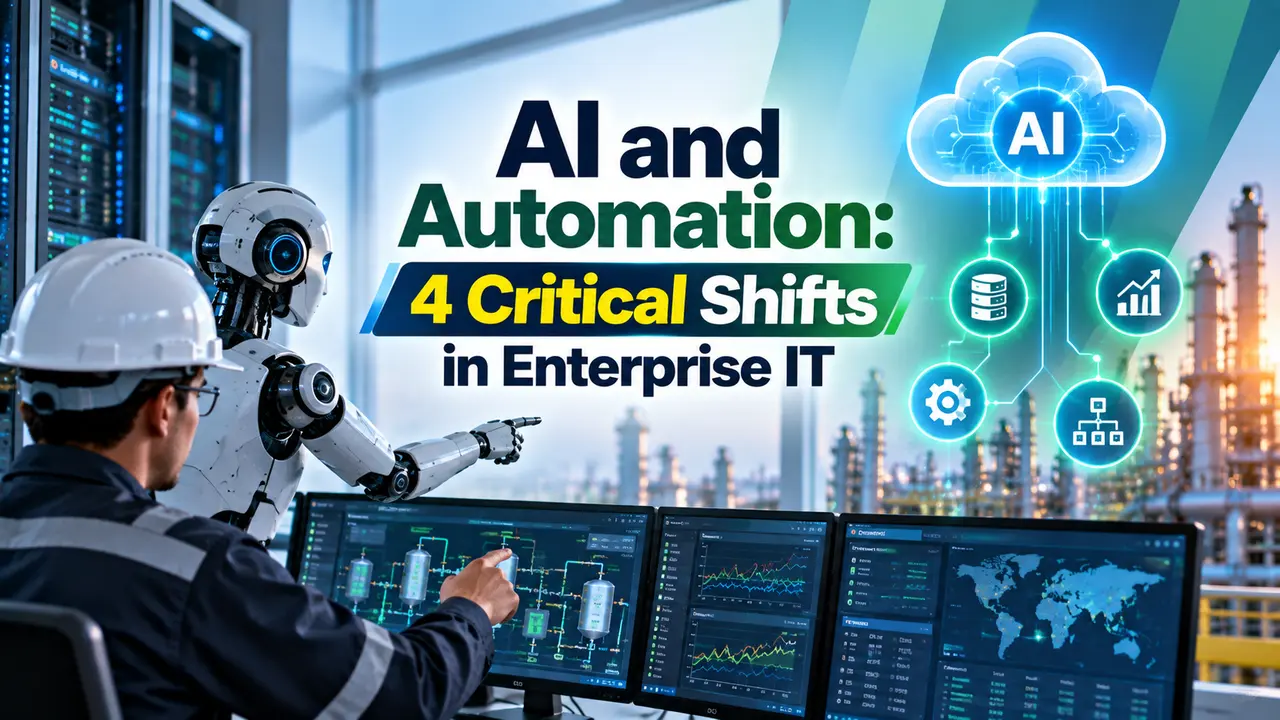
What AI and Automation as an Operating Layer Actually Means
An operating layer is the part of a system that everything else depends on to function, the way an operating system sits beneath every application on a computer.
AI and Automation are moving into that same role inside enterprises, sitting between raw plant floor data and the business decisions built on top of it, rather than existing as a standalone analytics tool that a few engineers open occasionally.
4 Shifts Behind This Change in Enterprise Infrastructure
Analyst research increasingly points to this same conclusion, that converged IT and OT is becoming a prerequisite for the AI driven operations plants are trying to build, not an optional cleanup project.
What Changes at Each Layer of the Stack
Numbers Worth Knowing, With Real Caveats
| Figure | Source and Caveat |
|---|---|
| 40 percent of enterprise apps expected to feature task specific AI agents by 2026, up from under 5 percent in 2025 | Gartner prediction, published 2025, treat as a forecast not observed adoption |
| 80 percent of CEOs surveyed say AI will force an overhaul of operational capability | Gartner survey result, reflects executive sentiment rather than a measured outcome |
| Unplanned downtime reductions from AI based predictive maintenance | Widely cited in industry sources but figures vary by methodology, verify against a named study before quoting a specific percentage |
None of these figures should be repeated as settled fact in a business case, they are useful direction indicators from credible analyst sources, not guarantees for any specific plant.
What an Operating Layer Looks Like in Practice
Centralized Governance vs Edge Autonomy
Centralized AI Governance
Keeps policy, model versioning, and audit trails consistent across every plant, at the cost of somewhat slower local response.
Edge Level Autonomy
Lets a local model react instantly to plant floor conditions, but makes consistent oversight across many sites genuinely harder.
Building an AI and Automation Layer Without Breaking OT Reliability
Building AI and Automation into plant infrastructure this way, gradually and with clear boundaries, tends to hold up far better over years than a fast, unmonitored rollout ever does.
Real Barriers Standing Between Pilots and Production
Most plants do not struggle with finding an AI model that works, they struggle with everything that surrounds getting it running reliably at scale.
None of these barriers are exotic, which is exactly why they get underestimated, a pilot that works in a lab setting can still stall for months once these ordinary organizational gaps show up.
Cybersecurity Implications of a Shared AI Layer
Connecting OT data to this kind of layer widens the attack surface, since a system that once sat isolated on the plant floor now has a path, however indirect, back toward enterprise networks.
A security review of this layer belongs in the same conversation as a security review of the control network itself, not as an afterthought handled separately by a different team.
Watch: How to Use AI in Industrial Automation, Machine Vision
How Roles Are Shifting Across IT, OT, and Data Science
None of these roles disappear as this layer matures, they shift toward oversight and validation rather than the manual data gathering that used to consume most of the working day.
Plants that treat this as a pure IT project, without real involvement from the people who understand the process itself, tend to end up with models nobody on the floor actually trusts.
Where This Is Headed Over the Next Few Years
Most industry commentary points toward the same general direction, more autonomous decisions handled by the system itself, with humans reviewing exceptions rather than approving every routine action.
That shift will not arrive evenly across every plant or every process, a well understood, low risk loop is a far more natural early candidate than anything touching a safety critical function.
Plants that build the underlying data and governance layer now, even before every planned AI use case is defined, tend to move faster later, since the hard infrastructure work is already done.
The plants that wait for a finished, risk free version of this technology before starting that groundwork will likely spend years catching up once the pace of adoption picks up around them.
Starting small, on a single well understood loop, and expanding only once the governance and data foundation genuinely proves itself is a far more reliable path than any large scale rollout attempted all at once, however tempting that faster route might look on paper.
AI and Automation Questions Engineers Ask
Related Articles on This Site
- AI in PLC, SCADA and DCS
- Digital Twin in Industrial Automation
- Predictive Maintenance vs Preventive Maintenance
- SCADA vs IIoT
- Wireless Pressure Transmitters in IIoT Systems
External References
- Digital Twins and Generative AI, a Powerful Pairing
- Gartner Predicts 40 Percent of Enterprise Apps Will Feature Task Specific AI Agents by 2026
What We Learn Today
- AI and Automation are becoming a genuine operating layer spanning sensors, control systems, and enterprise cloud, not a bolted on tool.
- Analyst figures like Gartner's agent adoption forecast are useful direction indicators, not settled facts to quote as current reality.
- A hybrid of edge autonomy and centralized governance, with safety functions kept entirely outside AI decision paths, holds up best in practice.