
ACB vs VCB vs SF6 comes down to one core question, what medium quenches the arc when the breaker opens, and that single choice decides voltage range, maintenance needs, and total lifetime cost.
This selection depends mainly on the arc quenching medium each breaker uses, air, vacuum, or sulfur hexafluoride gas, which sets the voltage range each type actually fits.
This builds on the earlier comparison in MCB vs MCCB vs ELCB vs RCCB, since ACB, VCB, and SF6 breakers sit one size class above those low voltage protective devices.
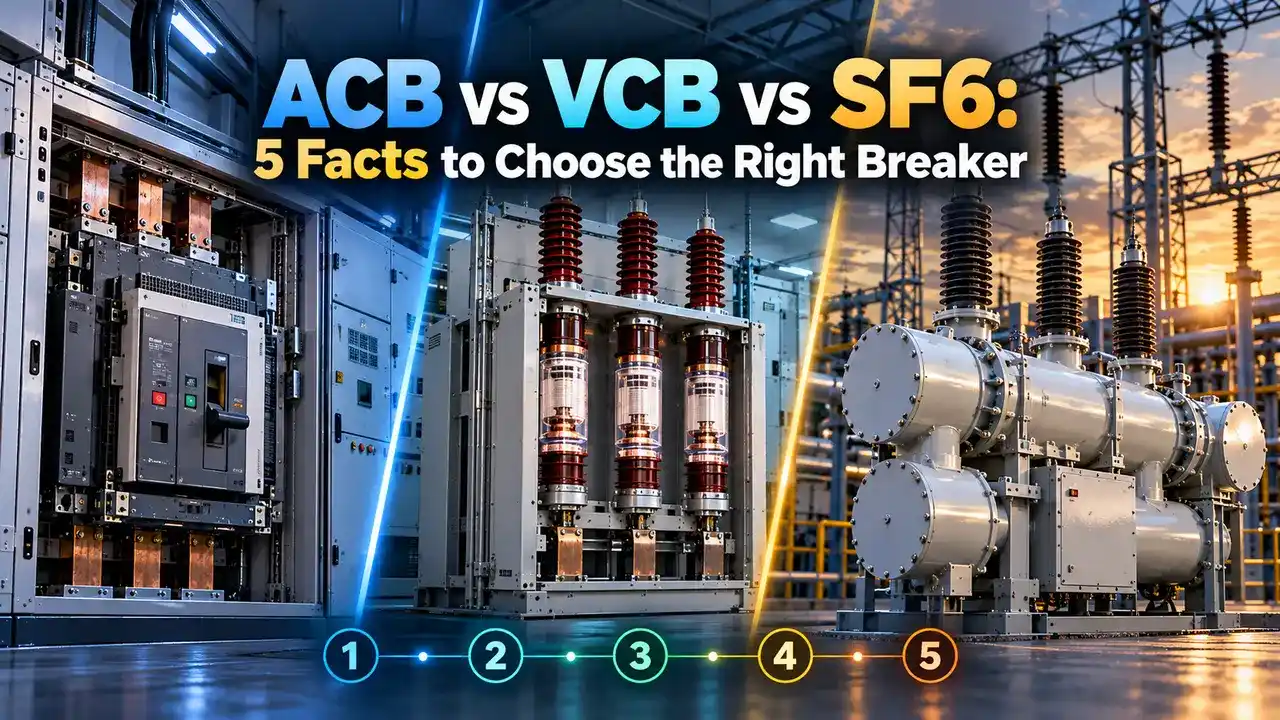
ACB vs VCB vs SF6 Circuit Breaker
Every circuit breaker interrupts current the same basic way, by separating contacts and quenching the resulting arc before it can restrike. The medium used to quench that arc is what actually separates these three types.
An Air Circuit Breaker, ACB, stretches and cools the arc in open air, usually with arc chutes, and dominates low voltage switchboards up to about 1000 volts.
A Vacuum Circuit Breaker, VCB, separates contacts inside a sealed vacuum bottle, where the near total absence of gas extinguishes the arc almost instantly.
An SF6 Circuit Breaker uses sulfur hexafluoride gas, an excellent insulator and arc quencher, making it the standard choice at higher voltages where vacuum bottles become impractical.
None of these three technologies is objectively best across every application. Each one earns its place in a specific voltage band, and choosing the wrong one usually shows up first as excessive maintenance rather than an outright failure.
Cost also scales differently across the three. An ACB is the cheapest option at low voltage, while an SF6 breaker at extra high voltage carries a much higher purchase price justified by the voltage class it serves.
Retrofitting an existing switchgear lineup with a different breaker technology is rarely as simple as swapping one unit for another, since cubicle dimensions and interlocking schemes are often technology specific.
The Three Breaker Types Compared
Arc quenched in open air using arc chutes, typically rated up to 1000 volts and high current levels.
Contacts separate inside a sealed vacuum bottle, giving fast, low maintenance interruption at medium voltage.
Sulfur hexafluoride gas provides excellent dielectric strength and arc quenching at very high voltage.
How Each Medium Quenches the Arc
The mechanical sequence is identical for all three types. Only the medium filling the gap between contacts, and how quickly it can absorb the arc's energy, actually changes.
Interruption speed also differs meaningfully. A vacuum bottle typically clears the arc within a couple of cycles, while an air breaker at low voltage can take noticeably longer to fully extinguish it.
Estimating Required Breaking Capacity
Example:
Fault level = 500 MVA
System voltage = 11 kV
Breaking current = 500 divided by (1.732 × 11)
Breaking current = 500 divided by 19.05 = 26.2 kA
Side by Side Comparison
| Type | Voltage Range | Maintenance |
|---|---|---|
| ACB | Up to 1000 V | Moderate, arc chutes need periodic inspection |
| VCB | 3.3 kV to 36 kV | Low, sealed vacuum bottle rarely needs service |
| SF6 | 36 kV and above | Low, but gas pressure and leaks need monitoring |
Where Each Type Is Typically Used
Common Mistakes When Choosing Between Them
Matching voltage but not breaking capacity: two breakers rated for the same system voltage can still have very different fault current ratings, and skipping that check is a frequent selection error.
Ignoring altitude and ambient temperature derating is another common gap, since a breaker's published rating usually assumes standard conditions that a hot equipment room or a high altitude site may not actually meet.
Vacuum vs SF6, the Environmental Angle
Vacuum Circuit Breaker
Uses no greenhouse gas at all, an increasingly important factor as utilities phase down SF6 use for climate reasons.
SF6 Circuit Breaker
Extremely effective electrically, but SF6 gas is a potent greenhouse gas if it ever leaks into the atmosphere.
Breaking Capacity Calculator
Reference Document
Watch: SF6 vs Vacuum Circuit Breaker, Which Is Better
ACB vs VCB vs SF6 FAQs
Related Articles on This Site
- MCB vs MCCB vs ELCB vs RCCB
- Circuit Breaker Coordination and Selectivity
- Single Line Diagram Symbols and How to Read One
- What Is Arc Flash
- Motor Control Center (MCC) Explained
External References
- Comparison Between Vacuum and SF6 Circuit Breaker, Electrical Engineering Portal
- Sulfur Hexafluoride Circuit Breaker, Wikipedia
What We Learn Today
- ACB, VCB, and SF6 breakers differ mainly in the medium used to quench the switching arc.
- Voltage range moves from ACB at low voltage up to SF6 at extra high voltage.
- Vacuum technology is gradually displacing SF6 wherever ratings allow, mainly for environmental reasons.