An orifice plate in your line keeps costing pump power for every hour it runs. Here you will calculate that unrecovered loss, convert it into rupees per year and see which meters waste less energy.
Permanent pressure loss is the part of a flow meter differential that never comes back downstream, and the pump pays for it every hour. Below are the ISO 5167 relation, typical figures for each meter type, a calculator and a worked energy cost example.
What is permanent pressure loss in a DP flow meter and how big is it?
Permanent pressure loss is the part of the measured differential pressure that is not recovered downstream of a flow element. For a sharp edged orifice, ISO 5167 gives loss ≈ DP × (1 minus β1.9), so 40 to 95 percent of DP is lost. Example: an orifice with β 0.6 and DP 250 mbar loses about 158 mbar, while a venturi typically loses only 5 to 20 percent.
What Is Permanent Pressure Loss?
Permanent pressure loss is the drop in line pressure that remains after the flow has passed a flow element and the pressure has recovered as far as it can. It is smaller than the differential pressure you read on the transmitter, and it decides how much extra pump energy the meter uses.
- ISO 5167 Part 2 gives the orifice loss as a function of beta ratio and discharge coefficient C.
- ABB lists 40 to 95 percent of DP for orifice plates and flow nozzles, depending on d/D.
- Venturi tubes recover most of the DP and typically lose 5 to 20 percent of it.
- Pump input power for the loss = Q × loss ÷ pump and motor efficiency.
The measured DP sits between the two tappings and the deepest drop is at the vena contracta. The permanent pressure loss is what remains about six pipe diameters downstream, once the jet has spread back to the wall.
Our orifice plate vs venturi tube guide calls the orifice a high loss meter, and here we put numbers on it. We assume you know the basics of orifice plate flow measurement already.
The orifice loss curve depends mainly on beta ratio and not on the fluid. The same β 0.6 plate loses about 63 percent of its DP whether it measures water, steam or natural gas, as long as the flow is turbulent.
Why Does an Orifice Plate Lose Pressure Permanently?
An orifice plate loses pressure permanently because the fast jet leaving the bore breaks up into eddies, and that turbulent mixing turns kinetic energy into heat. Only a gradual cone, like the venturi outlet, slows the fluid gently enough to turn that energy back into static pressure.
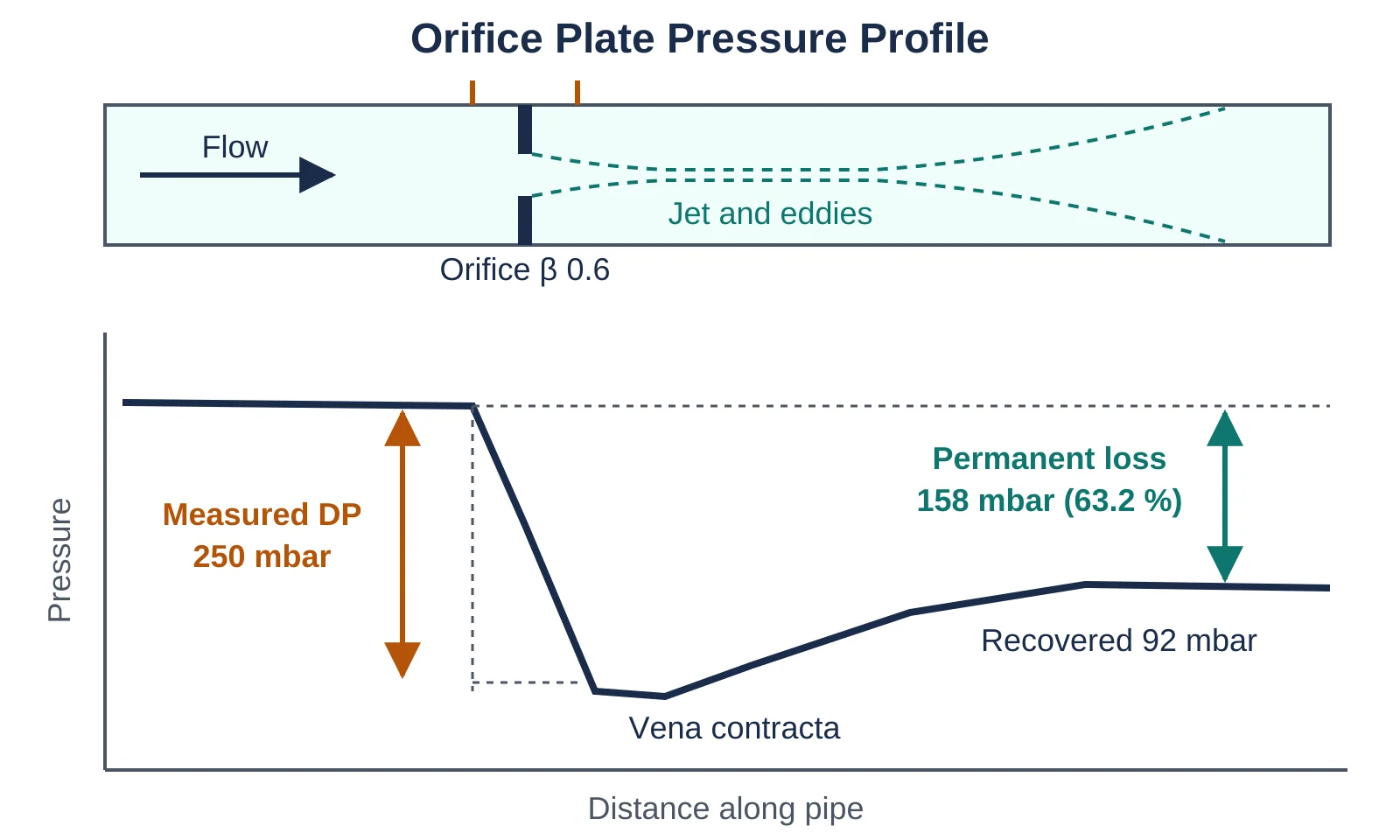
Downstream, the jet expands suddenly into the full pipe. A sudden expansion is the worst case for recovery, which is why a square edged plate wastes much more energy than a venturi tube flow meter with its 7 to 15 degree outlet cone.
The location of the downstream tap changes the measured DP but not the true loss. Read our note on pressure tappings in orifice plate before you compare figures from two vendors.
Permanent Pressure Loss Formula from ISO 5167
The ISO 5167 Part 2 equation calculates the permanent pressure loss of a sharp edged orifice from beta ratio β and discharge coefficient C. It applies to corner, flange and D and D/2 tappings, and a simple power law version is fine for field estimates.
S = √(1 minus β⁴ (1 minus C²))
Δϖ = DP × (S minus Cβ²) ÷ (S + Cβ²)
Quick estimate: Δϖ ≈ DP × (1 minus β1.9)
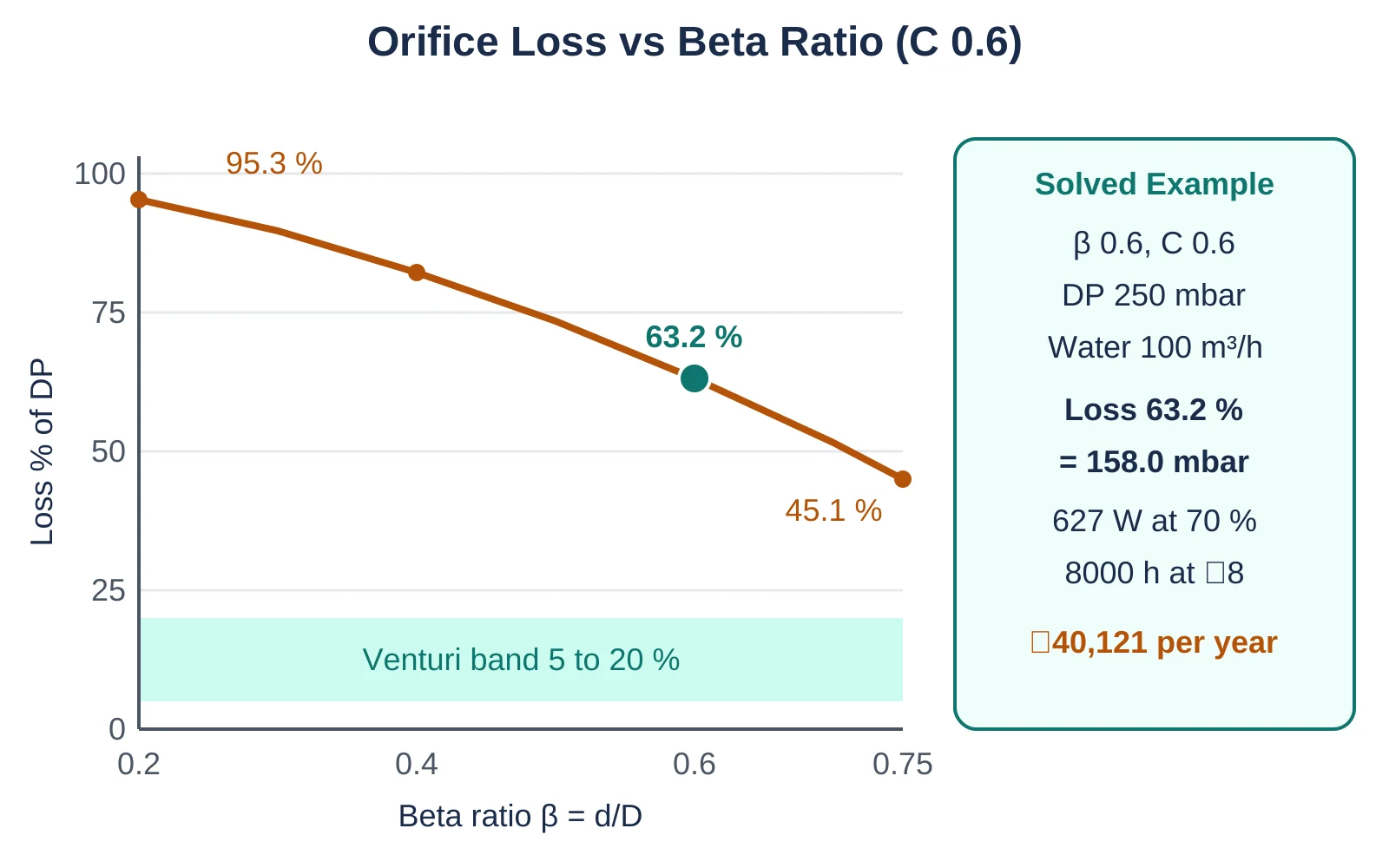
Here β is the bore diameter divided by pipe internal diameter, which you can work out with our orifice beta ratio calculation guide. For a standard plate C sits close to 0.6, so the loss fraction changes mostly with β.
| Beta ratio β | Exact (C 0.6) | 1 minus β1.9 |
|---|---|---|
| 0.20 | 95.3 % | 95.3 % |
| 0.40 | 82.3 % | 82.5 % |
| 0.50 | 73.4 % | 73.2 % |
| 0.60 | 63.2 % | 62.1 % |
| 0.75 | 45.1 % | 42.1 % |
The table matches published data. Engineering ToolBox quotes a head loss of about 70 to 75 percent of the differential for a ratio of 0.5, and the ABB data sheet gives 40 to 95 percent across the usual d/D range.
How to Calculate Pressure Loss Across an Orifice Plate?
To calculate pressure loss across an orifice plate, take the DP at maximum flow from the sizing sheet, find the loss fraction from β and C, and multiply. You then convert that loss into pump power and money with the flow rate, efficiency, running hours and tariff.
S = √(1 minus 0.1296 × 0.64) = 0.95763
Fraction = 0.74163 ÷ 1.17363 = 0.632
Loss = 0.632 × 250 = 158.0 mbar = 15,798 Pa
Q = 100 m³/h = 0.02778 m³/s
Power = 0.02778 × 15,798 ÷ 0.70 = 627 W
Energy = 0.627 × 8000 h = 5,015 kWh
Cost = 5,015 × ₹8 = ₹40,121 per year
So one modest orifice on a 100 m³/h cooling water line costs about forty thousand rupees a year. A venturi at the same 250 mbar DP with a 10 percent permanent pressure loss wastes only 25 mbar, about 99 W or ₹6,349 a year.
For a venturi or full bore meter, use the vendor loss figure instead. The flow measurement formulas and calculators page helps if you must back calculate the DP first.
Pressure Loss in Venturi vs Orifice vs Nozzle
A venturi tube has the lowest loss of the three classic DP elements, typically 5 to 20 percent of DP, while orifice plates and flow nozzles both fall in the 40 to 95 percent range. The nozzle generates less DP than an orifice at the same flow and β, so its loss in mbar is usually lower even though the percentage band is similar.
| Meter type | Typical loss | What drives it |
|---|---|---|
| Sharp edged orifice | 40 to 95 % of DP | β ratio, sudden expansion |
| ISA 1932 flow nozzle | 40 to 95 % of DP | β ratio, no outlet cone |
| Classical venturi | 5 to 20 % of DP | Outlet cone angle and length |
| V cone, wedge, averaging pitot | Lower than orifice | Shape, blockage, vendor data |
| Magnetic, ultrasonic | Near zero | Full bore, only pipe friction |
For a deeper side by side review of the three classic elements, see flow nozzle vs orifice plate vs venturi. If your line is clean and conductive, an electromagnetic flow meter removes the obstruction loss almost completely.
- Lower pump head on continuous duty lines saves energy every hour.
- Less flashing and cavitation risk just downstream of the element.
- More pressure left for control valves and process equipment.
- A venturi is longer, heavier and costs several times more than a plate.
- Changing range means a new body, not just a new bore.
- Full bore meters need power, grounding and liquid conductivity or clean signals.
ISO 5167 Part 4 covers classical venturi tubes and gives their loss as roughly 5 to 20 percent of DP. The ABB data sheet quotes 5 to 12 percent of differential head for its own venturi range, which sits inside that band.
What Does Permanent Pressure Loss Cost in Pumping Energy?
Permanent pressure loss costs pumping energy equal to flow rate times the loss, divided by the pump and motor efficiency, for every hour the line runs. Across a plant with dozens of continuous duty meters, this adds up to lakhs of rupees.
The formula is the same one you use for hydraulic power, so you can check it against our electrical energy consumption calculation notes. You can also cross check the motor side with the pump power calculator on our sister site.
The meter loss also adds to the line friction you calculate when you calculate pressure drop in pipes for pump selection. On a centrifugal pump with a flat curve, a few hundred mbar of extra head can cut the delivered flow.
How to Select a Low Pressure Loss Flow Meter?
Start by calculating the yearly cost of the orifice option, then compare it with the extra purchase and installation cost of a venturi, V cone or full bore meter. If payback is short and the fluid suits the alternative, the low loss meter wins.
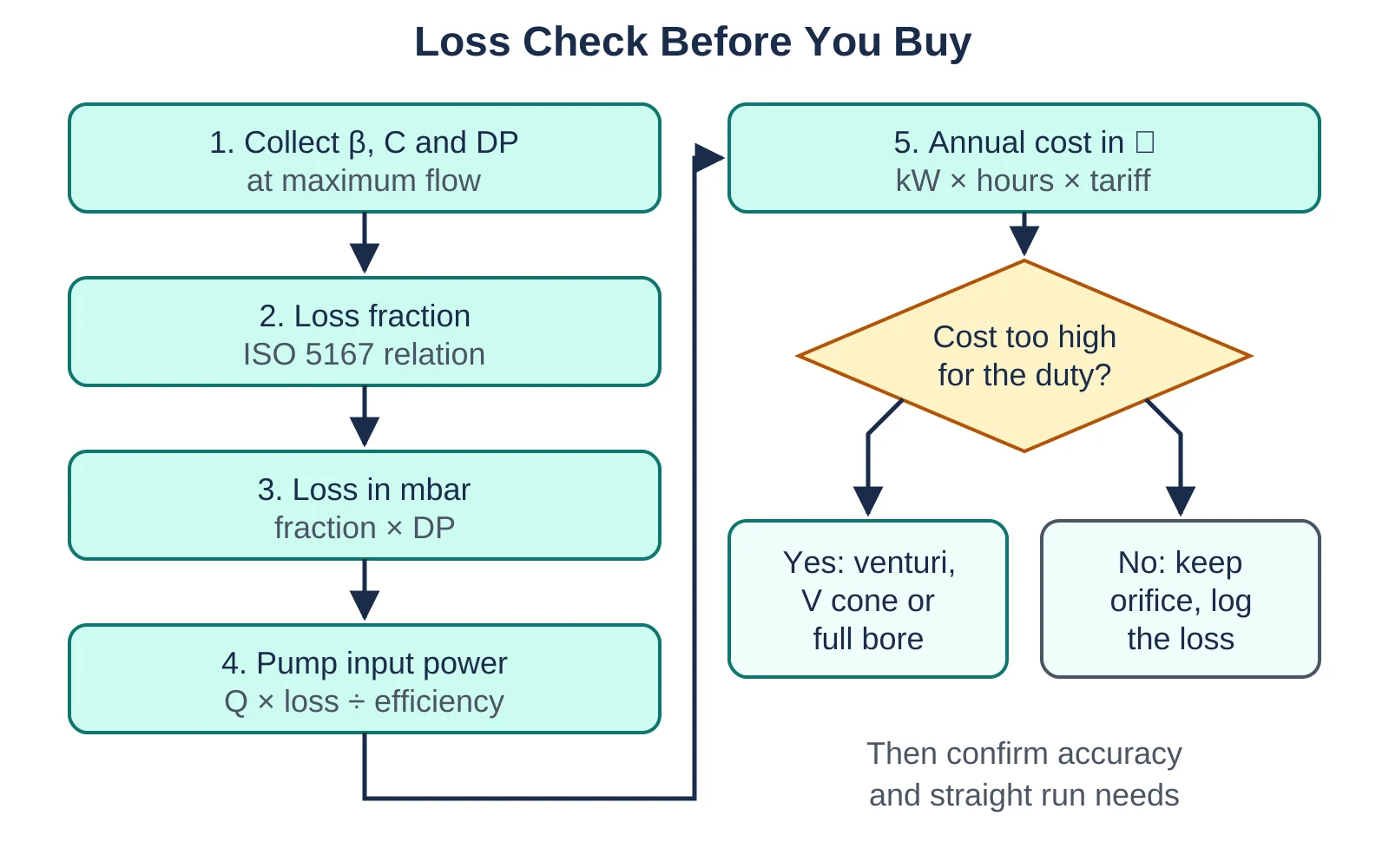
Cost is only one input, because accuracy, turndown ratio, straight run, fluid properties and maintenance all still matter, as our flow meter selection guide explains.
Raising the DP range to improve turndown also raises the loss in mbar in direct proportion. Choose the lowest DP range that still gives good resolution with your square root extraction setup.
Field Mistakes When You Estimate Unrecovered Pressure Loss
The most common field mistake is to take the transmitter DP as the line loss, which overstates the energy cost of an orifice by about 1.5 times at β 0.6. Other errors come from using design DP instead of real operating DP, or from ignoring a dirty or damaged plate.
| Symptom | Likely cause | Check or fix |
|---|---|---|
| Pump runs at end of curve after meter install | DP range too high for available head | Recalculate loss, resize to lower DP or larger β |
| Downstream gauge drops slowly over months | Deposits on plate or upstream face | Inspect and clean, check plate edge |
| Cavitation noise just after the plate | Low back pressure at vena contracta | Raise back pressure or use a venturi |
You will find more traps of this kind in our list of mistakes in DP flow measurement. The ABB data sheet below compares the loss of orifice, nozzle, venturi and wedge elements.
Endress+Hauser explains the DP principle for orifice, nozzle and venturi in this short video. Watch how differently the pressure recovers behind each element.
Permanent Pressure Loss FAQ
Differential pressure is read between the two tappings, while the unrecovered loss is measured far downstream after recovery. For a β 0.6 orifice with 250 mbar DP, about 158 mbar is lost for good and the other 92 mbar comes back as static pressure.
Find S = √(1 minus β⁴(1 minus C²)), then divide (S minus Cβ²) by (S + Cβ²) and multiply by DP. With β 0.6, C 0.6 and 250 mbar you get 0.632 × 250, which is 158 mbar of unrecovered loss.
Full bore magnetic and ultrasonic meters have almost no obstruction loss, only normal pipe friction. Among DP elements the venturi is lowest at about 5 to 20 percent of DP, compared with 40 to 95 percent for a sharp edged orifice plate.
Cost equals flow times loss divided by efficiency, multiplied by hours and tariff. A 100 m³/h water line with 158 mbar loss, 70 percent efficiency, 8000 hours and ₹8 per kWh costs about ₹40,121 a year in extra pump power.
The venturi outlet cone slows the fluid gradually, so most kinetic energy turns back into static pressure. An orifice ends in a sudden expansion where eddies turn that energy into heat, so far less pressure is recovered downstream of the plate.
The most common mistake is to take the full transmitter DP as the line loss. At β 0.6 that overstates the loss by about 58 percent, so the pump head and energy cost both look higher than they really are.
Related Articles
- Orifice Plate vs Venturi Tube
- Flow Nozzle vs Orifice Plate vs Venturi
- Orifice Beta Ratio Calculation
- Orifice Plate Sizing Guide
- V Cone Flow Meter Working Principle
External References
- ABB: Differential Pressure Flow Elements Data Sheet (PDF)
- Engineering ToolBox: Orifice, Nozzle and Venturi Flow Rate Meters
- Wikipedia: Orifice plate
What We Learn Today
- Permanent pressure loss is the unrecovered part of a flow meter DP, and for a sharp edged orifice it ranges from about 40 to 95 percent.
- The ISO 5167 relation uses beta ratio and discharge coefficient, and a β 0.6 orifice at 250 mbar DP loses about 158 mbar for good.
- Converting loss to pump power and rupees per year shows when a venturi, V cone or full bore meter pays back its higher price.