
Rubber gloves are the last barrier between an electrician and a live conductor, so the right class and a clean test record matter every single day. This guide explains the six glove classes, the field air test, retest rules, protectors and storage in plain language.
Electrical insulating gloves are graded into six classes by the highest voltage they can safely handle. Choosing the right class, testing before every use and storing them properly keeps electricians alive.
What Are Insulating Gloves?
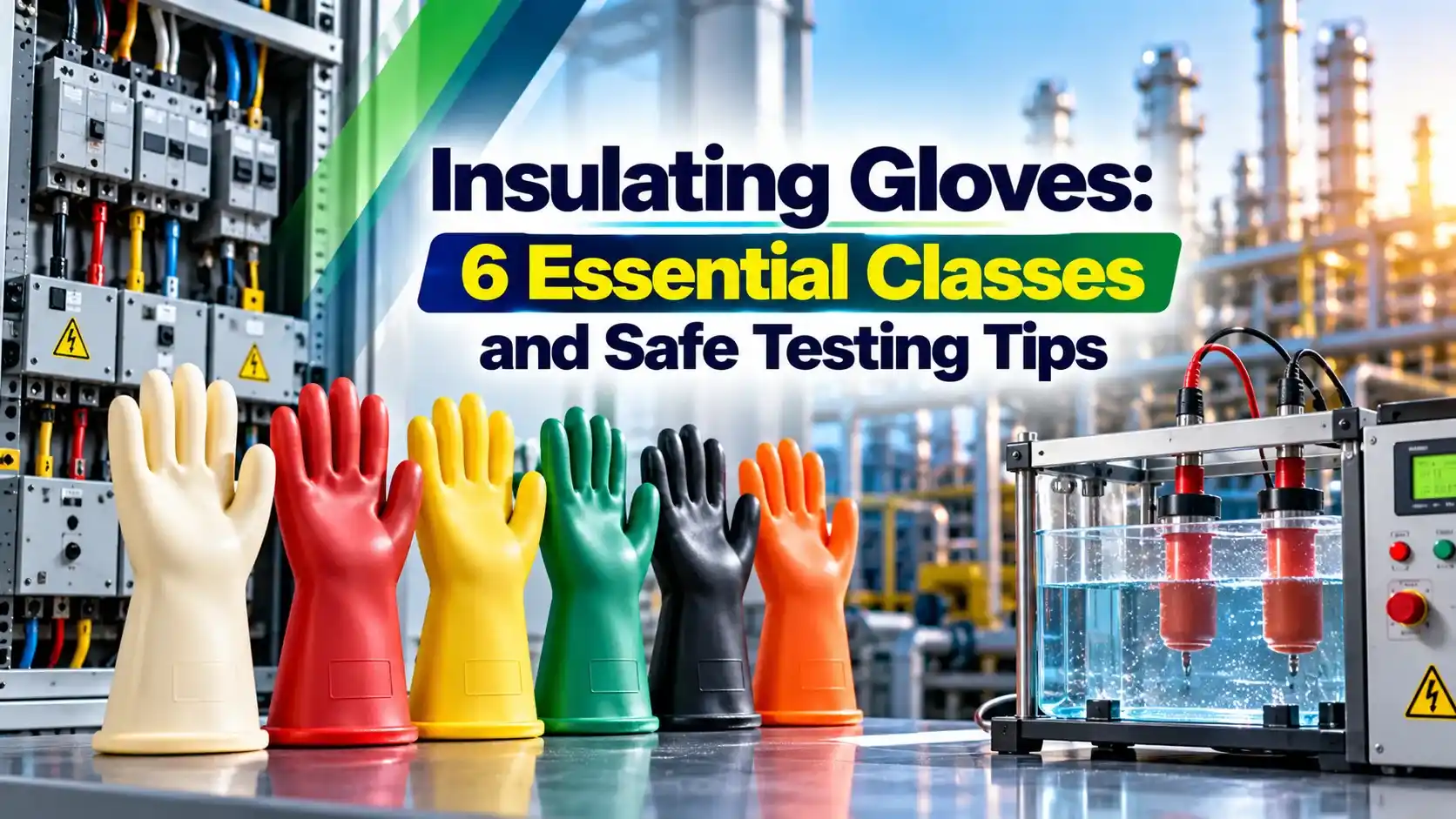
Insulating gloves are rubber gloves made from natural or synthetic elastomer that are tested to withstand a specified voltage, so a worker can touch or work near energised parts without current flowing through the body. They are the core item in any electrical safety PPE kit for live work, switching and testing.
A shock happens when the body completes a circuit between a live part and earth or another phase. As explained in electrical shock causes and prevention, even a few tens of milliamps across the chest can stop the heart, so the glove has to block that path completely.

The international standard is IEC 60903, adopted in Europe as EN 60903, while North America uses ASTM D120 for the glove itself and OSHA 1910.137 for care and use. In India, IS 4770 covers rubber gloves for electrical purposes, and many utilities now specify IEC 60903 gloves directly.
The 6 Insulating Gloves Classes and Voltage Ratings
| Class | Label Colour | Max Use AC | Max Use DC | Proof Test AC |
|---|---|---|---|---|
| 00 | Beige | 500 V | 750 V | 2.5 kV |
| 0 | Red | 1000 V | 1500 V | 5 kV |
| 1 | White | 7500 V | 11250 V | 10 kV |
| 2 | Yellow | 17000 V | 25500 V | 20 kV |
| 3 | Green | 26500 V | 39750 V | 30 kV |
| 4 | Orange | 36000 V | 54000 V | 40 kV |
Power and Cables, a UK cable accessories supplier, lists class 0 gloves at 1000 V AC and 1500 V DC, rising to 36000 V AC and 54000 V DC for class 4. It also notes that class 4 gloves are made longer, about 410 mm against 360 mm for the lower classes, to protect more of the forearm.
Thin gloves for low voltage panels and MCCs up to 1000 V AC.
Thicker gloves for systems up to 7500 V AC.
Heavy gloves for 11 kV and 22 kV distribution.
Thickest and longest gloves, rated up to 36000 V AC.
The proof test voltage of every class is higher than its maximum use voltage, for example 20 kV for a class 2 glove rated 17 kV. That gap is the built in safety margin, not extra capacity you can use.
Never pick insulating gloves by nominal voltage alone. Consider the phase to phase voltage a hand could bridge, induced voltages and the touch hazards described in step and touch voltage studies.
How to Select Insulating Gloves for a Job
IEC 60903 adds category letters: A for acid, H for oil, Z for ozone, R for all three and C for extreme cold. Insulating gloves for coastal substations or chemical plants often carry the R category.
Write the voltage of the panel on the permit and compare it with the class printed on the glove cuff before you start. If the numbers do not clearly match, stop and get the correct pair.
Insulating gloves are only one layer of protection. They do not stop an arc flash burn, so arc rated clothing and face shields chosen from an arc flash boundary calculation are still needed for the same task.
Insulating Gloves Class Selector Formula
The selection rule is simple: find the lowest class whose maximum use voltage is greater than or equal to the highest voltage that can be touched. For DC systems such as battery rooms and solar strings, use the DC column instead of the AC column.
AC limits: 500, 1000, 7500, 17000, 26500, 36000 V
DC limits: 750, 1500, 11250, 25500, 39750, 54000 V
Example 1, 11 kV AC feeder:
11000 V is above 7500 V and below 17000 V
Use Class 2, rated 17000 V AC, proof tested at 20 kV
Example 2, 1100 V DC solar string:
1100 V is above 750 V and below 1500 V
Use Class 0, rated 1500 V DC
Insulating Gloves Class Calculator
Air Inflation Test Before Every Use
A pinhole too small to see can still let current through, so insulating gloves must be checked by the wearer before each use. The simplest field check is the air inflation test, required by OSHA 1910.137 along with a visual inspection.
Look also for ozone cutting, seen as fine parallel cracks, and for chemical swelling. These defects reduce the insulation in the same way that ageing lowers the reading in an insulation resistance test of a cable.
- Class label and size are readable on the cuff.
- Last electrical test date is within the allowed period.
- No cuts, holes, tears, cracks or punctures.
- No swelling, stickiness or ozone cracks.
- Air inflation test passed with no leaks.
- Leather protectors are clean and free of metal particles.
Periodic Electrical Retest of Insulating Gloves
Apart from the daily air test, insulating gloves must go back to a laboratory for a dielectric test at regular intervals. OSHA 1910.137 requires gloves to be tested before first issue and every 6 months after that, and they may not be issued if they have not been tested within the previous 12 months.
A guidance note published by Safetec Direct on re testing states that classes 1 to 4 should not be used unless tested within a maximum of six months. It adds that many users test every 30 to 90 days, while for classes 00 and 0 an air check and visual inspection are often considered adequate.
Power and Cables quotes the policy of SP Energy Networks, a UK utility, which replaces gloves at 6 monthly intervals. That policy also allows a maximum of 12 months storage from the manufacturer test date before first use.
IEC 60903 does not print an expiry date on gloves. A glove remains usable as long as it keeps passing visual checks, air tests and the periodic electrical retest.
Keep a register with the serial number, class and retest date of all insulating gloves. Many plants tie this register to their lockout tagout procedure so that no isolation is signed off with an untested pair.
Leather Protectors and Correct Wearing
Rubber is easily cut by wire ends and tools, so leather protectors are worn over insulating gloves. The leather takes the mechanical damage while the rubber insulates.
Protectors must be shorter than the rubber glove, leaving a clear gap of rubber at the cuff so that the leather cannot form a conductive bridge. Never use protectors on their own, and never wear the rubber glove inside out or with rings and watches underneath.
Keep each pair of leather protectors with its own rubber gloves and inspect the leather for metal chips, oil and holes. A steel splinter in the leather can puncture the rubber the moment you grip a tool.
Storage and Care of Electrical Gloves
Sunlight, heat, ozone, oil and folds all attack rubber, so storage directly affects the life of insulating gloves. Keep them in their bag, cuff down, in a cool, dark cupboard away from motors and welding sets that produce ozone.
Never fold insulating gloves or keep them in a tool bag with pliers. Wash them with mild soap, dry them naturally and dust the inside lightly with talc.
In substations, store gloves inside the control building rather than in the switchyard kiosk where heat and humidity are high. Good housekeeping like this is part of the wider NFPA 70E electrical safety approach to PPE care.
Common Mistakes With Insulating Gloves
The safest choice is always to isolate, prove dead and apply local earths, as described in earthing in industrial plants. Insulating gloves then become an extra layer, not the only one.
- Direct protection of the hands, the most exposed body part.
- Clear class system makes selection simple.
- Reusable for years with proper testing and care.
- Low cost compared with an injury or fatality.
- Reduced dexterity, especially in classes 2 to 4.
- Easily damaged by cuts, ozone, oil and heat.
- Need regular laboratory retests and records.
- No protection against arc flash burns on their own.
Where Electrical Gloves Are Used
Gloves are worn for racking breakers, operating isolators, voltage testing and fitting temporary earths. They are used in in GIS and AIS substations, MCC rooms, battery rooms, solar plants and EV charging stations.
Before using gloves in an unfamiliar system, check how it is earthed. A worker on an unearthed or high resistance earthed network, described in TN, TT and IT earthing systems, may face full line voltage to earth during a first fault.
Safetec Guidance on Glove Retesting
How to Inspect Electrical Gloves Video
Insulating Gloves FAQ
They are rubber gloves tested to withstand a stated voltage so the wearer can work on or near live parts safely. Each pair carries a class marking from 00 to 4 on the cuff.
The class tells you the maximum use voltage for that glove in volts. They are covered by IEC 60903, ASTM D120 and, in India, by IS 4770 for electrical rubber gloves.
For an 11 kV system, choose class 2 gloves, which are rated for a maximum use voltage of 17000 volts. Class 1 gloves stop at 7500 volts, so they are far too low for this job.
Class 2 gloves are proof tested at 20 kV in the laboratory before they are issued. Always wear them with leather protectors and follow the permit to work system.
OSHA 1910.137 requires testing before first issue and then at intervals of no more than 6 months. Gloves that have not been tested within the previous 12 months must not be issued to anyone.
Many utilities test more often, every 30 to 90 days, because their crews do frequent live work. Classes 00 and 0 are often checked by air test and visual inspection only.
Roll the cuff tightly towards the fingers to trap air inside the glove and make it swell slightly. Then squeeze it gently and listen and look carefully for any leak.
Repeat the check on every finger and in the crotch between the fingers, where pinholes often hide. Any leak, crack or soft spot means the glove must be removed from service at once.
Rubber cuts easily on wire ends, sharp edges, lugs and hand tools during normal work. Leather protectors take this mechanical wear so the rubber layer stays intact and leak free.
Protectors must be shorter than the rubber glove to keep a clear rubber gap at the cuff. They must never be used alone as electrical protection, because leather has no voltage rating.
No, rubber gloves are designed for shock protection and not for the intense heat of an electric arc. An arc can melt or burn the rubber within a fraction of a second.
Arc rated clothing, a face shield and leather protectors are chosen separately for that hazard. The incident energy study for the panel sets the arc rating needed for each task.
Store them in their own bag, cuff down, in a cool, dry and dark place inside the building. Keep them away from sunlight, ozone, oil, solvents and sharp objects.
Never fold or crush them and never store them turned inside out. Wash dirty gloves with mild soap, let them dry naturally and dust the inside lightly with talc.
Related Articles
- Electrical Safety PPE Selection Guide
- What Is Arc Flash
- Lockout Tagout LOTO Explained
- Electrical Shock Causes, Effects and Prevention
- NFPA 70E Electrical Safety Explained
External References
- Periodic Re testing and Shelf Life of Insulating Gloves, Safetec Direct
- IEC 60903 Gloves, Power and Cables
- Personal Protective Equipment, Wikipedia
What We Learn Today
- Insulating gloves come in six classes, from class 00 rated 500 V AC up to class 4 rated 36000 V AC, under IEC 60903 and ASTM D120.
- Every glove needs a visual check and air inflation test before each use, plus a laboratory electrical retest at intervals of no more than six months.
- Leather protectors, correct storage away from sunlight and ozone, and a proper test register keep rubber gloves safe and reliable for years of field work.