
Electrical shock is responsible for hundreds of workplace deaths every year, yet most of these fatalities involve voltages that engineers and technicians consider routine: 230V single-phase supplies, 415V three-phase panels, and 110V site supplies.
This guide covers exactly how electrical shock happens at the physics level, what it does to the human body at each current threshold, the five most important prevention measures, and a live body current calculator based on IEC 60479-1.
Electrical shock occurs when current flows through the human body along a path from a live conductor to earth or to another conductor at a different potential. The severity depends on the magnitude of that current, not the voltage alone.
A voltage of 50V through wet skin in a damp environment can deliver a fatal current. A voltage of 10,000V through dry insulating gloves delivers none. The voltage matters only because it determines how much current flows through a given body resistance.
Why Electrical Shock Kills at Ordinary Plant Voltages
Most engineers instinctively respect high voltage installations above 1000V. The real danger in process plants is the 230V and 415V equipment that people interact with daily, treat as familiar, and sometimes work on without the same level of caution.
At 230V through wet skin with a body resistance of around 1000 ohms, the current through the body is 230 milliamps. That is nearly eight times the level at which ventricular fibrillation becomes highly likely per IEC 60479-1.
The shock duration determines survival. An unprotected 230V circuit takes seconds to trip a standard MCB, which is far too long. An RCD set at 30 mA trips in under 30 milliseconds, which is fast enough to prevent fibrillation in most cases.
Understanding the three elements of electrical shock (the voltage source, the current path through the body, and the return path to earth) helps engineers identify where protection can be added.
Removing any one of the three breaks the shock circuit completely. This is the basis of every electrical safety standard from IEC 60364 to OSHA 1910.303.
Main Causes of Electrical Shock in Industrial and Domestic Settings
Direct Contact with Live Parts
Touching a bare conductor, an exposed terminal, or damaged insulation that has allowed the live conductor to become accessible. The most common cause in both domestic and industrial environments. Prevented by insulation, guarding, and isolation before work.
Indirect Contact via Faulty Equipment
A fault inside equipment connects the live conductor to the metal casing. The casing becomes live. Anyone touching the casing while standing on earth completes the circuit. Prevented by earthing, equipotential bonding, and RCD protection.
Step Voltage near a Ground Fault
When high current flows into the ground from a fault or lightning strike, the ground surface develops a voltage gradient. A person with feet at different distances from the fault has a voltage across their legs.
This drives current through the lower body. The risk is especially high near substation earthing grids and lightning strike points.
Induced Voltage from Parallel Lines
Telecommunications cables, control cables, and de energized power cables running parallel to live lines can carry an induced voltage from electromagnetic coupling. Working on a de energized cable without verifying it is discharged to earth is a common cause of shock in cable maintenance work.
How Electrical Current Affects the Human Body: IEC 60479-1 Thresholds
The human body is not a uniform conductor. Skin resistance varies from 1,000 ohms when wet to over 100,000 ohms when completely dry.
Internal body resistance hand to hand through the chest is approximately 300 to 500 ohms regardless of skin condition. Once the skin is punctured or burned through, only internal resistance limits the current.
IEC 60479-1 defines four body current zones based on the physiological effects of AC current at 50 to 60 Hz:
| Current Level | IEC 60479-1 Zone | Physiological Effect | Risk |
|---|---|---|---|
| Below 0.5 mA | Zone 1 | No perceptible effect | None |
| 0.5 mA to 10 mA | Zone 2 | Perception, tingling, no harmful effect. At 5 to 10 mA some people cannot voluntarily release their grip (let go threshold) | Low |
| 10 mA to 30 mA | Zone 3 | Muscle contractions, breathing difficulty, reversible effects if current is quickly interrupted | Moderate |
| 30 mA to 300 mA | Zone 4 boundary | Ventricular fibrillation becomes possible above 30 mA. Probability increases rapidly above 80 mA. Burns begin. | High |
| Above 300 mA | Zone 4 | Ventricular fibrillation very likely, cardiac arrest, severe burns, death without immediate CPR and defibrillation | Fatal |
Burns deserve equal attention alongside fibrillation. Entry and exit burns occur where current enters and leaves the body. A 230 mA current through the hand to foot path delivers significant thermal energy.
Internal burns along the current path, including nerve and muscle damage, can worsen for days after the shock even when the victim appears stable.
Body Resistance and Why Skin Condition Changes Everything
The shock current is determined by the circuit voltage divided by the total circuit resistance, which includes the body. Body resistance is not a fixed value. It varies by several orders of magnitude depending on skin condition, contact area, and contact pressure.
This explains why electrical work in damp or wet environments such as pump rooms or outdoor switchgear in rain is so much more dangerous than the same work in a dry control room.
The IEC 60364 safe voltage limit for wet locations is 25V AC or 60V DC, compared to 50V AC in dry areas.
Body Shock Current Calculator
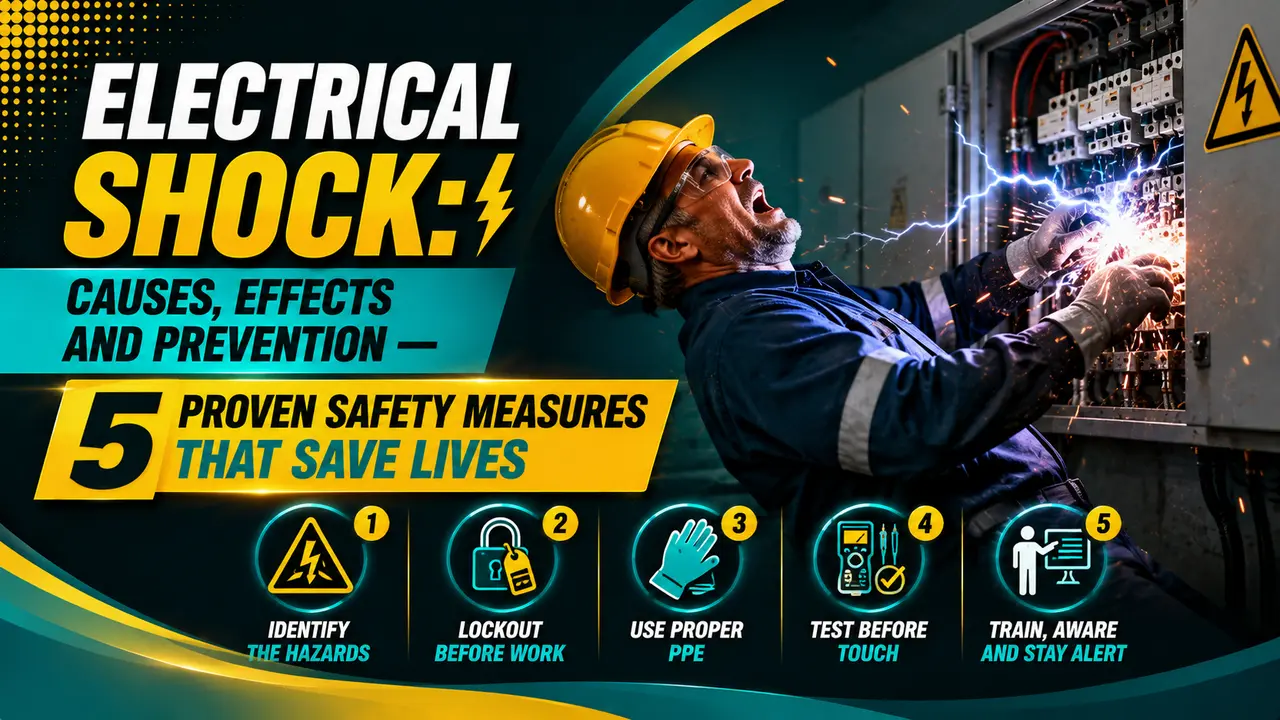
5 Proven Electrical Shock Prevention Measures
What to Do and What Not to Do Around Electrical Hazards
✅ Safe Practice
- Isolate, lockout, and verify dead before working on any electrical circuit
- Use a calibrated voltage indicator on every conductor including neutral before touching
- Install 30 mA RCDs on all socket outlets and portable equipment supplies
- Maintain earthing resistance below 1 ohm for TN systems and test annually
- Wear IEC 60900 rated gloves when live working is unavoidable under a permit
- Report damaged cables, cracked insulation, and missing earth pins immediately
❌ Dangerous Behaviour
- Working on live equipment without a live work permit and risk assessment
- Assuming a circuit is dead because a switch is off; always test with a voltage indicator
- Bypassing or removing the earth conductor to stop nuisance trips
- Using a standard MCB as the only protection against shock (MCBs do not trip at 30 mA)
- Working in wet or damp conditions without reviewing the safe touch voltage limit (25V AC)
- Standing on wet ground while working on electrical equipment without insulating matting
Watch: Principles and Prevention of Electrical Shock
Electrical Shock Questions Engineers and Technicians Ask
External References
What We Learn Today
- Electrical shock occurs when current flows through the body; severity depends on current magnitude, not voltage alone
- IEC 60479-1 zones: below 0.5 mA safe, 10 mA causes muscle lock, 30 mA risks fibrillation, above 300 mA is likely fatal
- Body resistance varies from 350 Ω (wet or burned skin) to 100,000 Ω (dry small contact); wet conditions are far more dangerous
- An RCD trips at 30 mA in under 30 ms; an MCB does not protect against shock. Both are required together.
- Safe touch voltage limits: 50V AC in dry locations, 25V AC in wet locations per IEC 60364
- The 5 key prevention measures: earthing, RCD protection, isolation and lockout before work, insulated PPE, and correct circuit protection
- Never touch a shock victim until the power is confirmed off. Always seek medical evaluation even after minor shocks due to delayed arrhythmia risk