
The mixer grinder in an Indian kitchen and the drill in a workshop share the same small, fast and powerful machine. It runs on AC or DC, reaches very high speed and packs a lot of power into a light body.
A universal motor is a series wound commutator motor that runs on both AC and DC supplies. Its high speed and high starting torque make it the heart of mixers, drills, vacuum cleaners and many other portable appliances.
What Is a Universal Motor?
A universal motor is a series wound commutator motor that can run on either AC or DC supply at about the same rated voltage. Its field winding and armature are connected in series, exactly like the series motor described in DC motor types, series, shunt and compound.
The name comes from this ability to work on both kinds of supply. In practice almost every one you meet today runs from the 230 V single phase AC mains, inside a household or workshop appliance.
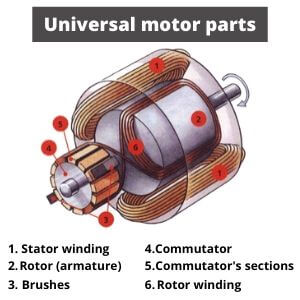
The diagram shows the universal motor stator with its field coils, the rotating armature, the commutator on the shaft and the carbon brushes pressing on it. Every part has a clear job, and knowing them makes fault finding much easier.
6 Essential Parts of a Universal Motor
The stator must be laminated because, on AC, its flux reverses 100 times every second on a 50 Hz supply. A solid iron stator, which is acceptable in many DC machines, would overheat from eddy currents.
Insulation on the windings must survive heat from high current density and fast speed. Appliance makers choose the insulation class with the same thinking explained in motor insulation classes.
A series motor on AC develops torque in the same direction during both half cycles. Field and armature currents reverse together, so their product, and hence the torque, stays positive.
How a Universal Motor Works on AC and DC
Current flows through the field winding and then through the armature via the brushes and commutator. The armature conductors sit in the field flux, so each one feels a force, and the commutator keeps that force turning the rotor in one direction, just as in any brushed DC machine.
On AC, both the field current and the armature current reverse every half cycle at the same instant, because they are the same series current. Torque is proportional to flux times armature current, so it is roughly proportional to current squared and always acts in one direction.
Back EMF: Eb = V minus I × (Ra + Rf) on DC
Speed: N ∝ Eb ÷ Φ
At light load, I is small, Φ is small and speed rises sharply
The rotating armature generates a back EMF that opposes the supply, as explained in AC motors, generators and back EMF. Because the field weakens when load current falls, the motor speeds up a lot at light load.
Electrical Easy points out that the same motor runs slower on AC than on DC at the same voltage. On AC the windings also have reactance, so part of the supply voltage is lost across that reactance and less is left to drive speed.
Never run a large universal motor completely unloaded for long periods. Its no load speed can climb high enough to damage bearings and throw commutator segments.
Speed and Torque Characteristics
NXP, in application note AN4609, says these motors work from about 1000 to 15000 rpm and are used in vacuum cleaners, washers, hand tools and food processors. Eltra Trade reports speeds up to 20000 rpm and efficiency of roughly 55 to 80 percent, depending on design and supply.
Eltra Trade also notes that a universal motor can deliver about twice the output of an induction motor of the same size. That is because it is not tied to the 3000 rpm synchronous limit of a 2 pole machine on 50 Hz, and power rises with speed.
The speed and torque curve is steep, like a DC series motor, and very different from a synchronous motor. Torque is very high at start and at low speed, and falls as speed rises, which suits tools that must push through a hard load and then spin freely.
Uncompensated and Compensated Types
Salient poles with concentrated field coils, simple and cheap.
Distributed field with a compensating winding that cancels armature reaction.
Field coil with taps selected by a switch for two or three speeds.
In the uncompensated type, armature reaction and winding reactance cause more sparking and lower performance on AC. The compensated type adds a winding that opposes armature flux, which reduces reactance and improves commutation at higher ratings.
Speed Control With a Triac
The most common universal motor speed control is phase angle control with a triac. The triac, described in thyristor and triac explained, is fired at a delay angle α after each zero crossing, so only part of each half cycle reaches the motor.
NXP AN4609 describes exactly this method, where shifting the gate pulses changes the effective voltage seen by the motor. A larger firing angle gives lower RMS voltage and lower speed.
α in degrees, Vs is the supply RMS voltage
Example: Vs = 230 V, α = 90 degrees
sin(180 degrees) = 0, so the root term = √(1 minus 0.5) = 0.7071
Vrms = 230 × 0.7071 = 162.63 V
This RMS value is what drives the motor, so it is worth knowing how RMS value is defined. Simple drills and dimmer style controllers fire the triac through a diac and RC network, while better controllers use a microcontroller with tacho feedback for regulated speed.
At a firing angle of 60 degrees, the same formula gives about 0.897 of supply, or roughly 206 V. At 120 degrees the motor receives only about 0.442 of supply, around 102 V.
A triac in a phase controlled drive switches near the voltage peak at mid speeds, which creates sharp current edges. That is why such controllers need a small RC snubber and an EMI filter capacitor across the mains.
Second Worked Example: Torque at Rated Speed
A mixer grinder motor is rated 600 W output at 18000 rpm. Shaft torque is T = P × 60 ÷ (2π × N) = 600 × 60 ÷ (2π × 18000) = 0.318 N m.
An induction motor delivering 600 W at about 2850 rpm would need about 2.0 N m, more than six times the torque and a much larger frame. This simple sum shows why the universal motor dominates light, high power appliances, while a BLDC motor is now replacing it where long life matters.
Brush Wear and Maintenance
Carbon brushes are the main wearing part of a universal motor. They slide on a commutator that may turn hundreds of times per second, so they slowly wear down and leave conductive carbon dust inside the machine.
- Remove brushes and measure their length against the minimum mark.
- Check that springs press both brushes with equal force.
- Look for an even, dark brown film on the commutator.
- Watch for heavy ring fire or long sparks while running.
- Blow out carbon dust from the housing and windings.
- Spin the shaft by hand to feel for rough or noisy bearings.
- Test insulation between winding and frame before reuse.
Use a 500 V insulation tester for a 230 V tool, as explained in insulation resistance test with a megger, because carbon dust can track to the frame. Replace brushes in pairs and let new brushes bed in at light load for a few minutes.
If new brushes spark heavily, check for a raised or burnt commutator segment before blaming the brushes. A worn commutator can be skimmed on a lathe and undercut so that the mica sits below the copper.
Where These Motors Are Used
Electrical Easy also lists sewing machines, food mixers and portable drills as common uses. Where these appliances cause radio noise, the cause is commutator sparking, which is covered in what is electromagnetic interference.
- Works on both AC and DC supply.
- Very high speed, far above synchronous speed.
- High starting torque from series field.
- High power for its size and weight.
- Simple, low cost speed control with a triac.
- Brushes and commutator wear and need service.
- Sparking produces noise and EMI.
- Speed rises dangerously at no load.
- Lower efficiency than induction or BLDC motors.
- Short life compared with brushless machines.
Selecting a Universal Motor for a Product
Most appliance motors are rated for short time duty, so check the on time limit on the label before using one for continuous work. For continuous industrial duty, an efficient IEC 60034 class induction motor or a brushless drive is usually the better choice.
NXP Motor Drive Application Note
Animated Motor Working Video
Universal Motor FAQ
It is a series wound commutator motor that runs on both AC and DC supply. The field winding and the armature carry exactly the same current at every instant.
Its main strengths are high speed, high starting torque and a small, light body. It powers mixer grinders, drills, vacuum cleaners and many other portable appliances found in Indian homes.
On alternating supply, the field current and armature current reverse at the same moment because they are in series. Their product, which sets the torque, therefore stays in one direction.
The stator is laminated to limit eddy current loss on alternating supply. The motor still runs a little slower than on DC because the windings add reactance.
It has no fixed synchronous speed, so its speed depends only on voltage, load and field strength. At light load the series field weakens and the speed rises sharply.
Typical appliance speeds run from a few thousand to around 20000 rpm. This high speed lets a small motor produce a large output power without a heavy frame.
The most common method is triac phase angle control, which delays the firing point in each half cycle. A larger delay gives a lower RMS voltage and a lower speed.
Other methods include tapped field windings, series resistors and closed loop control with a tachometer. Electronic control is now standard in drills, mixers and washing machines.
Each armature coil is switched by the commutator while it still carries current, and the coil inductance resists that sudden change. A small, even spark at the brush edge is therefore normal.
Heavy or ring shaped sparking points to worn brushes, weak springs or a damaged commutator. It also raises electrical noise and should be checked quickly by a technician.
There is no fixed interval, because wear depends on load, speed, dust and running hours. Check the brush length against the minimum mark given by the maker during every service.
Always replace both brushes together and clean the carbon dust from the housing. Run new brushes at light load for a few minutes so that they bed in properly on the commutator.
A BLDC motor has no brushes, so it lasts longer, runs quieter and is usually more efficient. It needs an electronic driver, which adds cost and design effort.
The brushed design remains popular where low price, high speed and simple control matter most. Many premium appliances, however, are now moving to brushless motors for longer life.
Related Articles
- DC Motor Types, Series, Shunt and Compound
- Thyristor and Triac Explained
- Brushless DC Motor Working Principle
- How an AC Induction Motor Works
- AC Motors, Generators and Back EMF
External References
- AN4609 Low Cost Universal Motor Drive, NXP Semiconductors
- What Is Universal Motor and How It Works, Eltra Trade
- Universal Motor, Wikipedia
What We Learn Today
- A universal motor is a series wound commutator motor whose field and armature currents reverse together, so it gives one way torque on both AC and DC.
- Speeds of several thousand to about 20000 rpm let a small, light motor deliver high power in mixers, drills and vacuum cleaners.
- Triac phase angle control sets the RMS voltage and speed, while regular checks of brushes and commutator keep the motor running safely.