
Some resistor networks refuse to break into simple series and parallel groups, and the classic bridge circuit is the best known example. Converting one triangle of resistors into an equivalent star, or the reverse, unlocks these circuits with nothing more than a few multiplications.
A delta of three resistors can always be replaced by an equivalent star, and a star by an equivalent delta. Master the star delta transformation once and bridge circuits, attenuator pads and 3 phase loads become simple exam and field problems.

What Is Star Delta Transformation?
The star delta transformation is a network reduction technique that replaces three resistors connected in a triangle (delta, also called pi or mesh) with three resistors connected to a common centre point (star, also called wye or tee), or the other way round. The replacement is exact, so every voltage and current measured at the three outer terminals stays the same.
You need it whenever a circuit cannot be simplified with the rules in series and parallel circuits. In such networks, resistors share nodes in a way that is neither purely series nor purely parallel, so the usual Ohm law shortcuts stop working.
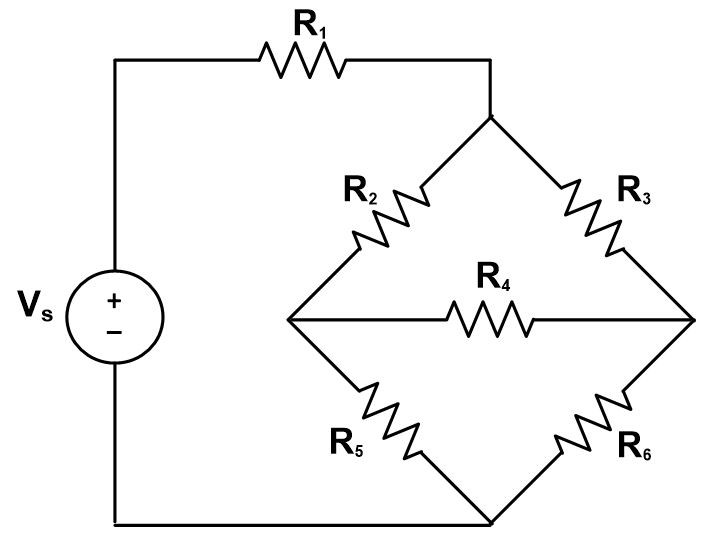
Electrical Academia notes that the star delta transformation is mainly used in bridge networks like the one above, where the middle resistor links two branches. The same bridge appears in strain gauge and RTD circuits built on the Wheatstone bridge, so the topic is useful well beyond the exam hall.
Star and Delta Networks Compared
| Feature | Delta (Δ, Pi, Mesh) | Star (Y, Wye, Tee) |
|---|---|---|
| Shape | Closed triangle of three resistors | Three resistors meeting at a centre node |
| Nodes | Three nodes only | Three outer nodes plus one hidden centre node |
| Resistor names | RAB, RBC, RCA between terminal pairs | RA, RB, RC from each terminal to centre |
| Balanced relation | RΔ = 3 × RY | RY = RΔ ÷ 3 |
The naming rule is the key to every formula. In a delta, each resistor sits between two terminals, so it carries two letters, while in a star each resistor joins one terminal to the centre and carries one letter, exactly as in the physical star vs delta connection of 3 phase equipment.
The transformation was published by the American engineer Arthur Edwin Kennelly in 1899. It is still called the Kennelly theorem in many older textbooks.
Delta to Star Conversion Formula
To convert a delta into a star, each star resistor equals the product of the two delta resistors touching that terminal, divided by the sum of all three delta resistors. The denominator is the same for all three results, so you calculate it only once.
RB = (RAB × RBC) ÷ (RAB + RBC + RCA)
RC = (RBC × RCA) ÷ (RAB + RBC + RCA)
Example from Electrical Academia:
RAB = 500 Ω, RBC = 300 Ω, RCA = 400 Ω
Sum = 500 + 300 + 400 = 1200 Ω
RA = 500 × 400 ÷ 1200 = 166.67 Ω
RB = 500 × 300 ÷ 1200 = 125.00 Ω
RC = 300 × 400 ÷ 1200 = 100.00 Ω
Star total = 391.67 Ω
A quick sanity check is that every star resistor must be smaller than the smallest delta resistor touching its terminal. If your answer is bigger, a product or sum has been mixed up, which is also a common slip when learners jump into Thevenin theorem problems.
Star to Delta Conversion Formula
For the reverse direction, each delta resistor equals the sum of the two star resistors at its ends plus their product divided by the third star resistor. An equivalent form divides the sum of the three pairwise products by the opposite star resistor.
RBC = RB + RC + (RB × RC) ÷ RA
RCA = RC + RA + (RC × RA) ÷ RB
Example from ROHM TechWeb:
RA = 15 Ω, RB = 10 Ω, RC = 30 Ω
RAB = 15 + 10 + 150 ÷ 30 = 30 Ω
RBC = 10 + 30 + 300 ÷ 15 = 60 Ω
RCA = 30 + 15 + 450 ÷ 10 = 90 Ω
ROHM TechWeb uses exactly this pair in its guide, first reducing a 30, 60 and 90 Ω delta to a 15, 10 and 30 Ω star and then rebuilding the original delta. Doing the round trip yourself is the best way to prove the formulas and catch any lettering mistake.
Write the terminal letters on your sketch before you touch a formula. Nearly every wrong answer in university exams comes from pairing RA with the wrong delta arm, not from arithmetic.
Balanced Star Delta Transformation Shortcut
When all three resistors are equal, the star delta transformation reduces to a single rule. A balanced delta of RΔ becomes a star of RΔ ÷ 3, and a balanced star of RY becomes a delta of 3 × RY.
For example, three 30 Ω resistors in delta act exactly like three 10 Ω resistors in star. Between any two terminals both measure 20 Ω, because 30 in parallel with 60 gives 20 for the delta and 10 plus 10 gives 20 for the star.
The University of Illinois lecture notes for ECE330 state the same relation for balanced impedances as ZΔ = 3ZY. This is why 3 phase load calculations in three phase power work often convert a delta load into an equivalent star and solve one phase only.
6 Steps to Solve a Bridge Network
Worked Example: Unbalanced Bridge
Take a bridge fed at the top node A and the bottom node D. The upper triangle has RAB = 20 Ω, RAC = 30 Ω and the bridge resistor RBC = 50 Ω, while the lower arms are RBD = 30 Ω and RCD = 25 Ω, and a 26 V supply is connected across A and D.
RA = 20 × 30 ÷ 100 = 6 Ω
RB = 20 × 50 ÷ 100 = 10 Ω
RC = 30 × 50 ÷ 100 = 15 Ω
Branch through B = 10 + 30 = 40 Ω
Branch through C = 15 + 25 = 40 Ω
40 in parallel with 40 = 20 Ω
RAD = 6 + 20 = 26 Ω, so I = 26 V ÷ 26 Ω = 1 A
Since the two branches are equal, the 1 A supply current splits into 0.5 A in each lower arm. The drop across RBD is 15 V and across RCD is 12.5 V, so node B sits at 15 V and node C at 12.5 V above node D.
Back in the original circuit, the bridge resistor therefore carries (15 minus 12.5) ÷ 50 = 0.05 A from B to C. You can verify this answer with Kirchhoff current law at node B, where 0.55 A arrives through RAB and leaves as 0.5 A plus 0.05 A.
Solving the same bridge with mesh equations needs three simultaneous equations built from Kirchhoff voltage law. The star delta transformation reaches the same result with a handful of multiplications, which saves valuable minutes in an exam.
A balanced bridge never needs this conversion at all. When the arm ratios match, the bridge resistor carries zero current and can simply be removed, which is exactly the null condition used in bridge instruments.
Delta to Star Calculator
Star Delta Transformation for AC Impedances
The star delta transformation formulas remain valid when each resistor is replaced by a complex impedance Z, because the derivation only uses linear network laws. You simply multiply, add and divide complex numbers in rectangular or polar form, as reviewed in impedance and reactance in AC circuits.
ZY = ZΔ ÷ 3 = 10 + j5 Ω
Magnitude of ZY = √(10² + 5²) = 11.18 Ω
Angle of ZY = arctan(5 ÷ 10) = 26.57°
Notice that the impedance angle does not change during a balanced conversion, so the load power factor stays the same. That angle is the phase angle in AC circuits between phase voltage and phase current.
When a balanced 3 phase delta load is given, convert it to star first and work on one phase with the line to neutral voltage. Multiply the single phase power by three at the end.
Where the Star Delta Transformation Is Used
Electronics Tutorials shows how a tee attenuator pad can be turned into its equivalent pi pad with these formulas, which helps when a design needs one topology but the tables list the other. Passive filter sections built from the elements in RC low pass and high pass filters can be rearranged the same way.
In power system calculations, engineers use the idea together with the per unit system to model transformers and meshed lines. The transformer vector group tells you whether each winding is physically star or delta connected.
Common Mistakes and How to Avoid Them
- Label A, B and C on both the delta and the star sketch.
- Compute the common denominator once and reuse it.
- Confirm each star leg is smaller than its adjacent delta arms.
- Confirm each delta arm is larger than its two star legs.
- Keep the new centre node free of any extra connection.
- Verify one terminal pair resistance before continuing.
Selecting a Reduction Method
The star delta transformation is best when a single triangle or star blocks an otherwise simple network. For circuits with several sources, superposition theorem or nodal analysis is usually faster, and for a load that keeps changing, a Thevenin or Norton equivalent is the smarter choice.
- Solves bridge networks without simultaneous equations.
- Works equally for DC resistances and AC impedances.
- Balanced cases need only a divide or multiply by three.
- Gives quick hand checks for simulation results.
- Needs careful lettering to avoid pairing errors.
- Adds a hidden node that is easy to misuse.
- Unbalanced complex impedances need tedious arithmetic.
- Applies only to linear, bilateral elements.
Reference Lecture Notes
Video Explanation With Worked Examples
Star Delta Transformation FAQ
It is a method that replaces three resistors in a triangle with three resistors meeting at a centre point, or the reverse. Both networks show the same resistance between every pair of outer terminals.
Engineers use it to simplify bridge circuits and meshed networks that cannot be reduced by series and parallel rules. It works for resistances as well as AC impedances.
Each star resistor equals the product of the two delta arms that touch its terminal, divided by the sum of all three arms. For terminal A this gives RA equal to RAB times RCA over the total.
The denominator is common to all three results, so calculate it only once. Each answer should be smaller than both delta arms at that terminal.
Each delta arm equals the sum of the two star legs at its ends plus their product divided by the third leg. For arm AB you add RA and RB, then add their product divided by the third leg.
Every delta arm must come out larger than the two star legs it replaces. If it does not, recheck your terminal lettering first.
With equal arms, each adjacent product is R squared and the common sum is three times that arm value. Dividing the first by the second leaves one third of R for every star leg.
Going the other way, each delta arm becomes R plus R plus R squared over R, which equals three times the star value. The Illinois ECE330 notes state the same rule for balanced impedances in 3 phase work.
Yes, because the derivation uses only linear network laws that hold for complex impedances too. You simply replace every resistance with its impedance and use complex arithmetic.
A balanced delta of 30 plus j15 ohms becomes a star of 10 plus j5 ohms. The impedance angle, and therefore the power factor, remains exactly the same.
It gives little benefit when the circuit already reduces with series and parallel rules. It is also slow for large networks that contain many sources, many meshes or several dependent sources.
In those cases nodal analysis, superposition or a Thevenin equivalent is usually quicker. Use the star delta transformation when a single bridge or triangle is the only obstacle in the way.
No, the names are similar but the purpose is different. The starter physically reconnects motor windings from star to delta to limit starting current.
The network method is only a calculation that keeps the real circuit untouched. It helps you analyse the circuit on paper, in exams and in design checks, and never changes any wiring.
Related Articles
- Wheatstone Bridge 10 Applications
- Star vs Delta Connection
- Thevenin Theorem Made Simple
- Series vs Parallel Circuits Explained
- Kirchhoff Voltage Law Explained
External References
- ECE330 Lecture 5, Wye and Delta Conversion, University of Illinois
- What Is the Delta and Y Transformation, ROHM TechWeb
- Y and Delta Transform, Wikipedia
What We Learn Today
- A delta converts to star by adjacent product over sum, so a 500, 300 and 400 Ω delta becomes 166.67, 125 and 100 Ω.
- A star converts to delta by adding two legs plus their product over the third, and equal arms simply follow RΔ = 3 × RY.
- The star delta transformation solves unbalanced bridge networks in six clear steps and works equally well for complex AC impedances.