
Mobile robots, wireless cameras and moving machines need a network that stays reliable across a whole site. A cellular network owned and controlled by the plant itself brings predictable latency, strong security and wide coverage to the shop floor.
Factories are moving from fixed cables and patchy Wi Fi toward cellular networks they own and manage themselves. Dedicated spectrum and an on site core give predictable performance for demanding industrial traffic.

What Is Private 5G?
A private 5G network is a 5G cellular network built for one organisation, using its own or leased spectrum and a core that is often located on site. It connects machines, sensors and vehicles with the kind of control that a public network cannot offer, a step beyond many IIoT designs.
5G ACIA calls these non public networks and describes versions that run fully standalone or share parts of a public operator network. The choice depends on security, cost and coverage needs.
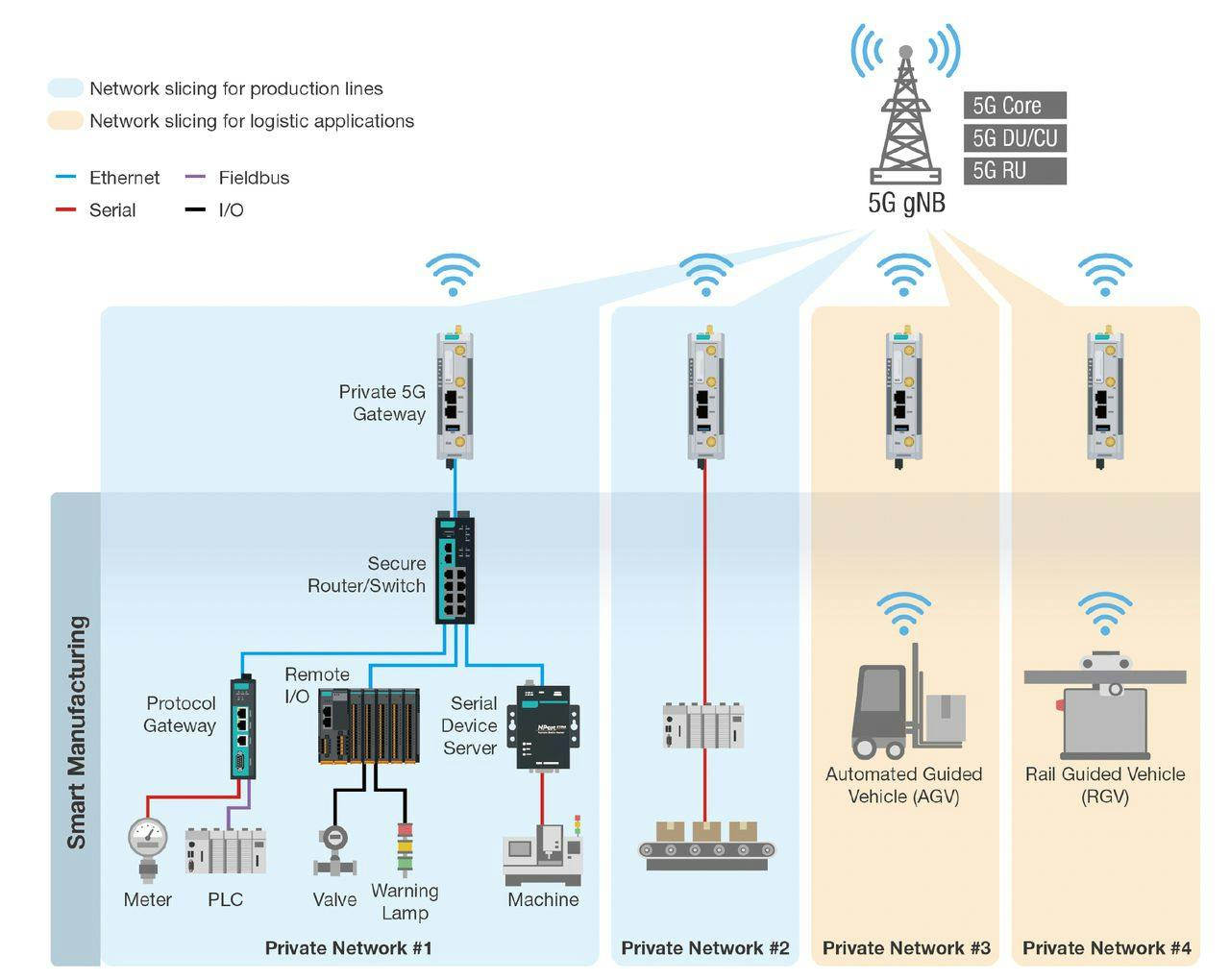
Automation World reports that 6 key regions have set aside spectrum for private use. These are the US with band n48, Germany and Australia with n77, and Japan, South Korea and Taiwan with n79.
The same article notes that the Moxa CCG 1500 5G gateway draws about 8 W on average. Low power gateways make it practical to connect existing Ethernet machines.
4 Powerful Features of Private 5G
Ultra reliable low latency communication for time critical traffic.
Separate logical networks on shared hardware, each with its own quality.
A 5G core on site keeps data local and removes public network dependency.
Devices authenticate with SIM or eSIM credentials and encryption.
SIM based identity fits well with zero trust for OT networks, since every device must prove who it is. Slicing keeps camera traffic from delaying control data.
URLLC targets latencies of a few milliseconds with very high reliability. Real results depend on the equipment release and radio planning.
Standalone vs Non Standalone
| Aspect | Standalone (SA) | Non Standalone (NSA) |
|---|---|---|
| Core network | 5G core | 4G LTE core |
| URLLC and slicing | Fully supported | Limited |
| Deployment | Newer, more complex | Faster, uses LTE anchor |
| Best for | Advanced automation | Broadband and early pilots |
Most industrial projects now target standalone, because URLLC and slicing need the 5G core. Non standalone can still serve cameras and handheld devices.
Private 5G vs Wi Fi 6
- Licensed or dedicated spectrum, less interference.
- Smooth handover for moving vehicles.
- Wide coverage from fewer cells outdoors.
- SIM based device security.
- Lower cost and simpler setup.
- Huge range of client devices.
- No spectrum licence needed.
- Familiar to IT teams.
Many plants use both, with Wi Fi for offices and tablets and private 5G for mobile robots and critical links. Wider options appear in types of communication protocols.
How a Deployment Is Planned
Edge servers near the core keep data local, as discussed in edge AI vs cloud AI. A digital twin can also help plan cell placement.
Small Cell Count Formula
Cells needed = Area ÷ Effective coverage, rounded up
Example:
Area 60000 m², each small cell covers 5000 m², overlap 20 percent
Effective coverage = 5000 × 0.8 = 4000 m²
Cells needed = 60000 ÷ 4000 = 15
Coverage per cell varies with frequency, antenna height and obstacles. Always confirm with a radio survey.
Small Cell Calculator
Check backhaul capacity for all these cells using network speed and throughput methods. Plan addressing with internet protocols in mind.
Sensors and gateways often publish data with MQTT over the cellular link. Industrial variants of wireless transmitters with 5G modems are appearing.
5G ACIA Non Public Networks PDF
Nokia Factory Automation Video
For more networking basics, try the industrial network protocol crash courses.
Private 5G FAQ
Related Articles
- SCADA vs IIoT
- MQTT for Industrial IoT
- Edge AI vs Cloud AI
- Zero Trust for OT Networks
- Digital Twin in Automation
External References
- 5G Non Public Networks for Industrial Scenarios, 5G ACIA
- Enabling Smart Manufacturing with Private 5G, Automation World
- 5G, Wikipedia
What We Learn Today
- Private 5G gives a plant its own spectrum, core and security.
- URLLC, slicing and standalone mode suit demanding automation.
- Plan cells with overlap and confirm with a radio survey.