
Running new cable to a remote tank or a rotating machine can cost more than the transmitter itself. A secure, battery powered wireless mesh lets engineers add measurements quickly while keeping reliability close to a wired loop.
Wireless field instruments have moved from pilot projects to everyday use in refineries and chemical plants. ISA100 Wireless, one of the two main process standards, builds its mesh on IPv6 and tunnels other protocols.
What Is ISA100 Wireless?
ISA100 Wireless is an industrial wireless standard, published as ISA100.11a and internationally as IEC 62734, for monitoring and control in process plants. It is the main alternative to WirelessHART, covered in WirelessHART questions and answers.
The radio follows IEEE 802.15.4 in the licence free 2.4 GHz band. Devices are usually battery powered and send process values at set update rates.
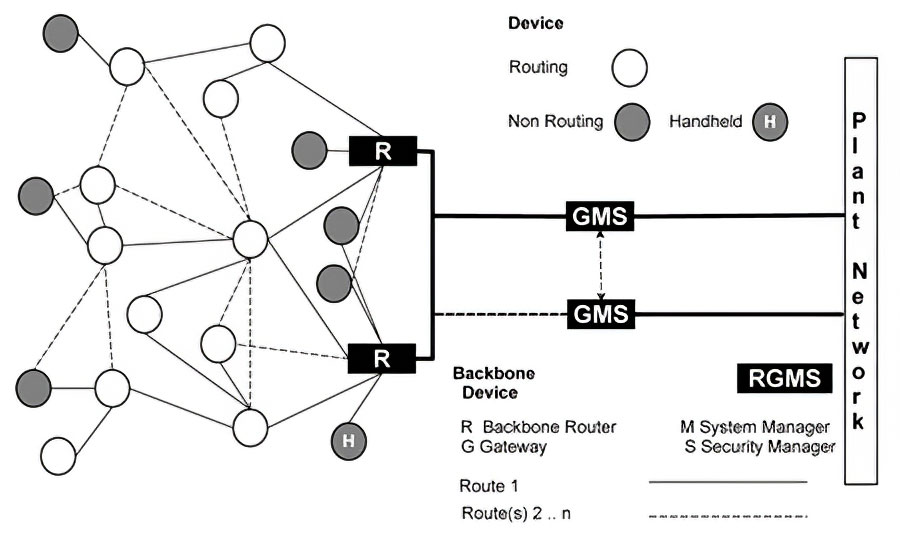
Automation.com explains that the mesh is integrated with IPv6 through 6LoWPAN. That makes every device addressable in the same way as a network computer.
The standard can also tunnel other protocols such as HART, Modbus or PROFIBUS through the wireless network. This makes it useful as a transport layer in mixed communication protocol environments.
6 Essential Parts of the Network
Battery transmitters that measure and may also route.
Line powered or battery nodes that extend the mesh.
Link the wireless mesh to a wired or high speed backbone.
Connects the network to the host system over Modbus, OPC or HART IP.
Allocates time slots, routes and resources.
Issues and manages encryption keys.
The system and security managers are often built into the gateway hardware. Large plants use several backbone routers to share the load.
Transmitters described in wireless pressure transmitters often support this standard directly.
How Timing and Hopping Work
Automation.com notes that TDMA time slots are configurable from 10 to 14 ms. It also describes three channel hopping schemes, called slotted, slow and hybrid hopping.
Channel hopping spreads traffic across the 2.4 GHz channels, so interference on one channel affects only a few packets. Channels used by plant Wi Fi can be blacklisted.
ISA100 Wireless vs WirelessHART
| Feature | ISA100.11a | WirelessHART |
|---|---|---|
| Standard | IEC 62734 | IEC 62591 |
| Radio | IEEE 802.15.4, 2.4 GHz | IEEE 802.15.4, 2.4 GHz |
| Network layer | IPv6 with 6LoWPAN | HART based mesh |
| Time slot | Configurable, 10 to 14 ms | Fixed 10 ms |
| Protocol support | Tunnels many protocols | HART commands |
WirelessHART fits naturally into existing HART asset tools. ISA100 Wireless offers more flexibility for mixed protocols and IP based systems.
Both are strong choices for monitoring, and plant preference often follows the DCS vendor. Wider options are listed in DCS communication protocols.
Battery Life Estimate
Energy per year = (31536000 ÷ Update interval) × Energy per update
Battery life = Battery energy ÷ Energy per year
Example:
19 Ah, 3.6 V gives 246240 J
Update every 10 s at 20 mJ gives 63072 J per year
Battery life = 3.9 years
This example ignores sleep current, routing load and cold weather derating. Real life can differ, so use vendor tools for final design.
Battery Life Calculator
Doubling the update interval roughly doubles battery life, so choose the slowest rate the process allows. Backup sizing ideas also appear in battery backup time.
Strengths and Weaknesses
- No signal cable to install.
- IPv6 addressing for every device.
- Tunnels HART, Modbus and more.
- Strong AES encryption and key management.
- Battery changes needed over time.
- Update rates limited for fast control.
- Shares 2.4 GHz with Wi Fi.
- Fewer device vendors than WirelessHART.
Wireless suits monitoring and slow loops rather than fast safety functions. For wider IIoT designs, see SCADA vs IIoT and MQTT for industrial IoT.
Yokogawa Technical Report PDF
ISA100 Introduction Video
Test your knowledge with communication protocol MCQs or the network protocol crash courses.
ISA100 Wireless FAQ
Related Articles
- WirelessHART Questions and Answers
- Wireless Pressure Transmitters
- How HART Protocol Works
- Communication Protocols in DCS
- MQTT for Industrial IoT
External References
- Wireless Field Instruments Based on ISA100.11a, Yokogawa
- Analysis of Wireless Standards ISA100.11a and WirelessHART, Automation.com
- ISA100.11a, Wikipedia
What We Learn Today
- ISA100 Wireless runs an IPv6 mesh on IEEE 802.15.4 radios.
- Gateways, backbone routers and managers control the network.
- TDMA slots and channel hopping make it reliable and efficient.