
A loop that keeps cycling no matter how you tune it is often not a tuning problem at all. Very often the real culprit is a sticky control valve that refuses to move until the controller pushes hard, and then jumps too far.
Static friction in the packing and trim makes a control valve move in jerks instead of smooth steps. This guide explains how to recognise the pattern, confirm it in the field and fix the mechanical cause.

What Is Valve Stiction?
Valve stiction is the static friction that stops a control valve stem from moving until the actuator force exceeds a breakaway threshold, after which the stem slips suddenly and often overshoots the requested position. The word joins "stick" and "friction", and it is one of the most common mechanical faults found during control valve troubleshooting.
Control Station explains that a sticky valve breaks free only when actuator force crosses a threshold, then travels farther than commanded. That extra travel is called the slip jump.
Friction mainly comes from the packing around the stem, the guiding surfaces in the trim and the actuator seals. You can see where each part sits in the basic parts of a control valve.
Deadband, Stiction and Slip Jump Compared
| Term | What Happens | Typical Cause |
|---|---|---|
| Deadband | Output reverses but stem waits, then follows smoothly | Loose linkages, backlash, positioner settings |
| Stiction | Stem sticks, then breaks free with a jump | Tight packing, worn or dirty trim |
| Slip Jump | Stem travels past the requested position | Stored actuator force released at breakaway |
OptiControls describes deadband as backlash between controller output and valve position. With stiction, the valve sticks, the output reverses and the process repeats.
How Stiction Creates a Limit Cycle
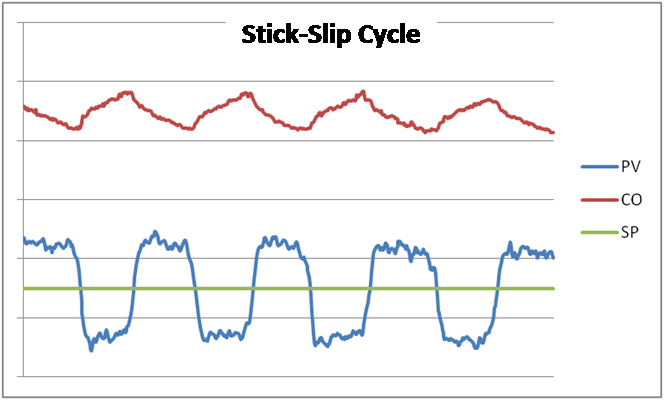
Control Station notes that retuning cannot remove this cycle, because the root cause is mechanical. Detuning only stretches the period for a while.
In a flow loop the output forms a saw tooth and the PV a square wave. Before you touch the PID tuning, always check the valve first.
6 Proven Checks to Detect Valve Stiction
A smart valve positioner records travel feedback, so valve stiction can be read against actual stem position. That removes guesswork caused by process dynamics.
Choudhury, Shah and Thornhill showed that valve stiction can be quantified from routine closed loop data. Their method fits an ellipse to the filtered PV and OP plot.
Stiction Estimate Formula
PV cycle ≈ Process gain × Stiction %
Example, 4 to 20 mA output with span 16 mA:
Smallest step that moves the valve = 0.4 mA
Stiction = 0.4 ÷ 16 × 100 = 2.5% of span
Process gain = 1.5, PV cycle ≈ 1.5 × 2.5 = 3.75%
About 2.5% stiction, moderate, plan maintenance
This rough valve stiction estimate assumes the slip jump is close to the stick band. Real cycles also depend on integral time.
Valve Stiction Estimate Calculator
Common Causes of a Sticky Valve
Gland nuts tightened to stop a leak raise stem friction sharply.
Deposits and galling on the plug and cage guide surfaces.
Dry seals, undersized actuator or low supply pressure.
Actuator choice matters because piston types usually carry more seal friction, as compared in diaphragm vs piston actuators. Sliding stem designs are covered in how sliding stem valves work.
Fixing the Problem for Good
Control Station warns that stiction worsens over time as packing ages, corrosion grows and lubrication fades. A valve that passed at commissioning may need a full actuator review years later.
The installed gain also affects how badly a small jump disturbs the PV, see flow characteristics of control valves. A valve that also leaks when closed may need the checks in control valve passing causes.
- Stops endless retuning of healthy loops.
- Reduces product variability.
- Targets maintenance to the right valves.
- Extends packing and trim life.
- Data based tests need steady operation.
- External disturbances can mimic cycles.
- Bump tests disturb the process slightly.
- Compensation hides but does not cure friction.
Step tests from DCS auto tune tools also expose valve stiction. Use them together with the valve signature.
Stiction Quantification PDF
Stiction and PID Control Video
Valve Stiction FAQ
Valve stiction is the static friction that holds a control valve stem still until the actuator force exceeds a breakaway threshold. Once it breaks free, the stem jumps and usually overshoots the position the controller asked for.
The name simply combines the words stick and friction. It is a mechanical fault in the valve, so the controller settings are not the root cause.
Deadband is a lag after the signal reverses, after which the stem follows the signal smoothly. Stiction adds a sudden jump once the stem breaks free from static friction.
Both faults show up as a flat band in a plot of PV against controller output. Only stiction produces the typical slip jump with a square wave PV and a saw tooth output.
The cycle comes from the friction band, so integral action always winds up until the stem breaks free. Detuning the controller only makes each cycle slower and smaller for a while.
Control Station reports that such loops slowly return to the same cycle after detuning. Repairing the valve itself is the only lasting cure for this kind of oscillation.
Put the loop in manual and make small output steps of about half a percent in one direction, then reverse. Count the total output change needed before the PV starts to move.
A smart positioner signature confirms the result directly without disturbing production. It plots actuator pressure against travel and shows the width of the friction band clearly.
Overtightened or dry packing is the most common cause of sticking in control valves. Dirty trim, galling on guide surfaces and undersized actuators also add a lot of friction.
High temperature graphite packing usually creates more friction than PTFE rings. Deposits from scaling or slurry fluids can make the problem worse over months of service.
Many engineers treat anything below about 1% of span as acceptable for most process loops. Fast pressure and flow loops may need an even tighter limit to control well.
Above a few percent, cycling usually becomes obvious in the historian trends. Such a valve should be scheduled for repair at the next suitable maintenance window.
Knocker and dither methods add short pulses to the output to help the stem break free. They can reduce cycling in the loop as a temporary measure until repair.
These methods also increase wear on the packing and the actuator over time. Plan a proper mechanical repair of the valve at the next opportunity instead.
Related Articles
- Control Valve Troubleshooting
- Control Valve Positioner Working
- Basic Parts of a Control Valve
- PID Controller Tuning Guide
- Valve Actuator Types and Applications
External References
- Detection and Quantification of Control Valve Stiction, DYCOPS 2004
- Valve Stiction and PID Control Detection, Control Station
- Stiction, Wikipedia
What We Learn Today
- Valve stiction is static friction that holds the stem until force builds up, then releases it with a jump that overshoots the requested valve position.
- Deadband gives a lag followed by smooth movement, while stiction adds a slip jump that produces a square wave PV and a saw tooth output.
- Confirm friction with manual bump tests and positioner signatures, then repack, clean trim or resize the actuator instead of detuning the loop.