
Diaphragm Actuator vs Piston Actuator: Control Valve Selection Guide
Force equals pressure times area, the entire diaphragm versus piston debate in one equation. One design gets there with a large area at low pressure, the other with a small area at high pressure.
Diaphragm and piston actuators both convert compressed air pressure into linear force on a control valve stem, using the same fundamental physics but at very different operating pressures and precision levels. This guide compares both designs, the force formula behind them, and a clear framework for choosing between them.
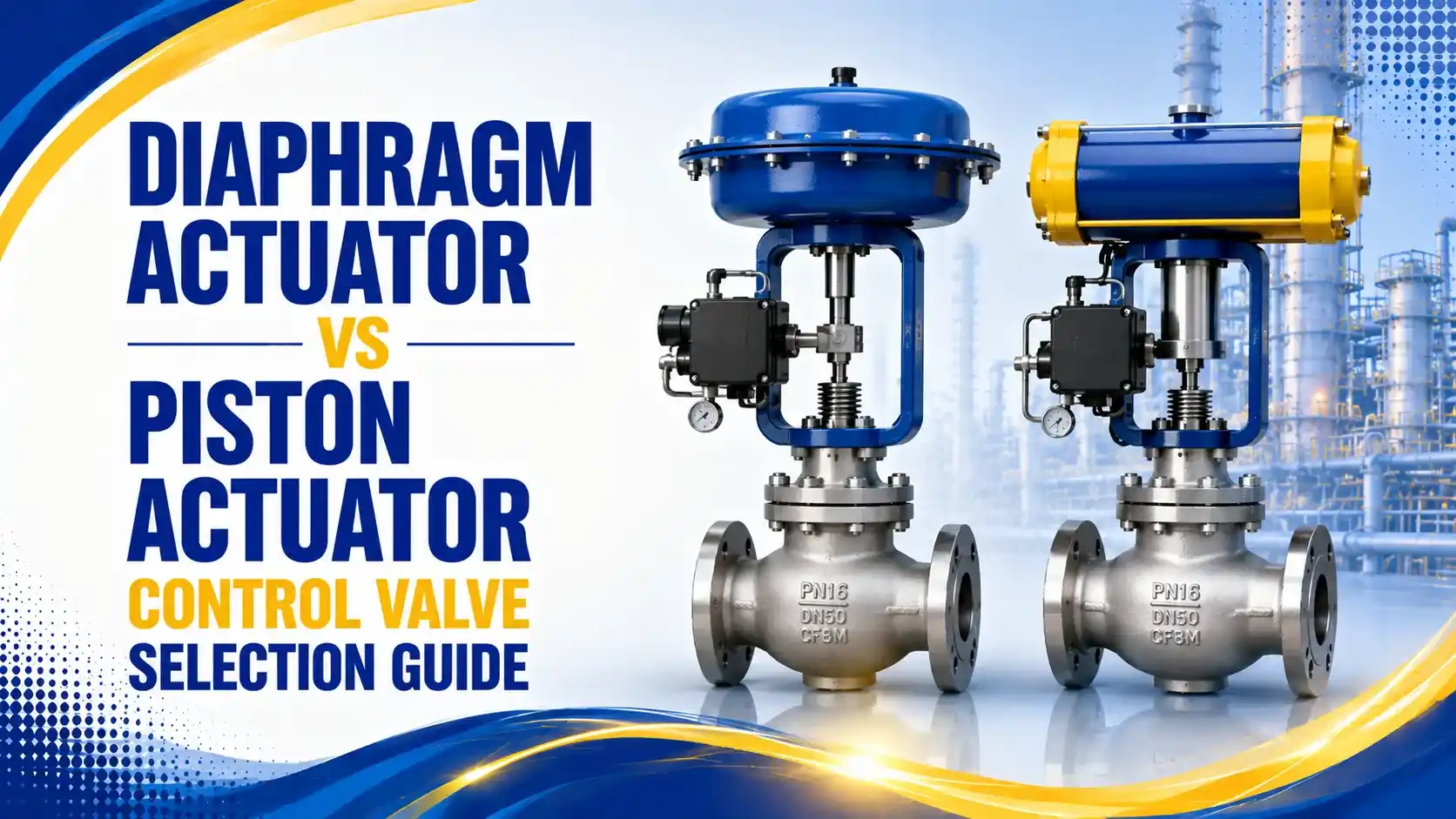
The Same Formula, Two Different Approaches
Every pneumatic linear actuator, diaphragm or piston, generates force according to one simple relationship: Force equals Pressure times Area (F = P × A). A diaphragm actuator uses a large, flexible rubber or fabric-reinforced membrane and relatively low air pressure, typically up to around 60 psi (4 bar), to generate its force. A piston actuator uses a rigid metal piston in a cylinder at much higher pressure, commonly 40 to 120 psi (2.8 to 8.3 bar), achieving equivalent or greater force through a much smaller effective area.
This single difference in approach, large area/low pressure versus small area/high pressure, cascades into nearly every other characteristic that distinguishes the two designs, including precision, positioner response, stroke length, and overall footprint.
Real Life Example
Think of pushing open a heavy door two different ways: flat-palm pushing with your whole hand spread wide (a large area, low individual pressure per square inch, like a diaphragm), versus poking it with one finger using much more concentrated pressure (a small area, high pressure per square inch, like a piston). Both can generate the same total force on the door, but the flat-palm push feels smoother and more controlled, while the finger-poke, though more concentrated, is stiffer and reacts faster to a small change in how hard you push, exactly mirroring the diaphragm's smooth precision versus the piston's stiff, rapid response.
Force Comparison at Equal Footprint
Diaphragm Actuator
Large area, low pressure
~5,388 lb force*
Piston Actuator
Small area, high pressure
~23,091 lb force*
*Based on a 14-inch diaphragm at 35 psi vs an equivalent-footprint piston at 150 psi. Circle sizes are illustrative of relative working area, not exact scale.
Fail-Safe Action and Spring Range
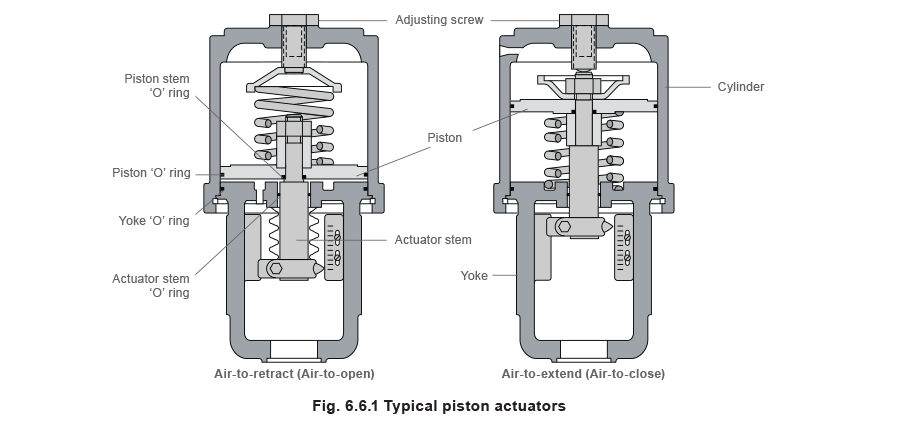
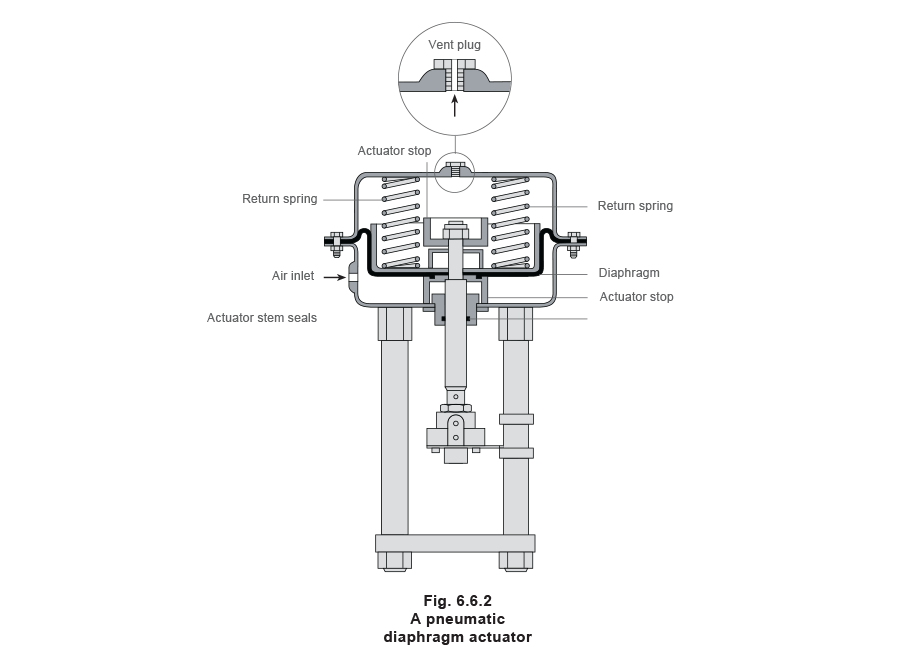
Both actuator types are commonly built as spring-return designs, meaning a spring, not the air supply, drives the valve to its safe position if instrument air is lost. In a diaphragm actuator, this is described by its "bench range," the pressure span, commonly 3 to 15 psi, over which the actuator strokes the valve through its full travel against the spring.
Reverse-Acting (Spring-to-Extend)
- Air pressure pulls the stem up as pressure rises
- Spring pushes stem back down on air loss
- Common pairing: fails valve open
Direct-Acting (Spring-to-Retract)
- Air pressure pushes the stem down as pressure rises
- Spring pulls stem back up on air loss
- Common pairing: fails valve closed
Why Positioners Matter More With Piston Actuators
Neither actuator accepts a 4-20 mA signal directly, both need a positioner with a built-in I/P converter. But they don't benefit equally from having one:
A diaphragm's low friction already gives it decent precision even without a positioner. A piston's higher seal friction makes open-loop positioning unreliable, so the positioner isn't optional, it's what makes precise piston control possible at all. Modern digital positioners output anywhere from zero to full supply pressure (not the old fixed 3-15 psi range), giving them enough authority to drive either design accurately once spring range and supply pressure are correctly matched.
Diaphragm vs Piston Actuator: Video Walkthrough
Diaphragm vs Piston Actuator
🟦 Diaphragm Actuator
Flexible rubber/fabric membrane connects to the stem, moving under low-pressure air. Low friction since the diaphragm rolls and flexes rather than rubs, giving excellent precision at low to moderate pressure drops. Nearly always spring-return for inherent fail-safe action. Limited to shorter stroke lengths, typically under 4 inches.
⚙️ Piston Actuator
Rigid piston in a cylinder, operating at much higher air pressure. Higher friction from piston/stem seals, historically making precise positioning harder without a positioner. Available spring-return or double-acting. Supports much longer strokes and higher thrust, suited to large valves and high shutoff pressure.
Comparison Table
Sizing Considerations in Practice
Required Thrust
Size against maximum shutoff pressure, not normal operation. Diaphragms deliver roughly 2 to 125 kN depending on area; beyond that, piston becomes the only practical option.
Piston wins at high pressureStroke Length
Diaphragms stay linear only up to ~4 inches of travel; beyond that, effective area distorts. Pistons hold constant area across any stroke length.
Piston wins for long travelCost & Maintenance
Diaphragms are simpler to build and maintain, the default for the vast majority of small-to-medium globe control valves plant-wide.
Diaphragm wins on costPiston actuators earn their higher upfront and maintenance cost only where their extra thrust or stroke genuinely solves a problem a diaphragm physically can't, not as a default upgrade.
Applications
Globe Control Valves
Diaphragm actuators remain the most common choice for standard globe control valves.
High Shutoff Pressure Service
Piston-actuators handle large valves needing high thrust at elevated shutoff pressures.
HVAC and Utility Systems
Diaphragm actuators suit low-pressure, cost-sensitive utility valve applications well.
High-Pressure Steam Service
Piston actuators provide the thrust and stroke length large steam valves often require.
Precise Throttling Loops
Piston actuators with positioners suit demanding, high-precision modulating control.
Isolation and On/Off Valves
Both types serve isolation duty; piston actuators favored for larger valve sizes.
Frequently Asked Questions
- Industrial Monitor Direct, Diaphragm vs Piston Actuators: Control Valve Selection Guide
- Control.com, Control Valve Actuators
- ScienceDirect, Diaphragm Actuator, an Overview
What We Learn Today
- Both actuator types follow F = P × A; diaphragms use large area/low pressure, pistons use small area/high pressure
- Diaphragm actuators offer low friction and good precision but are limited to shorter strokes and lower thrust
- Piston actuators offer higher thrust, longer stroke, and stiffer response, at the cost of seal friction
- The "waterbed effect" in diaphragm actuators can cause position drift under process pulsation
- Both actuator types require a positioner to accept modern 4-20 mA electronic control signals