
The same 132 kV switching job can fill a field with steel structures or fit inside a compact building, and the choice shapes decades of operation.
Air insulated substations use open air as the insulation between live parts, while gas insulated substations enclose conductors in metal tubes filled with SF6. Each suits different sites, budgets and risks.
GIS vs AIS: The Basic Idea
The GIS vs AIS decision is about how live conductors are insulated from each other and from earth. An air insulated substation, or AIS, relies on clearances in open air, while a gas insulated substation, or GIS, seals busbars, breakers and disconnectors inside earthed metal enclosures filled with pressurised SF6 gas.
SF6 has a dielectric strength roughly two to three times that of air at the same pressure. Pressurised to a few bar, it allows very small phase spacing.
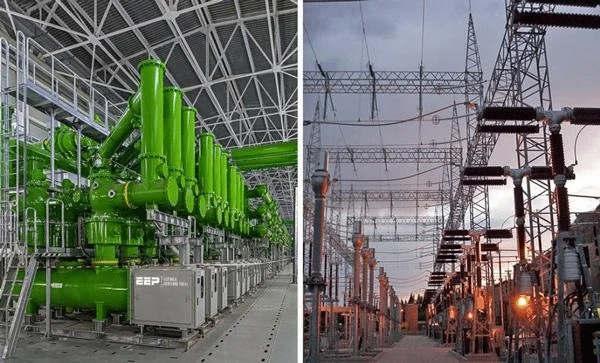
Both types use the same functions, including breakers, CTs, VTs, disconnectors and earth switches. Breaker technology choices are compared in ACB vs VCB vs SF6 circuit breakers.
EEPower notes that GIS takes about 70 to 90 percent less space than AIS at the same voltage. The CED Engineering course puts it at roughly one tenth of the AIS footprint.
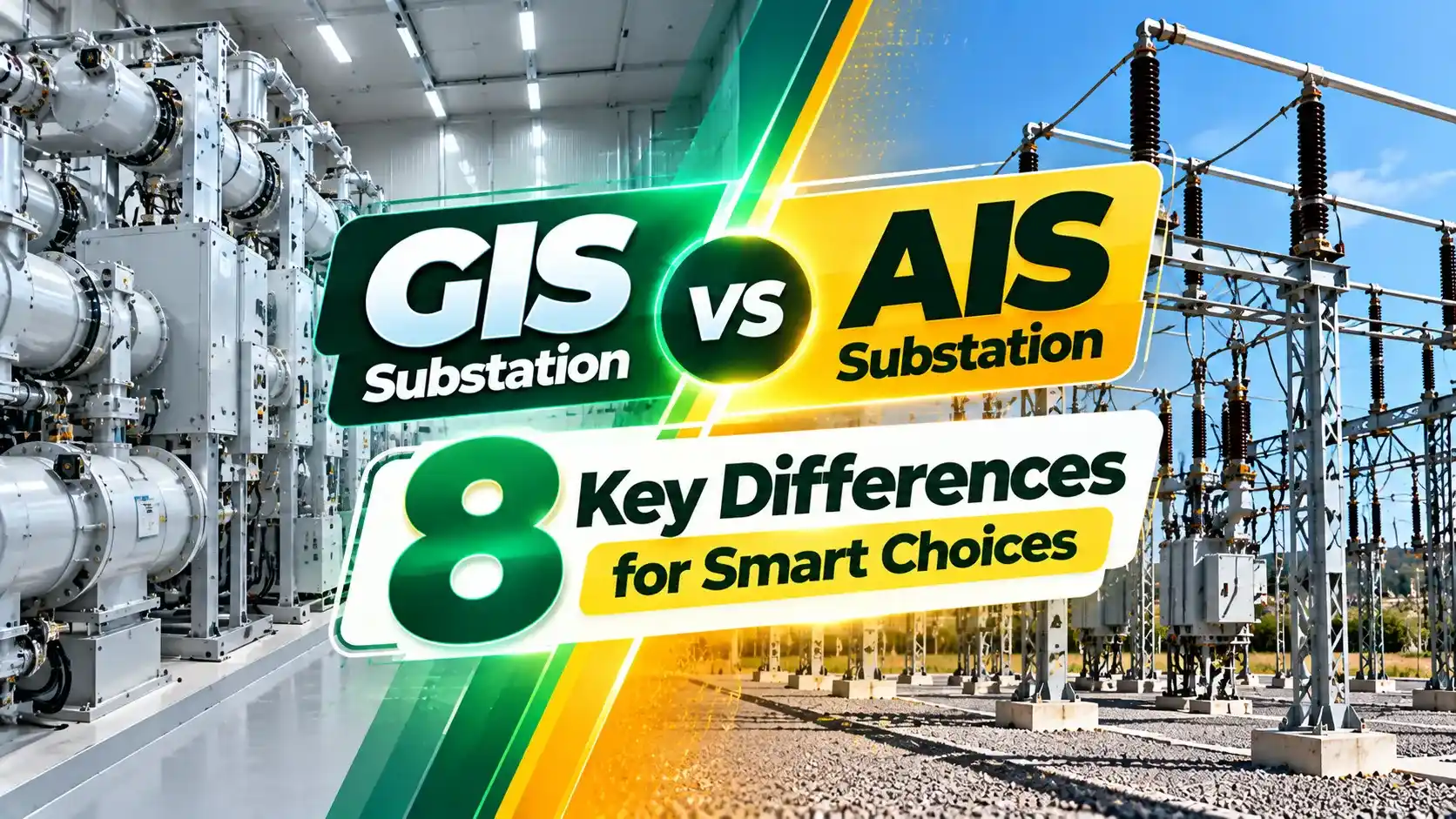
8 Key Differences Between GIS and AIS
| Factor | AIS | GIS |
|---|---|---|
| 1. Space | Large open yard | 70 to 90 percent smaller |
| 2. Capital cost | Lower | Higher |
| 3. Environment | Exposed to pollution and weather | Sealed from salt, dust and humidity |
| 4. Maintenance | Frequent cleaning and checks | Long intervals |
| 5. Visual inspection | Easy | Needs monitoring sensors |
| 6. Repair time | Short, parts accessible | Longer, specialist work |
| 7. Extension | Simple | Must match the original maker |
| 8. Greenhouse impact | None from insulation | SF6 leakage risk |
EEPower adds that GIS costs more up front but can have a lower lifecycle cost where land is valuable. AIS remains cheaper where land is available and pollution is low.
Neither is better in every case. The right answer comes from land cost, voltage level, environment and the skills available for maintenance.
How a GIS Bay Is Built
Each compartment is separated by gas tight barriers so a leak or fault is confined to one section. Density monitors raise alarms long before insulation is lost.
Protection uses the same current transformers and protective relays as AIS. Modern GIS often ships with IEC 61850 automation built in.
When to Choose Each Technology
Open air switchyard with steel structures.
Compact metal enclosed switchgear.
Gas insulated breaker modules in an air insulated yard.
Uses clean air, vacuum or alternative gases.
Underground and indoor substations in city centres are almost always GIS. Large generating stations with plenty of space still favour AIS for the 400 kV yard.
High altitude sites also favour GIS, because thinner air forces larger clearances in open yards.
SF6 and the Environment
EEPower states that SF6 has a global warming potential about 23500 times that of CO2 over 100 years. Regulators in Europe and elsewhere are restricting its use in new equipment.
Leak rates for modern GIS are often guaranteed below 0.1 percent per year. Gas handling, recovery and records are part of every maintenance plan.
Makers now offer SF6 free designs using vacuum interruption with clean air or fluoronitrile mixtures. These change the GIS vs AIS comparison for new projects.
Lifecycle Cost and Earthing
A fair GIS vs AIS comparison adds land, civil works, equipment, maintenance, outages and end of life gas handling over 30 to 40 years. Short term price alone usually favours AIS, but the lifecycle view often narrows the gap.
GIS enclosures carry induced currents, so the earthing grid needs many bonding points and careful design. The principles follow earthing in process plants and the earth conductor size calculation.
Fault levels also shape both designs, because busbars and enclosures must withstand the short circuit current for the rated time. Ask the maker for type test certificates at the site fault level.
Land Area Calculator
Add the land saving to the equipment and civil cost of each option. In expensive urban areas this often tips the balance toward GIS.
- Very small footprint.
- Protected from pollution.
- Low routine maintenance.
- High safety, no exposed live parts.
- High capital cost.
- SF6 environmental concern.
- Long repair outages.
- Tied to one manufacturer.
CED Gas Insulated Substations PDF
Key Differences Explained Video
GIS vs AIS FAQ
Related Articles
- ACB vs VCB vs SF6 Circuit Breaker
- IEC 61850 Substation Automation
- Protective Relays Explained
- Busbar Sizing Calculation
- Short Circuit Fault Current
External References
- Gas Insulated Substations, CED Engineering
- Choosing Between Gas and Air Insulated Substations, EEPower
- Electrical Substation, Wikipedia
What We Learn Today
- GIS saves most of the space but costs more to buy.
- AIS is cheaper and easier to extend where land is available.
- SF6 impact and lifecycle cost now drive the final choice.