
RTDs and thermocouples are the two most widely used temperature sensors in industrial process plants.
Choosing the right sensor depends on the process temperature, required accuracy, vibration, response time, and cost.
Each technology has clear strengths that make it the better choice in specific industries and process conditions.
RTDs give better accuracy and long-term stability below 600 degrees C. Thermocouples cover higher temperatures, respond faster, and survive harsh environments better.
Understanding the applications of RTD and thermocouple sensors helps engineers select the right sensor from the start.
We will cover how each sensor works briefly, the industries and processes where RTDs are preferred, the industries and processes where thermocouples are preferred, and a quick selection guide to help you choose between them.
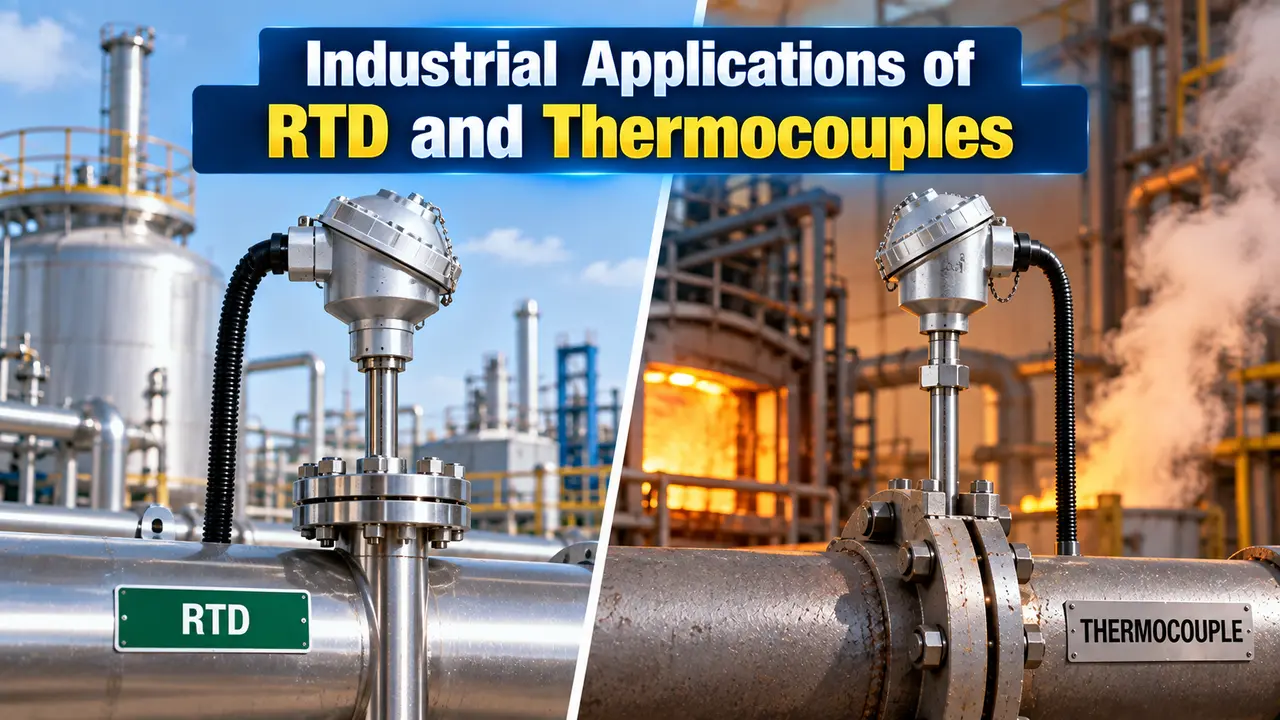
Applications of RTD vs Thermocouple: Key Differences at a Glance
An RTD (Resistance Temperature Detector) measures temperature by detecting the change in electrical resistance of a platinum element. The Pt100 is the most common type.
A thermocouple generates a millivolt signal when two dissimilar metals are joined at a measurement junction. This output is converted to a temperature reading using the characteristic curve for that TC type.
RTDs offer accuracy of plus or minus 0.1 to 0.3 degrees C and excellent long-term stability.
Thermocouples offer a wider range and faster response, with typical accuracy of plus or minus 1 to 2 degrees C.
Applications of RTD and Thermocouple: Industry Infographic
The infographic below shows which sensor type is used in each major industry. Green = RTD preferred. Orange = thermocouple preferred. Some industries use both depending on the temperature zone.
Applications of RTD Sensors in Industry
The applications of RTD sensors are widest wherever accuracy, stability, and repeatability matter more than temperature range or cost. The Pt100 and Pt1000 are the most common RTD types in process industries.
Pharmaceutical and Biotechnology
RTDs are mandatory in pharmaceutical applications. Autoclave validation, WFI loop monitoring, bioreactor control, and cold chain monitoring all require the stability and accuracy that only RTDs provide.
USP and EU GMP regulations require validated temperature measurement. Pt100 Class AA (plus or minus 0.1 degrees C) RTDs meet these requirements. Thermocouples are rarely specified for validated pharmaceutical processes.
Food and Beverage Processing
Sanitary Pt100 RTDs with hygienic tri-clamp connections are used in pasteurisation, CIP (Clean in Place) temperature monitoring, cooking and chilling lines, and cold store monitoring.
The food industry requires traceable measurement and HACCP compliance. Pt100 RTDs with 4-20 mA transmitters are standard across typical food process temperatures (minus 20 to 150 degrees C).
Semiconductor and Electronics Manufacturing
Semiconductor diffusion furnaces, CVD reactors, and clean room environmental monitoring all use high-accuracy Pt100 or Pt1000 RTDs. Wafer processing requires temperature uniformity and measurement accuracy within fractions of a degree.
Ultrapure process environments exclude many thermocouple materials that might contaminate the process. Platinum RTDs in ceramic or quartz sheaths are the accepted standard in these applications.
HVAC and Building Management
HVAC applications of RTD sensors include duct temperature sensing, chilled water loops, and air handling units. Pt100 stability makes them ideal for energy management where small temperature differences carry large cost implications.
RTD sensors in HVAC are also more convenient in terms of wiring. No special extension cable is needed (unlike thermocouples), and standard copper cable can run from the sensor to the controller.
Thermocouple Applications in Industry
Thermocouples are chosen when temperatures exceed 600 degrees C, when fast response is needed, when sensors must survive vibration and thermal shock, or when cost per measurement point is a constraint.
Fired Heaters and Furnaces (Oil and Gas)
Refinery fired heaters use Type K thermocouples for flue gas temperature and thermocouple pad assemblies for tube metal temperature monitoring. Typical measurement points are 400 to 1100 degrees C.
Fired heater tube skin monitoring is a demanding thermocouple application.
Type N thermocouples with V-pad assemblies and heat shields are used for continuous tube metal monitoring. See the thermocouple and RTD basics guide for TC type selection details.
Power Generation Boilers
Boiler superheater tube temperatures (600 to 900 degrees C) use Type K or Type N thermocouples. At the superheater outlet (500 to 570 degrees C) both RTD and thermocouple are viable.
Multiple thermocouples installed at different heights around the furnace allow operators to detect uneven combustion. Each measurement point feeds the DCS for real-time combustion optimisation.
Steel Mills and Metal Processing
Steel furnace temperatures (up to 1600 degrees C) require noble metal thermocouples: Type S or Type R. These are expensive but are the only option that survives continuously at these temperatures.
Immersion (dip) thermocouples are single-use sensors destroyed by the measurement. They give molten steel melt temperature within plus or minus 3 degrees C in 3 to 5 seconds during tapping and casting.
Cement Kilns and Glass Furnaces
Rotary cement kilns reach 1400 to 1500 degrees C at the flame zone. Type B thermocouples are used here because they have meaningful output only above 600 degrees C.
Glass furnace crown temperatures (up to 1700 degrees C) require refractory-packed Type S or Type R thermocouple assemblies. The thermocouple is inserted through the furnace crown wall in a refractory protection tube.
Mining and Mineral Processing
Process temperatures in mining conveyors, grinding mills, and ore roasters are typically measured with Type K thermocouples. The sensors must survive dust, moisture, and vibration.
High-vibration applications use mineral insulated (MI) thermocouples with heavy-wall sheath construction. RTDs fail earlier in high-vibration environments because the platinum element is more fragile than a TC wire.
RTD vs Thermocouple: Full Application Comparison
| Parameter | RTD (Pt100) Applications of RTD | Thermocouple (Type K) Applications |
|---|---|---|
| Typical temperature range | minus 200 to 600 degrees C | minus 200 to 1260 degrees C |
| Accuracy | Class B: plus or minus 0.3 degrees C at 0C. Class A: plus or minus 0.15 degrees C | Class 1: plus or minus 1.5 degrees C. Class 2: plus or minus 2.5 degrees C |
| Long-term stability | Excellent. Pt100 is highly stable over years of continuous service | Good at moderate temperatures. Drifts above 800 degrees C (Type K). Use Type N above 600C for better stability |
| Response time | Slower: 3 to 15 seconds typical (larger element mass) | Faster: 1 to 5 seconds typical for bare wire. Faster still for fine wire TCs |
| Vibration resistance | Poor. Platinum element fragile under high vibration | Good. MI cable construction survives high vibration environments |
| Special wiring required? | No. Standard copper cable from sensor to transmitter | Yes. Thermocouple extension cable of the correct type must be used to the transmitter |
| Self-powered? | No. Requires external excitation current | Yes. Generates its own millivolt signal |
| Pharmaceutical use | Yes. Standard choice for validated processes | Rarely used for validated pharmaceutical applications |
| Fired heater use | Not suitable above 600 degrees C | Yes. Standard choice for furnace and heater monitoring |
| Cost per point | Higher sensor cost. Lower wiring cost (standard cable) | Lower sensor cost. Higher wiring cost (special extension cable) |
Quick Selection Guide: Which Sensor for Your Application?
Watch: RTD vs Thermocouple Industrial Applications
Applications of RTD and Thermocouple Questions
Related Articles on This Site
- Basics of Thermocouples and RTD Explained
- Thermocouple Selection Guide for Instrumentation
- Thermocouple Types Comparison: K, J, T, E, N, S, R, B
- RTD Temperature Sensor Working Principle
- Thermocouple and RTD Installation Precautions
External References
- RTDs and Thermocouples Product Review | Ashcroft
- RTD Temperature Sensors: Types, Applications, Differences | Temp-Pro
What We Learn Today
- Applications of RTD sensors cover pharmaceutical, food processing, semiconductor, and HVAC where accuracy better than 1 degree C is required below 600 degrees C. Thermocouples are chosen above 600 degrees C, in high-vibration environments, or where fast response is critical.
- Thermocouples cover high-temperature applications RTDs cannot reach: fired heaters (Type K, N), steel mills (Type S, R), cement kilns (Type B), and boilers. Type K works to 1260 degrees C. Type N has better drift stability above 600 degrees C.
- In the 400 to 600 degree C overlap zone, choose RTD for accuracy and thermocouple for vibration resistance or fast response. Above 600 degrees C, only thermocouple is suitable. Below 400 degrees C in pharmaceutical or food service, RTD is standard.