
Table of Contents
ToggleImportant Factors for Thermocouple Selection
Thermocouples are among the most commonly used temperature sensors in industrial process plants. They are found in furnaces, boilers, pipelines, chemical reactors, heat-treatment equipment, engines, power plants, food-processing systems, and many other applications.
For many technicians and engineers, thermocouples are often the first temperature-measuring devices they encounter in the instrumentation field. Their simple construction, wide temperature range, fast response, and relatively low cost make them suitable for a large variety of industrial applications.
Thermocouple selection is not as simple as choosing a temperature range and ordering a sensor.
A thermocouple assembly may include different wire combinations, junction designs, sheath materials, probe diameters, insertion lengths, mounting fittings, cable types, and terminal arrangements. Each of these factors can affect the accuracy, response time, service life, and safety of the measurement.
Selecting the wrong thermocouple may result in slow response, unstable readings, corrosion, premature sensor failure, or inaccurate process control.
This article explains the most important factors that engineers should consider during thermocouple selection.
What Is a Thermocouple?
A thermocouple is a temperature sensor made by joining two wires manufactured from different metals.
When the measuring junction is exposed to a temperature that is different from the reference junction, a small voltage is generated. This voltage is called thermoelectric voltage or electromotive force.
The measuring instrument interprets this voltage and converts it into a temperature reading.
Different combinations of metals produce different voltage characteristics. These combinations are standardized and identified by letters such as:
- Type K
- Type J
- Type T
- Type E
- Type N
- Type R
- Type S
- Type B
Each thermocouple type has its own temperature range, accuracy, sensitivity, and resistance to environmental conditions.
Why Is Proper Thermocouple Selection Important?
The thermocouple is often installed directly inside the process. It may be exposed to high temperature, pressure, vibration, chemicals, moisture, gases, or abrasive materials.
Therefore, a sensor that works well in one application may fail quickly in another.
For example, a thermocouple selected for a clean laboratory environment may not survive inside a corrosive chemical reactor. Similarly, a heavy and thick probe may be durable but may respond too slowly for a rapidly changing process.
Correct thermocouple selection helps achieve:
- Reliable temperature measurement
- Faster response to process changes
- Better measurement accuracy
- Longer sensor life
- Reduced maintenance
- Improved process safety
- Stable control-system performance
The following factors should be reviewed before selecting a thermocouple.
1. Thermocouple Type
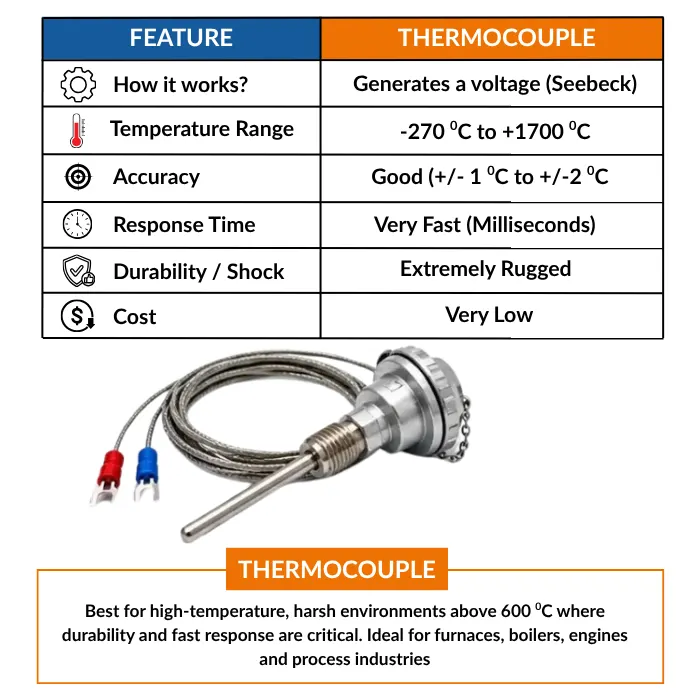
The first step in thermocouple selection is choosing the correct thermocouple type.
Each type uses a specific combination of metals and is suitable for a particular temperature range and environment.
Type K Thermocouple
Type K is one of the most commonly used thermocouples in industry. It offers a wide temperature range and good resistance to oxidation.
It is widely used in:
- Furnaces
- Boilers
- Heat-treatment equipment
- Engines
- General industrial processes
Type K is suitable for many applications, but it may not perform well in reducing atmospheres or environments containing sulfur.
Type J Thermocouple
Type J thermocouples use iron as one of the conductors. They are commonly used for moderate-temperature applications.
Typical applications include:
- Plastic-processing machines
- Industrial ovens
- General manufacturing equipment
- Older temperature-control systems
Because iron can oxidize, Type J thermocouples are not normally preferred for high-temperature oxidizing environments.
Type T Thermocouple
Type T thermocouples offer good accuracy and stability at lower temperatures.
They are often used in:
- Refrigeration systems
- Cryogenic applications
- Food-processing equipment
- Pharmaceutical processes
- Laboratory measurements
Type N Thermocouple
Type N thermocouples provide better stability at high temperatures than Type K in some applications.
They are used in:
- High-temperature furnaces
- Aerospace applications
- Power-generation equipment
- Applications requiring improved resistance to oxidation
Types R, S, and B
These thermocouples use noble metals and are suitable for extremely high-temperature applications.
They are commonly used in:
- Glass manufacturing
- Steel plants
- High-temperature furnaces
- Ceramic manufacturing
- Laboratory standards
They offer excellent high-temperature performance but are considerably more expensive than base-metal thermocouples.
When selecting the type, avoid choosing a thermocouple whose expected operating temperature is very close to its maximum or minimum limit.
A suitable safety margin should always be maintained.
2. Required Temperature Range
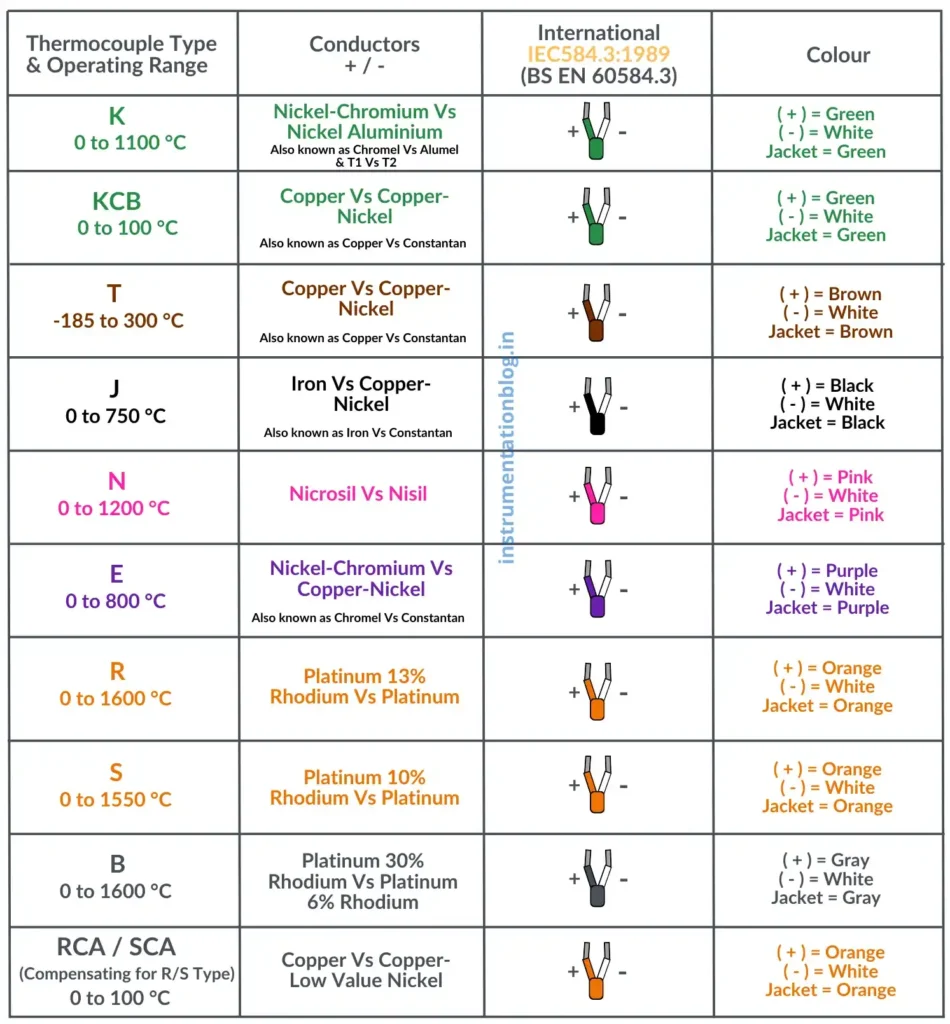
The expected process temperature is one of the most important thermocouple selection factors.
The selected thermocouple must safely operate across the complete temperature range of the process, including:
- Normal operating temperature
- Start-up temperature
- Shutdown temperature
- Temporary temperature spikes
- Abnormal process conditions
For example, a process may normally operate at 500°C but occasionally reach 700°C during start-up. The thermocouple must be capable of handling the higher temperature.
The temperature capability of the thermocouple wire alone is not sufficient. The limits of the sheath, insulation, cable, fittings, and connection head must also be considered.
The complete thermocouple assembly should be rated for the highest anticipated temperature.
3. Measurement Accuracy
Different thermocouple types have different accuracy limits.
The required accuracy depends on the application.
A general process-monitoring application may accept a small measurement error. However, pharmaceutical processing, laboratory testing, custody-related measurements, and certain heat-treatment processes may require much greater accuracy.
Accuracy can be affected by:
- Thermocouple type
- Wire quality
- Manufacturing tolerance
- Sensor ageing
- Extension cable errors
- Cold-junction compensation
- Electrical noise
- Installation method
Before selecting a thermocouple, determine the maximum acceptable measurement error for the process.
A highly accurate thermocouple may cost more, but it may be necessary where temperature directly affects product quality or process safety.
4. NIST Traceability and Calibration
Some applications require the thermocouple to be supplied with a traceable calibration certificate.
NIST traceability means that the sensor has been tested against a reference standard whose calibration can be traced through an unbroken chain to the National Institute of Standards and Technology.
During calibration, the thermocouple output is compared with a known temperature standard. Any difference between the thermocouple reading and the reference value is recorded.
The certificate may include:
- Calibration temperature points
- Actual sensor readings
- Measurement errors
- Correction values
- Reference-standard details
- Calibration uncertainty
Traceable calibration may be required in:
- Pharmaceutical manufacturing
- Food-processing plants
- Aerospace applications
- Research laboratories
- Quality-controlled heat treatment
- Regulated manufacturing processes
Not every application requires traceable calibration. However, it should be considered when accuracy, compliance, or documented quality is important.
5. Thermocouple Junction Type
The thermocouple junction is the point where the two different metal wires are joined.
For sheathed thermocouples, the junction may be grounded, ungrounded, or exposed.
The junction type strongly affects response time, electrical isolation, durability, and suitability for the process environment.
Grounded Junction
In a grounded thermocouple, the measuring junction is physically connected to the metal sheath.
This design offers:
- Fast response time
- Good heat transfer
- Strong mechanical protection
However, because the junction is electrically connected to the sheath, it may be affected by ground loops, electrical noise, or stray voltages.
A grounded junction may not be suitable where electrical isolation is required.
Ungrounded Junction
In an ungrounded thermocouple, the junction is electrically insulated from the outer sheath.
Its advantages include:
- Electrical isolation
- Reduced risk of ground loops
- Better performance in electrically noisy systems
- Protection from the process environment
The main disadvantage is a slower response compared with a grounded junction.
Ungrounded junctions are often preferred when the process equipment or sensor sheath may carry unwanted electrical voltage.
Exposed Junction
In an exposed-junction thermocouple, the measuring junction extends outside the protective sheath.
This provides:
- Very fast response
- Direct contact with the process medium
- Excellent sensitivity to rapid temperature changes
However, the junction is vulnerable to:
- Corrosion
- Mechanical damage
- Moisture
- Abrasion
- Chemical attack
Exposed-junction thermocouples are generally suitable for clean, non-corrosive gases and low-pressure applications.
They are not recommended for harsh industrial environments unless the junction material is compatible with the process.
6. Probe Sheath Material
The sheath protects the thermocouple wires and measuring junction from the process environment.
Sheath material selection should be based on:
- Maximum temperature
- Corrosion resistance
- Chemical compatibility
- Mechanical strength
- Oxidation resistance
- Process pressure
- Vibration conditions
Common sheath materials include stainless steel, Inconel, ceramic, and other corrosion-resistant alloys.
Stainless-Steel Sheaths
Stainless-steel sheaths are commonly used because they provide good mechanical strength and corrosion resistance.
They are suitable for many general industrial applications at moderate temperatures.
Inconel Sheaths
Inconel provides excellent resistance to oxidation and high-temperature environments.
It is commonly used in:
- Furnaces
- Exhaust systems
- Heat-treatment equipment
- High-temperature gas applications
Ceramic Sheaths
Ceramic protection tubes are used in extremely high-temperature applications.
They are suitable for furnaces, kilns, and molten-metal applications but can be brittle and sensitive to mechanical shock or rapid temperature changes.
The sheath material must be compatible with both the process temperature and the process chemistry.
A material that can withstand high temperature may still fail if it is attacked by a particular chemical.
7. Probe Diameter and Configuration
Thermocouple probes are available in different diameters, lengths, shapes, and configurations.
Probe diameter affects both durability and response time.
A larger-diameter probe generally provides:
- Better mechanical strength
- Greater resistance to vibration
- Longer service life
- Slower temperature response
A smaller-diameter probe generally provides:
- Faster response
- Lower thermal mass
- Easier installation in small spaces
- Lower mechanical strength
The insertion length is also important.
The thermocouple junction should be placed at a location that accurately represents the process temperature. Insufficient insertion may allow heat conduction along the probe or process connection to influence the reading.
Some applications may require:
- Straight probes
- Bent probes
- Flexible probes
- Surface-mounted probes
- Bayonet-style probes
- Spring-loaded probes
Any bend should be designed within the manufacturer’s recommended bending limits. Excessive bending may damage the internal insulation or thermocouple wires.
8. Response Time
Response time refers to how quickly the sensor reacts to a change in temperature.
It is influenced by:
- Junction type
- Probe diameter
- Sheath thickness
- Protective thermowell
- Process velocity
- Sensor contact with the medium
- Thermal mass around the junction
An exposed junction typically responds faster than a grounded junction, while an ungrounded junction is generally slower.
A thick probe installed inside a heavy thermowell may provide excellent protection but may react slowly to rapid process changes.
The correct balance between response time and mechanical protection depends on the application.
For fast-moving processes, a smaller probe or faster junction may be required. For harsh applications, durability may be more important than speed.
9. Mounting Fittings
Thermocouple assemblies can be supplied with many types of mounting arrangements.
Common options include:
- Threaded fittings
- Compression fittings
- Flanges
- Bayonet fittings
- Welded connections
- Spring-loaded fittings
- Thermowell-mounted assemblies
The mounting method should provide:
- Secure installation
- Correct insertion depth
- Process sealing
- Easy removal
- Safe maintenance access
The process pressure and temperature must also be considered.
A simple compression fitting may be suitable for a low-pressure air duct, but a high-pressure steam line may require a properly designed thermowell and process connection.
10. Fittings, Terminations, and Connection Heads
The electrical termination determines how the thermocouple connects to the measuring instrument.
Available options may include:
- Flying leads
- Terminal heads
- Miniature connectors
- Standard thermocouple plugs
- Junction boxes
- Transmitter-mounted heads
The selected termination should suit the environment and maintenance requirements.
For example, a field-mounted terminal head may require protection from:
- Rain
- Dust
- Moisture
- Corrosive vapours
- Hazardous-area gases
- High ambient temperature
The termination should also be accessible for testing, replacement, and calibration.
When selecting a connection head or enclosure, check its ingress-protection rating and hazardous-area certification where applicable.
11. Extension and Compensating Cables
The thermocouple signal is very small, normally measured in millivolts. Therefore, the correct extension or compensating cable must be used.
Each thermocouple type requires compatible cable materials.
For example, a Type K thermocouple should be connected using Type K extension or compensating cable.
Using ordinary copper cable incorrectly can introduce measurement errors.
Important cable-selection factors include:
- Thermocouple type
- Ambient temperature
- Cable length
- Moisture resistance
- Chemical resistance
- Mechanical protection
- Electrical-noise exposure
The polarity of the extension cable must also be maintained throughout the circuit.
Reversed polarity can produce incorrect or unstable temperature readings.
12. Environmental Conditions
The surrounding environment can greatly affect thermocouple life and performance.
Before selecting a sensor, review the possible exposure to:
- Vibration
- Moisture
- Dust
- Corrosive chemicals
- Abrasive particles
- High pressure
- Electrical interference
- Hazardous gases
- Rapid temperature cycling
A sensor installed on rotating equipment may require additional vibration resistance. A sensor in a washdown area may require a moisture-resistant connection head and cable.
For hazardous areas, the thermocouple assembly and associated transmitter may need suitable explosion-protection certification.
13. Process Compatibility
The thermocouple must not negatively react with the process medium.
Direct exposure to chemicals, molten metals, combustion gases, or abrasive materials can damage the sensor.
In such cases, additional protection may be required through:
- A thermowell
- A ceramic protection tube
- A corrosion-resistant coating
- A special alloy sheath
- A replaceable protective sleeve
The protective arrangement should be selected carefully because extra material around the sensor increases response time.
14. Maintenance and Replacement
Ease of maintenance is another important thermocouple selection factor.
Consider how the sensor will be inspected, removed, tested, calibrated, and replaced.
Ask the following questions:
- Can the sensor be removed without shutting down the process?
- Is the connection head easily accessible?
- Can the sensing insert be replaced separately?
- Is a thermowell required?
- Are replacement parts readily available?
- Can technicians safely reach the installation point?
A sensor may have excellent measurement performance but still be unsuitable if replacement requires a long and costly plant shutdown.
Frequently Asked Questions
1. What is the most commonly used thermocouple type?
Type K is one of the most widely used thermocouples because it offers a broad temperature range, reasonable accuracy, and good oxidation resistance.
2. How do I select the correct thermocouple type?
Select the type based on the process temperature, required accuracy, atmosphere, chemical exposure, response time, and expected service life.
3. What is the difference between grounded and ungrounded junctions?
A grounded junction provides faster response because it touches the sheath. An ungrounded junction provides electrical isolation but normally responds more slowly.
4. Which thermocouple junction offers the fastest response?
An exposed junction generally offers the fastest response because it directly contacts the process medium.
5. Why is thermocouple sheath material important?
The sheath protects the sensor from temperature, corrosion, pressure, vibration, and chemical attack. Incorrect material selection can cause premature failure.
6. Does probe diameter affect response time?
Yes. A smaller-diameter probe usually responds faster, while a larger probe provides greater mechanical strength and durability.
7. Can ordinary copper cable be used with a thermocouple?
Ordinary copper cable should not replace the correct thermocouple extension or compensating cable because it may introduce measurement errors.
8. When is NIST-traceable calibration required?
It may be required in regulated, laboratory, pharmaceutical, aerospace, food-processing, and quality-controlled applications where documented measurement accuracy is important.
What we learn today?
Thermocouple selection involves much more than choosing between Type J, K, or T.
The engineer must consider the temperature range, required accuracy, junction style, sheath material, probe size, response time, process conditions, mounting arrangement, cable type, environmental protection, and maintenance requirements.
Every design decision involves a balance.
A small exposed junction may provide an extremely fast response, but it may not survive a corrosive process. A large protected probe may last longer, but its response may be too slow. A grounded junction may react quickly, but an ungrounded design may provide better protection against electrical interference.
When the application is complex, consult the thermocouple manufacturer or an experienced instrumentation engineer. Combining the manufacturer’s product knowledge with accurate process information will lead to safer and more reliable temperature measurement.


I hope you like above blog. There is no cost associated in sharing the article in your social media. Thanks for Reading !! Happy Learning