
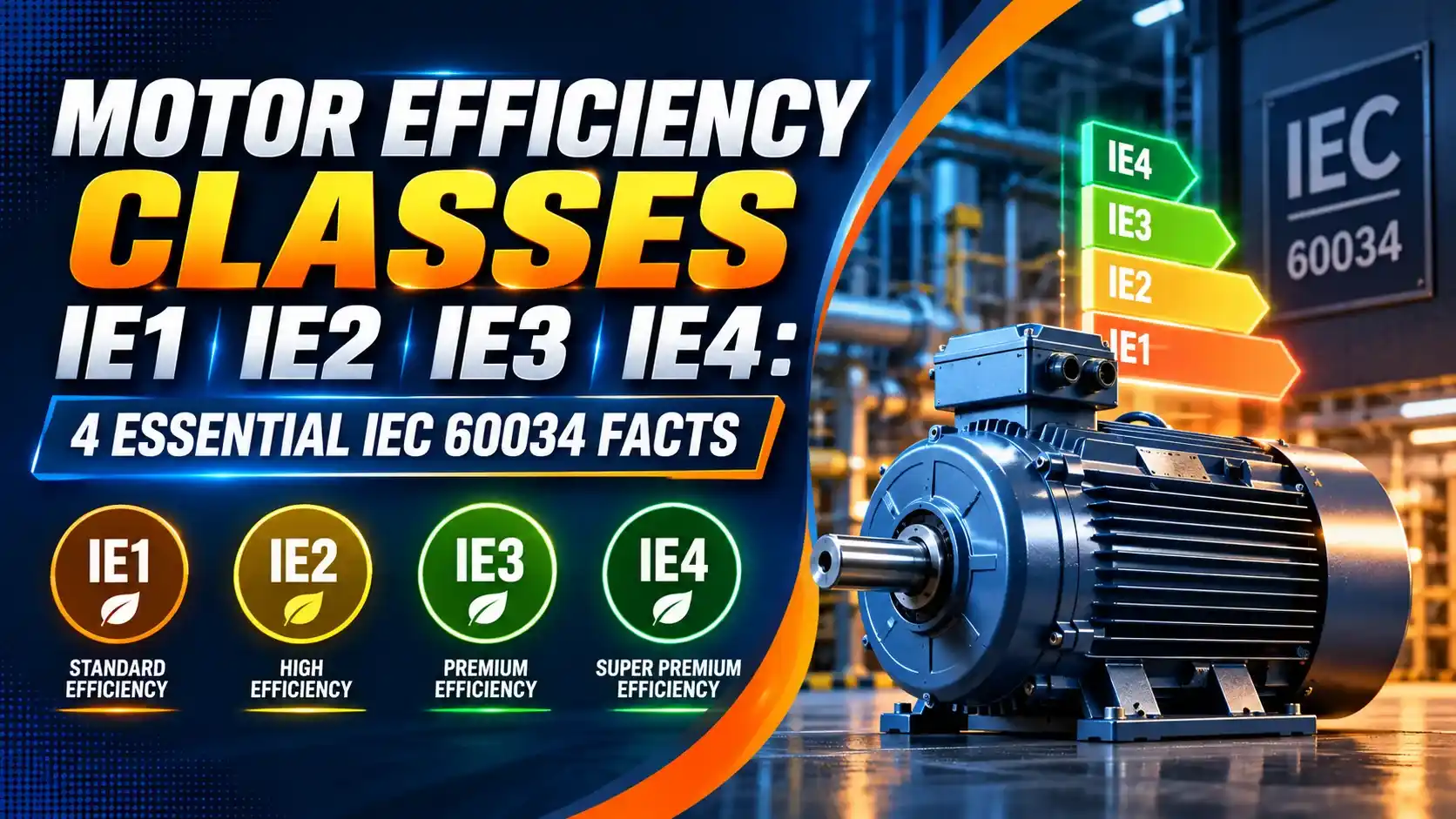
Motor efficiency classes are defined by IEC 60034-30-1. This standard sets the minimum efficiency a motor must achieve to belong to a given class.
IE stands for International Efficiency. The four main classes are IE1, IE2, IE3, and IE4. Each step up means lower energy losses inside the motor.
This guide explains what each motor efficiency class means and the real efficiency numbers at common power ratings. It also covers which class is mandatory in India and the EU.
Electric motors consume roughly 45 to 50 percent of all electricity used in industry. Even a 1 percent improvement in motor efficiency translates into thousands of kilowatt-hours saved every year.
The IE efficiency class on the motor nameplate is the single fastest way to know how much energy a motor wastes before you run it.
Why Motor Efficiency Classes Were Created
Before IEC 60034-30 standardised motor efficiency classes, different countries had different efficiency labels. Europe used EFF1, EFF2, EFF3. The USA used NEMA standards.
Manufacturers had to certify motors differently for every market. This made comparison almost impossible for engineers buying motors internationally.
The IEC introduced the IE classification in 2008. The 2014 update, IEC 60034-30-1, covers motors from 0.12 kW to 1000 kW at 50 Hz and 60 Hz.
It gives a single, globally consistent motor efficiency label. IE3 on a nameplate means the same thing whether the motor was made in Germany, India, China, or Brazil.
Test methods are defined separately in IEC 60034-2-1. This distinction matters: IEC 60034-30-1 defines the class boundaries; IEC 60034-2-1 defines how to measure the efficiency to check against those boundaries.
Motor Efficiency Classes IE1 to IE4: What Each One Means
Real Efficiency Numbers: What the IEC 60034-30-1 Table Says
The efficiency thresholds below are from IEC 60034-30-1:2014 for 4-pole motors at 50 Hz. These are minimum nominal efficiency values. Actual motor efficiency may be higher than the class minimum.
| Rated Power (kW) | IE1 min. efficiency (%) | IE2 min. efficiency (%) | IE3 min. efficiency (%) | IE4 min. efficiency (%) |
|---|---|---|---|---|
| 1.5 kW | 77.2 | 82.8 | 85.3 | 88.7 |
| 4 kW | 84.2 | 87.4 | 89.8 | 92.3 |
| 7.5 kW | 86.0 | 88.7 | 90.4 | 92.6 |
| 11 kW | 87.6 | 90.3 | 91.9 | 93.6 |
| 22 kW | 89.5 | 91.6 | 93.0 | 94.6 |
| 37 kW | 90.8 | 92.7 | 93.9 | 95.3 |
| 75 kW | 92.7 | 94.1 | 95.0 | 96.1 |
| 200 kW | 94.2 | 95.4 | 96.2 | 97.0 |
| 375 kW | 94.7 | 95.8 | 96.5 | 97.3 |
The efficiency gap between IE1 and IE3 is largest at small power ratings (8.1 points at 1.5 kW) and narrows at large ratings (1.8 points at 375 kW).
Even small percentage-point differences matter more at high power because the absolute energy flowing through the motor is much larger.
This is why engineers who think in percentage-point differences underestimate the real impact of moving from IE1 to IE3. The correct way to compare is to look at loss reduction, not efficiency-point difference.
How Motor Efficiency Classes Affect Energy Losses
Motor efficiency is defined as output power divided by input power. The difference is lost as heat. The motor efficiency class determines how low those losses must be.
The four main loss sources are shown in the tabs below.
Copper Losses (I squared R losses)
These are caused by current flowing through the resistance of the stator windings and rotor bars. They are proportional to the square of the current and the resistance.
Higher efficiency motors use more copper in the windings (reducing resistance) and design the rotor with lower-loss materials.
Copper losses are typically the largest single loss source in a standard induction motor. IE3 and IE4 motors often have deeper stator slots and more copper per slot.
In the case of IE4, some designs use a copper squirrel cage rotor instead of aluminium. This directly reduces I squared R losses at the same load.
Iron Losses (Core Losses)
These occur in the stator and rotor iron cores due to hysteresis and eddy currents as the magnetic field alternates at the supply frequency.
They are reduced by using thinner silicon steel laminations with higher silicon content and better annealing of the core after stamping.
IE3 and IE4 motors use premium-grade silicon steel. Laminations are 0.35 mm or thinner compared to 0.5 mm in older IE1 designs, reducing eddy current losses at 50 Hz and 60 Hz.
Friction and Windage Losses
These are caused by bearing friction and the drag of the cooling fan. They are relatively small but are reduced in higher motor efficiency classes by better bearings and fan designs.
Some IE4 motors use totally enclosed designs with external cooling or IP55 rated fan-cooled frames. These have lower windage losses than open drip-proof designs.
For permanent magnet motors, some designs can use significantly smaller fans because the rotor itself generates less heat.
Stray Load Losses
These are additional losses under load that come from non-uniform current distribution, leakage flux, and harmonic components in the air gap flux.
IEC 60034-2-1 specifies how stray load losses must be measured in the efficiency calculation. Motors tested without properly accounting for stray load losses can appear more efficient than they really are.
Always check that an efficiency certificate references IEC 60034-2-1 as the test method.
Energy Savings Worked Example: IE1 vs IE3 at 7.5 kW
This example shows the real annual energy and cost difference between an IE1 and an IE3 motor at the same load, running continuously in a pump application.
IE1 efficiency: 86.0%
IE3 efficiency: 90.4%
IE1 input power: 7.5 kW / 0.860 = 8.72 kW
IE3 input power: 7.5 kW / 0.904 = 8.30 kW
Power saved: 8.72 minus 8.30 = 0.42 kW
Operating hours per year: 8000 h (one continuous shift)
Annual energy saved: 0.42 kW x 8000 h = 3360 kWh/yr
Energy cost at Rs 8 per kWh: 3360 x 8 = Rs 26,880 per year
IE3 motor premium over IE1: approx. Rs 8,000 to Rs 12,000
Simple payback period: less than 6 months
Loss reduction check:
IE1 losses: 8.72 minus 7.5 = 1.22 kW wasted as heat
IE3 losses: 8.30 minus 7.5 = 0.80 kW wasted as heat
Loss reduction: (1.22 minus 0.80) / 1.22 x 100 = 34.4% fewer losses
The purchase price of a motor is typically less than 2% of its total 10-year lifecycle cost. Running cost dominates. This is why paying Rs 10,000 more for an IE3 motor instead of an IE1 motor almost always pays back within the first year of operation for any motor running more than 4000 hours per year.
Motor Efficiency Class Regulations by Region
| Region | Regulation | Current Minimum Class | Notes |
|---|---|---|---|
| European Union | EU Regulation 2019/1781 (Ecodesign) | IE3 for 0.75 to 1000 kW (since July 2021). IE4 for 75 to 200 kW (since July 2023). | IE2 permitted only when operated with a VFD. IE4 mandatory for 2, 4, and 6-pole motors in the 75 to 200 kW band. Brake motors and explosion-proof motors have some exemptions. |
| India | BIS IS 12615 (updated 2023) | IE3 for 0.75 to 375 kW (mandatory from July 2023) | IE2 was mandatory before July 2023. Testing must be done at a BIS-recognised laboratory using IS 15999 / IEC 60034-2-1 methods. IE class must be marked on the motor nameplate. |
| China | GB 18613-2020 | IE3 for most three-phase induction motors | Chinese standard aligns closely with IEC 60034-30-1. Phased implementation. IE4 under discussion for future editions. |
| USA / Canada | EISA 2007, DOE 10 CFR Part 431, NRCan | NEMA Premium (equivalent to IE3) for most AC motors 1 to 500 HP | Uses NEMA efficiency classes rather than IE designations, but the efficiency thresholds align. IE4 (Super Premium) mandatory for certain motor types from June 2027. |
| Australia | MEPS (Minimum Energy Performance Standards) | IE3 for most motors in the regulated power range | Aligns with IEC 60034-30-1. Tested under AS/NZS 1359 (aligned with IEC methods). |
| Southeast Asia | Various national MEPS | IE2 in many markets (Thailand, Vietnam, Malaysia) | Adoption of IE3 as minimum is progressing but not yet uniform. Major project specifications often require IE3 regardless of local law. |
Regulations tighten over time. A motor installed today at IE2 may become non-compliant if regulations are updated before the motor reaches end of life. IE3 motors cost only marginally more at point of purchase and are already the international baseline for project specifications, tender documents, and energy audits worldwide.
How to Read the IE Class from a Motor Nameplate
The motor nameplate is the rectangular metal plate fixed to the motor frame. IEC 60034-30-1 requires the motor efficiency class to be marked on it. Here is what to look for.
Key nameplate items for IE class verification
IE class marking: Printed as IE1, IE2, IE3, or IE4 on the nameplate per IEC 60034-30-1. If missing, ask the manufacturer for a test certificate.
Rated efficiency (eta or n): The nameplate efficiency at full load and rated power. Must be at or above the IEC 60034-30-1 minimum for the stated IE class and pole count.
Pole count and frequency: The IE class threshold depends on both. A 6-pole motor has a different minimum than a 4-pole motor. Always use the correct pole count and frequency.
How to verify an IE class claim
Step 1: Find the rated output power (kW), pole count (2P, 4P, 6P, 8P), and supply frequency (50 Hz or 60 Hz) on the nameplate.
Step 2: Look up the IEC 60034-30-1 minimum efficiency for the stated IE class at that power, pole count, and frequency in the standard's efficiency tables.
Step 3: Compare the nameplate efficiency against the table minimum. The nameplate value must be at or above the table minimum. If lower, the IE class marking is incorrect.
Step 4: For formal verification, request the test certificate showing the efficiency was measured per IEC 60034-2-1 at an accredited laboratory. A nameplate alone is not sufficient evidence for regulatory compliance.
Common mistakes when reading IE class markings
Confusing IE class with efficiency value: IE3 does not mean 93% efficient. It means the motor meets the IE3 minimum for its specific power rating and pole count.
Ignoring pole count: A 6-pole 22 kW motor has a lower IE3 minimum than a 4-pole motor at the same kW. Using the wrong column in the table gives the wrong threshold.
Accepting a self-declared class without a test certificate: Any manufacturer can print IE3 on a nameplate. Always request a third-party test certificate referencing IEC 60034-2-1 for compliance.
IE4 and the Technology Shift from Induction to Synchronous Motors
For motors below about 55 kW, reaching IE4 motor efficiency with a standard cage induction motor is very difficult. The squirrel cage rotor losses are too high to meet the IE4 threshold.
IE4 at smaller frame sizes uses one of two technologies. The first is a Synchronous Reluctance Motor (SynRM). This motor has a specially shaped rotor with no copper or aluminium windings.
It has very low rotor losses because there is no current in the rotor during normal operation.
The second is a Permanent Magnet Synchronous Motor (PMSM). This has permanent magnets on the rotor that create the rotor field without any electrical excitation, and therefore without rotor copper losses.
PMSMs are more expensive than SynRM designs but can reach even higher efficiencies, approaching the proposed IE5 class at some ratings.
The IEC 60034-30-2 standard (a companion to IEC 60034-30-1) defines efficiency classes for variable speed motors specifically. This standard includes the IE5 ultra-premium class as an informative annex, which sets the stage for the next round of efficiency regulation beyond IE4.
Watch: IE Motor Efficiency Classes Explained
Motor Efficiency Classes Questions Engineers Ask
Related Articles on This Site
- Thermal Overload Relay Explained
- Active, Reactive and Apparent Power Explained
- How to Calculate Short-Circuit Fault Current
- MCB vs MCCB vs ELCB vs RCCB: 4 Critical Differences
- What Is Arc Flash? 4 Critical PPE Category Facts
External References
- IEC 60034-30-1: Rotating Electrical Machines Part 30-1, Efficiency Classes | IEC
- IE Motor Efficiency Classification Guide | ABB (2024)
What We Learn Today
- Motor efficiency classes IE1 to IE4 are defined by IEC 60034-30-1. Each class is a minimum efficiency threshold that depends on power rating, pole count, and frequency, not a single fixed efficiency number.
- IE3 is now the mandatory minimum in India, the EU, China, and Australia. Moving from IE1 to IE3 reduces motor losses by 30 to 35 percent even though the efficiency percentage points look small.
- IE4 at smaller frame sizes requires SynRM or PMSM technology and a VFD. Always verify the IE class claim against the IEC 60034-30-1 table and ask for a test certificate referencing IEC 60034-2-1.