
Level sensors are capable of measuring far more than just level. In an open channel, such as a stream, irrigation canal, or unpressurized sewer line, the same bubblers, radar, and ultrasonic transmitters used for tank level can measure flow rate too.
A weir or flume does not measure flow directly. It constricts the channel in a known, repeatable way, and lets a level sensor upstream do all the actual measuring.
Flow rate measurement in an open channel is accomplished using hydraulic structures known as weirs and flumes. Both function by constricting the flow of the channel and measuring how the fluid level responds to that constriction. Because the physical characteristics of a weir or flume, and therefore its effect on flow, are known and repeatable, a level sensor placed at the right point can feed a mathematical equation that converts a simple head reading into an accurate flow rate.
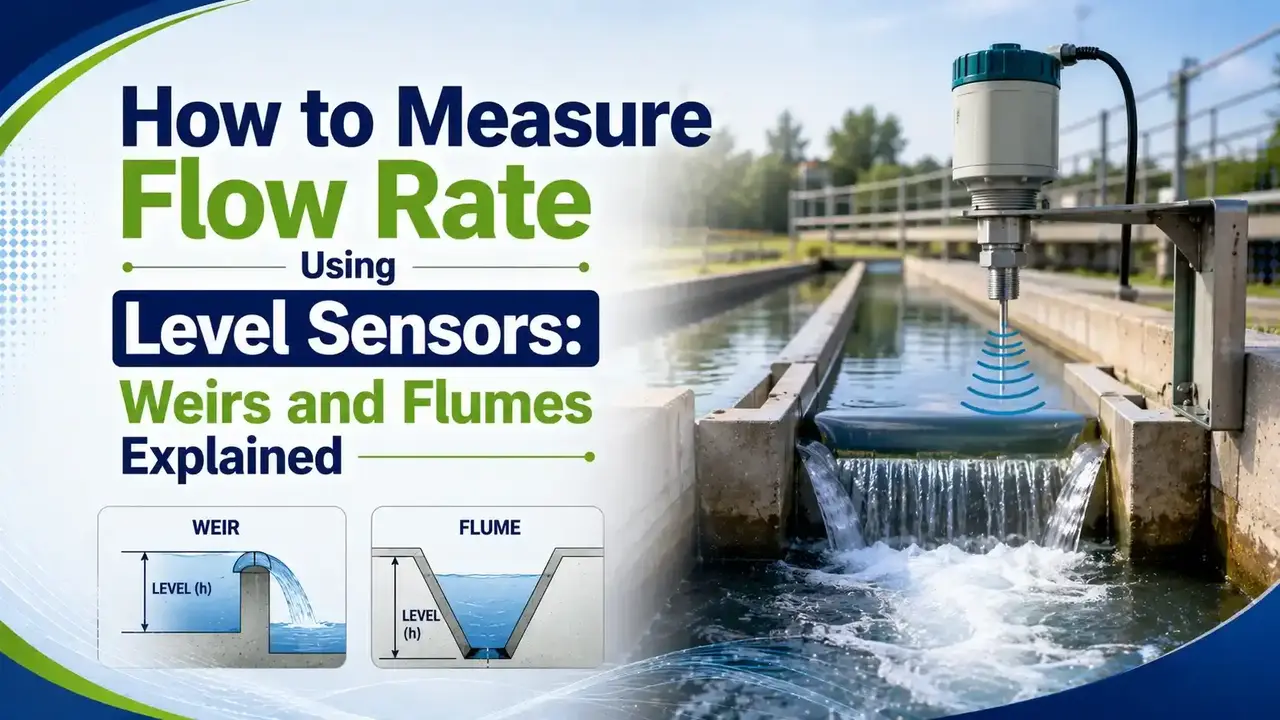
This guide covers how level sensors measure flow in open channels, the specific level sensing technologies typically used, the real formulas behind rectangular, V notch, and Cipolletti weirs, how Parshall and Cutthroat flumes work, common installation mistakes to avoid, and when to choose a weir over a flume or the other way around.
How Level Sensors Measure Flow
The core idea is straightforward once you see it laid out. A weir or flume is installed across the channel, and it always changes the relationship between water level and flow rate in the same predictable way, provided its geometry is standard and well maintained.
A level sensor is positioned upstream of the structure, at the specific point the applicable formula calls for, and continuously reports the head, the depth of water above a reference point on the weir or flume. That head value is then run through the structure's own flow equation to produce a continuous flow rate reading, without ever touching the water directly with a mechanical flow sensing element.
Level Sensor Technologies Used for Open Channel Flow
The same three level sensing technologies commonly used for tank level measurement also dominate open channel flow measurement, chosen based on the environment and the reliability required.
Bubbler Systems
A bubbler injects a small, steady stream of air or gas through a tube submerged at the measurement point, then reads the back pressure required to push bubbles out against the water column, a technique covered in more depth in our guide to choosing the right level sensor.
Radar Level Transmitters
Non contact radar sends a microwave pulse down to the water surface and times its return, unaffected by turbulence, foam, or debris that can confuse other technologies in an open, exposed channel.
Ultrasonic Level Transmitters
An ultrasonic transmitter times a sound pulse's round trip to the water surface, a lower cost non contact option widely used in irrigation canals and wastewater applications, similar to ultrasonic level transmitters used in closed tanks.
Weirs: Types and Formulas
Weirs function very similarly to small dams. They span the full width of the channel and constrict the flow, allowing fluid to escape over a precisely shaped opening and continue downstream. The fluid level is always measured upstream from the weir, at a set distance that avoids the drawdown curve right at the crest.
Rectangular Weir
The simplest and most common weir shape, a rectangular weir uses a horizontal crest across part or all of the channel width.
Where Q is flow in cubic feet per second, L is the crest length in feet, and H is the head in feet above the crest, using the standard Francis formula for a suppressed rectangular weir.
V Notch (Triangular) Weir
A V notch weir concentrates all flow through a narrow triangular notch, which makes it far more sensitive and accurate at low flows than a rectangular weir, since the flow area shrinks disproportionately as head drops.
Common notch angles include 22.5°, 45°, 60°, and 90°, each with its own coefficient, chosen based on the expected flow range and required low flow sensitivity.
Cipolletti (Trapezoidal) Weir
A Cipolletti weir uses a trapezoidal notch with sides sloped at a specific 1 horizontal to 4 vertical ratio, chosen specifically so that no separate correction factor for end contractions is needed, simplifying the math compared to a rectangular weir.
Where L is the crest length at the base of the trapezoid, in feet, and H is head in feet, giving flow in cubic feet per second.

🧮 Interactive Weir Flow Calculator
Select a weir type, enter the head and crest length, and get the calculated flow rate.
Flumes: Construction and the Parshall Flume Formula
Flumes typically consist of three sections: a converging (constricting) end, a throat, and a diverging (expanding) end. The flume sits partially submerged in the channel, the throat constricts the flow, and the fluid level is measured at a set point in the converging section.
The Parshall flume, developed by Ralph L. Parshall of the U.S. Soil Conservation Service, is the most widely used flume type. It accelerates flow by contracting both the sidewalls and dropping the floor at the throat, creating a transition from subcritical to supercritical flow that makes the head to flow relationship reliable and repeatable.
Where Q is flow in cubic feet per second, W is throat width in feet, and H is head in feet, valid for standard Parshall flume throat widths between 1 and 8 feet under free flow conditions.
Other common flume types include the Palmer-Bowlus flume, designed to fit directly into existing round pipes without major channel modification, the H flume, favored for its wide flow range in a single structure, and the Cutthroat flume, which uses a flat floor with no throat section at all, following its own Q = K × H^n relationship where K and n depend on the flume's length.
Common Installation Mistakes That Ruin Weir and Flume Accuracy
Even a perfectly manufactured weir or flume can produce misleading flow readings if it is installed or maintained poorly. Most of these mistakes trace back to disrupting the exact flow conditions the formula assumes, similar to the installation precautions that matter just as much for pressure transmitters and other field instruments.
Sediment and Debris Buildup
Silt, sediment, and debris accumulating upstream of a weir crest, or inside a flume's converging section, change the effective geometry the formula was calibrated against. Regular inspection and cleaning is essential, particularly for weirs, which lack a flume's natural self cleaning action.
Non Level Installation
A weir crest or flume floor that is not perfectly level, both lengthwise and side to side, introduces a systematic error into every single reading, since the formulas assume a uniform, level reference surface across the full width of the structure.
Submerged (Non Free Flow) Conditions
Every standard weir and flume formula assumes free flow discharge, meaning the water downstream of the structure does not back up high enough to influence the upstream level. Submergence invalidates the simple head to flow relationship and requires a separate, more complex submerged flow correction.
Incorrect Sensor Positioning
Placing the level sensor too close to the crest or throat picks up the drawdown curve rather than the true undisturbed upstream head, while placing it too far away can pick up unrelated channel disturbances. Each structure type specifies an exact measurement location for exactly this reason.
Non Uniform Approach Flow
Turbulent, swirling, or uneven approach flow entering the weir or flume distorts the head reading even when the structure itself is installed correctly. A straight, calm approach channel of sufficient length upstream is part of every proper installation, much like straight pipe run requirements shape closed pipe flow measurement accuracy too.
Watch: Weirs and Flumes Explained
This video covers the essentials of weirs and flumes for precise open channel flow measurement.
Video: "Explained: Weirs and Flumes, Measurement of Flow", via YouTube.
Weirs vs Flumes: When to Use Each
Choosing between the two often comes down to the same practical tradeoffs engineers weigh when selecting any measurement approach: upfront cost versus long term maintenance burden.
| Factor | Weirs | Flumes |
|---|---|---|
| Cost to construct | Generally lower | Generally higher, more material required |
| Sediment and debris | Prone to accumulation upstream | Largely self cleaning |
| Head loss | Higher, since flow drops over the crest | Lower, especially with Parshall style flumes |
| Resistance to submergence | Poor, needs a ventilated nappe for free flow | Good, especially for H type and RBC flumes |
| Best suited for | Clean water, low sediment applications | Wastewater, irrigation water with solids or debris |
Field accuracy for both types tends to land around plus or minus 10% once installation, calibration, and site conditions are accounted for, even though laboratory conditions can show tighter differences between structure types, a similar real world gap to what shows up in flow meter reading stability more broadly, and a reminder that no open channel flow measurement, however well designed, escapes the need for periodic field verification against a known reference.
A weir and a flume solve the same problem in opposite ways. A weir forces water to drop over an obstruction; a flume forces water to squeeze through one. Both turn that forced change into a number a level sensor can read reliably.
FAQs on Measuring Flow with Level Sensors
You May Also Like
How to Choose the Right Level Sensor for Your Application
Weirs and flumes are only half the picture, the level sensor reading the head still has to be selected correctly for the environment. This guide covers the key selection factors, technology comparisons, and common mistakes to avoid when picking a level sensor for any application, open channel or otherwise.
Read Full Article →External References
What we learn today
- Weirs and flumes let ordinary level sensors, bubblers, radar, and ultrasonic, measure open channel flow rate rather than just tank level.
- Rectangular, V notch, and Cipolletti weirs each follow their own head to flow formula, with V notch weirs best suited to low flow accuracy.
- Parshall flumes use a converging section, throat, and diverging section, with a flow formula that bakes throat width directly into the head exponent.
- Weirs tend to be cheaper but more prone to sediment buildup, while flumes cost more upfront but handle solids and debris far better.
- Real world field accuracy for both weirs and flumes tends to land around plus or minus 10%, regardless of which structure type is used.