
Most motors slow down a little under load. A synchronous motor refuses to, locking its rotation to the frequency of the AC supply no matter what the load throws at it. Here is exactly how that lock happens and why it makes these motors so valuable in industry.
A synchronous motor is the one AC machine that will not compromise on speed. Load it lightly or load it heavily, and as long as it stays locked to the supply frequency, it turns at exactly the same speed either way.
A synchronous motor is a type of AC motor that runs at a speed directly proportional to the frequency of the current supplying it, and that speed does not change with load the way an induction motor's does. This single property is why synchronous motors show up in clocks, timers, and industrial drives where constant speed genuinely matters.
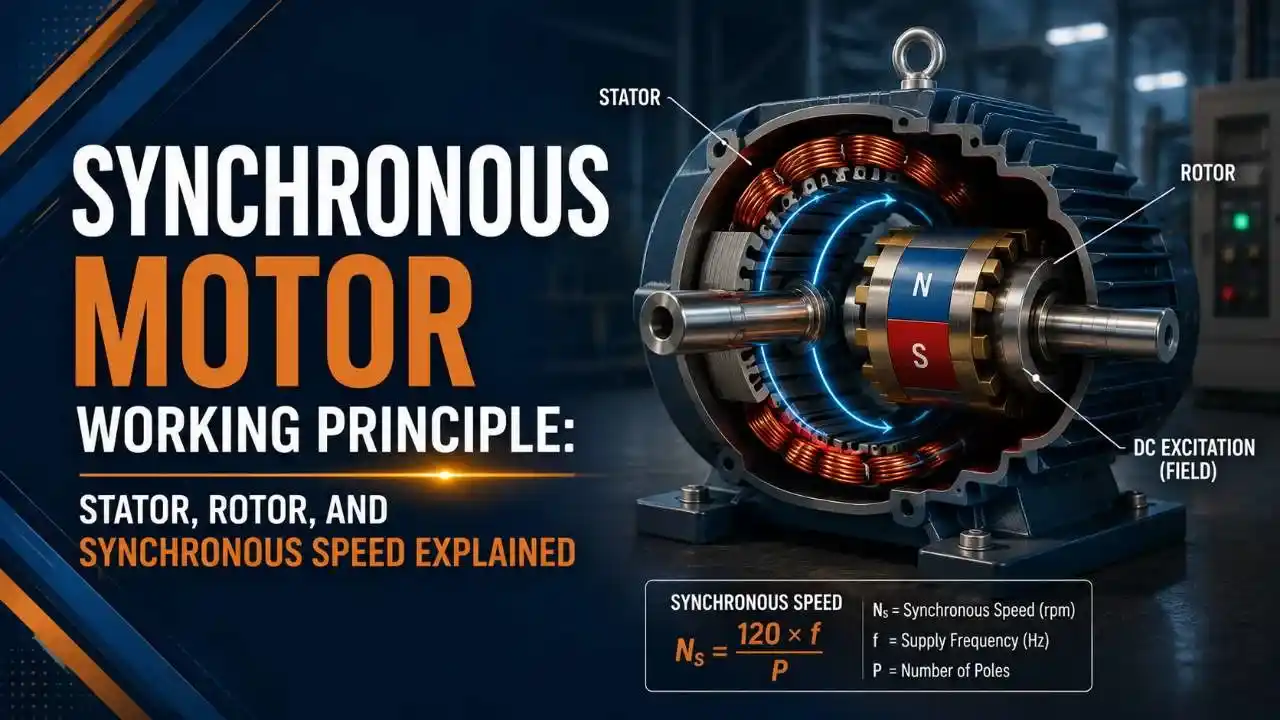
This guide walks through the construction of a synchronous motor, exactly how the stator and rotor interact to create synchronism, why the motor cannot start on its own, the methods used to get it moving, and where these motors actually get used.
What Is a Synchronous Motor
A synchronous motor operates at a speed set entirely by the frequency of its AC supply, and it holds that speed regardless of changes in load. An induction motor, by contrast, slips a little more as load increases, so its speed drifts down under heavier work.
That difference makes synchronous motors the natural choice anywhere constant speed control genuinely matters, such as clocks, timers, and industrial processes that depend on a fixed rate of rotation.
Construction: Stator and Rotor
Stator
The stationary part of the motor, wound with three phase windings similar to an induction motor. Energizing these windings with AC power is what creates the rotating magnetic field.
Rotor
The rotating part of the motor, built as either a salient pole design or a cylindrical design, carrying electromagnets or permanent magnets that lock onto the stator field.

Synchronous Motor Working Principle
The working principle rests on one idea: synchronism between the rotor's rotation and the frequency of the AC supply. When a three phase AC supply energizes the stator windings, they produce a rotating magnetic field.
That rotating field interacts with the magnetic field of the rotor, locking the rotor into step so it rotates at the same rate as the field itself. This locked in step rotation is what gives the motor its name and its defining constant speed behavior.
The moment the rotor locks onto the rotating field, load no longer has any say over speed. Add more load and the motor draws more current and torque to keep up, but the speed itself does not move.
The Synchronous Speed Formula
- Ns is synchronous speed in revolutions per minute
- f is the frequency of the AC supply, typically 50 Hz or 60 Hz
- P is the number of poles in the motor
This formula shows exactly why synchronous speed is fixed once frequency and pole count are set. The only practical way to change the motor's operating speed is to change the supply frequency itself, which is exactly what a variable frequency drive does.
Watch: Synchronous Motors Explained
This video from the Electrical Deck channel covers the same stator and rotor interaction with clear animations.
Video: "Synchronous Motor Explained", via YouTube.
Why a Synchronous Motor Is Not Self Starting
At standstill, the stator's rotating field still forms, but it sweeps past the stationary rotor so quickly that the rotor only feels an alternating torque, first one way, then the other, that averages out to nothing. The rotor has no way to catch that field on its own.
Because of this, every synchronous motor needs some form of external help to bring it near synchronous speed before its field excitation locks it in step permanently.
How to Start a Synchronous Motor
Damper Winding (Amortisseur Winding)
Copper bars embedded in the rotor poles form a squirrel cage like structure. The motor starts as an induction motor using this winding, and once it nears synchronous speed, DC excitation locks it into step.
Pony Motor (Auxiliary Motor)
A small external motor couples to the shaft and brings the machine near synchronous speed. Once it gets there, the pony motor disconnects and DC excitation takes over to maintain synchronism.
Variable Frequency Drive
A VFD gradually raises the supply frequency from zero up to its rated value, letting the rotor accelerate smoothly. Once it reaches synchronous speed, DC excitation is applied for efficient running.
Types of Synchronous Motors
| Type | Key Characteristic | Typical Use |
|---|---|---|
| Reluctance synchronous motor | Variable reluctance rotor that aligns with the field to minimize reluctance | Low power precision control tasks |
| Permanent magnet synchronous motor | Permanent magnets in the rotor remove the need for external excitation | Robotics, electric vehicles, CNC machines, HVAC systems |
| Hysteresis motor | Hard magnetic rotor material generates torque through the hysteresis effect | Electric clocks, timing devices, audio equipment |
Applications of Synchronous Motors
Industrial Drives
Conveyors, mixers, extruders, machine tools, printing presses, and packaging machinery.
Power Generation
Driving large generators or pumps while also improving power factor at the plant level.
Pumps
Driving pump rotors to maintain constant fluid flow rates.
Clocks and Timers
Keeping accurate time over extended periods without drift.
Robotics
Permanent magnet variants provide the precise control robotic joints need.
Wind Turbines
Operating in reverse as generators tied to grid frequency.
FAQs on Synchronous Motors
You May Also Like
How AC Induction Motor Works
Synchronous motors are best understood next to their most common counterpart. This guide breaks down how an induction motor generates torque without any rotor excitation at all, and why its speed quietly slips under load where a synchronous motor's never does.
Read Full Article →What we learn today
- A synchronous motor runs at a speed fixed by supply frequency and pole count, and that speed does not change with load.
- The stator's rotating magnetic field locks the rotor into step, and that locked rotation is the whole working principle.
- A synchronous motor cannot start on its own and needs damper windings, a pony motor, or a VFD to reach synchronous speed first.
- Reluctance motors, permanent magnet motors, and hysteresis motors each apply the same synchronism idea with a different rotor design.
- Beyond driving industrial equipment, an overexcited synchronous motor can also improve a facility's power factor.