
A servo motor rarely dies without warning. It runs hot, hunts a little, throws an odd fault code, and then one day it stops for good. Here are the four failure paths that account for nearly every servo motor problem, and how to design and maintain around each one. This guide breaks down why servo motors fail in plain, plant floor language.
Servo motors are precise, fast, and reliable right up until they are not. When one fails, the line behind it usually stops too, and the cost of that stoppage is almost always higher than the cost of the motor itself. Understanding why servo motors fail is what separates a five minute fix from a week of guesswork.
Servo motors show up everywhere motion needs to be accurate: CNC machines, packaging lines, robotics, conveyors, and precision positioning systems. Their accuracy makes them valuable, and that same precision makes them sensitive to conditions that a simple induction motor would shrug off. That sensitivity is at the root of why servo motors fail more often than the equipment around them.
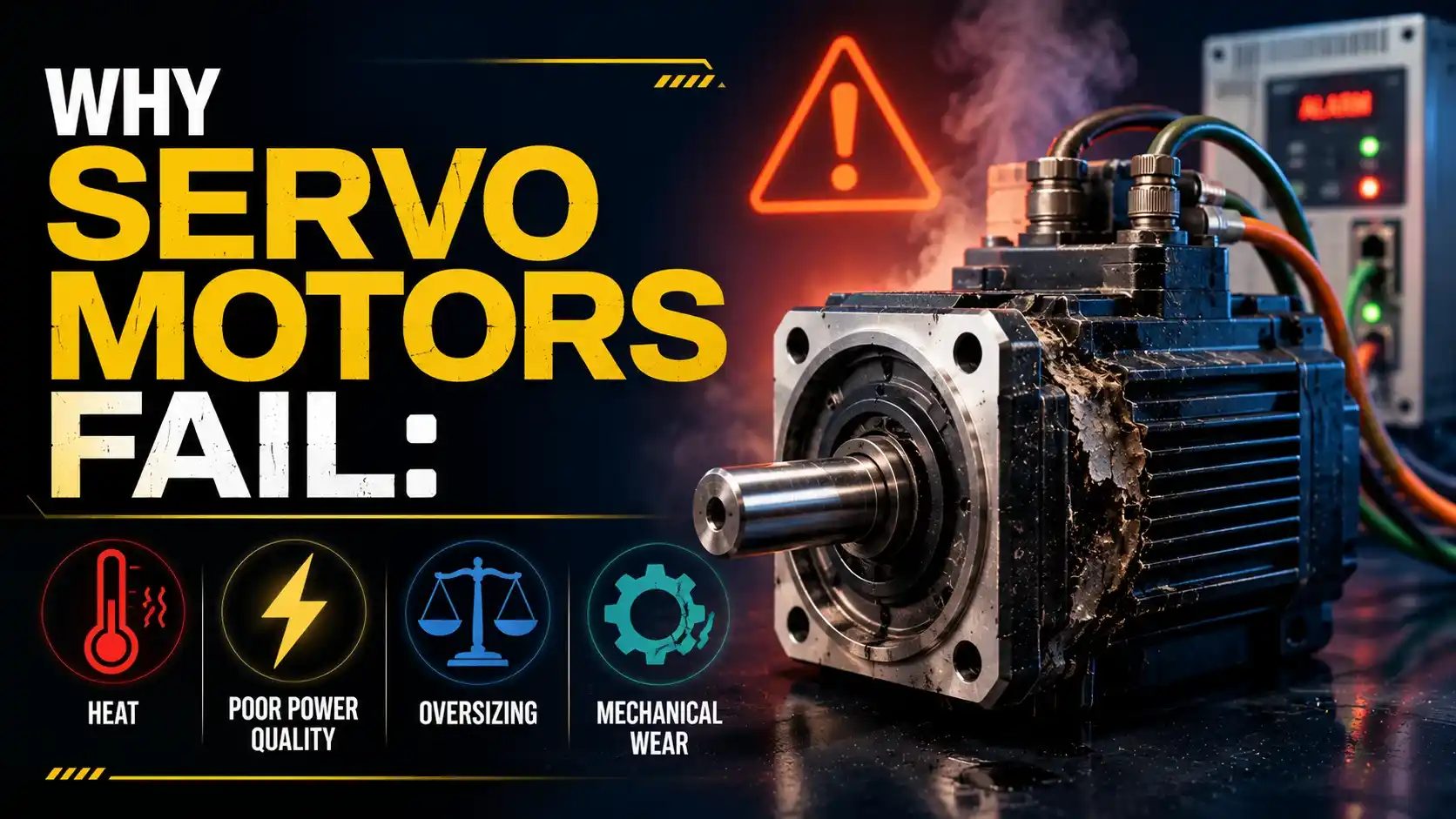
Most servo motor failures trace back to one of four overlapping causes: heat, poor power quality, oversizing at the design stage, and ordinary mechanical wear. Understanding all four is what actually keeps a servo system running for its full service life, and it answers the core question of why servo motors fail in the first place.
The Four Failure Paths at a Glance
Heat
The slow, silent breakdown of insulation, bearings, and magnets from sustained high temperature. This is the single biggest reason why servo motors fail in the field.
Poor Power Quality
Voltage dips, surges, harmonics, and noise from the wider electrical system reaching the motor and drive. This is one of the least obvious reasons why servo motors fail.
Oversizing
Choosing a bigger motor than the application needs, assuming it adds safety margin instead of risk. This design choice explains why servo motors fail even when everything looks generously sized.
Mechanical Wear
Misalignment, worn couplings, and contamination that stress bearings and the encoder over time. This overlooked cause rounds out the full picture of why servo motors fail.
1. Heat: The Most Common Cause of Servo Motor Failure
Why It Happens
Sustained high load or torque, poor ventilation around the motor or drive, a clogged or blocked cooling fan, running past the rated duty cycle, and mechanical binding or misalignment that adds friction all raise the motor's internal temperature over time. Heat like this is the single biggest answer to why servo motors fail.
What It Damages
Heat breaks down the winding insulation, wears out bearings early, weakens magnetic strength, reduces available torque, raises motor current, and eventually causes an unplanned shutdown. Because the damage builds slowly, it often goes unnoticed until the motor simply stops working.
How to Prevent It
Give the cabinet enough airflow and cooling, avoid running the motor above roughly 80 to 85 percent of its rated continuous load, keep the motor free of dust, oil, and dirt, inspect bearings and couplings on a schedule, and monitor temperature through the drive or dedicated sensors.
Keeping continuous load under about 80 to 85 percent of the motor's rated value is one of the simplest, highest impact ways to extend servo motor life. The margin costs almost nothing and buys back years of service, and it answers why servo motors fail long before their rated lifespan.

2. Poor Power Quality: A Hidden Source of Servo Motor Damage
Why It Happens
Voltage dips or surges, high harmonic content, electrical noise from nearby welding equipment or large motors, unstable grounding, and sudden power interruptions all disturb the clean, stable supply a servo drive needs to control the motor accurately. Disturbances like this are a major part of why servo motors fail in facilities with heavy electrical loads nearby.
What It Damages
Disturbed power causes overcurrent heating in the windings, unpredictable torque response, drive shutdowns and fault codes, encoder errors, and premature wear across motor components. These faults are usually intermittent and can be genuinely difficult to trace back to their source, which is part of why servo motors fail without a clear pattern.
How to Prevent It
Install power conditioners, stabilizers, or a UPS where needed, use proper grounding and shielding on cables, keep power wiring physically separate from signal and encoder wiring, add line reactors or harmonic filters where electrical noise is a known problem, and monitor voltage patterns on a regular basis rather than only after a fault.
3. Oversizing Mistakes: When a Bigger Motor Backfires
Why It Happens
Engineers oversize motors to future proof a design, from inaccurate load calculations, from a weak understanding of the actual motion profile, or simply from assuming that a larger motor always performs better. This habit is a surprisingly common answer to why servo motors fail earlier than expected.
What It Damages
A larger motor usually needs a larger reflected inertia match, and a mismatch here creates instability. It also draws more inrush current at start, struggles to control a load it was never sized against in the first place, and increases vibration and resonance while running less efficiently and generating more heat, compounding why servo motors fail sooner than expected.
How to Prevent It
Carry out detailed load and inertia calculations before selecting a motor, use the manufacturer's sizing guides rather than a rule of thumb, account for the real motion profile, acceleration, deceleration, and duty cycle, and pick a motor with adequate margin rather than an excessive one.
4. Mechanical Wear: The Cause That Often Gets Missed
Why It Happens
Couplings that were never precisely aligned during installation, bearings that wear from ordinary use, and dust, coolant, or moisture getting past a seal that was not rated for the environment all place mechanical stress on a servo motor that heat and power quality checks will not catch. This is the overlooked fourth answer to why servo motors fail.
What It Damages
Misalignment and worn couplings accelerate bearing wear and add vibration that shows up as resonance and unexpected heating. Contamination reaching the encoder disc or bearing races causes position errors and eventual mechanical seizure, rounding out why servo motors fail from mechanical causes alone.
How to Prevent It
Use laser alignment during coupling installation rather than alignment by eye, select an enclosure rating that actually matches the environment, particularly in washdown, marine, or heavy dust areas, add vibration monitoring where the motor is critical to the process, and protect encoder cabling from both physical damage and electrical noise.
Servo Motor Health Checklist
These habits catch most of the reasons why servo motors fail before they become a shutdown.
Trend the Temperature
Log motor and drive temperature, not just a one time reading, since heat is the top reason why servo motors fail.
Keep It Clean
Clear dust and debris from the motor body and cooling fan regularly, since contamination is an overlooked reason why servo motors fail.
Watch Line Quality
Monitor for voltage sags, surges, and rising harmonic content.
Recheck Alignment
Verify coupling alignment during commissioning and after any rework.
Confirm Sizing
Revisit inertia ratio and duty cycle whenever the application changes, since oversizing is a common answer to why servo motors fail.
Log Fault Codes
Track drive fault history instead of clearing and forgetting each one.
Common Oversizing Myths
Oversizing is one of the quieter answers to why servo motors fail, since it rarely looks like a mistake at the time.
✔ Do
- Size the motor to the actual torque, speed, and inertia the application needs, since mismatched sizing is a common answer to why servo motors fail
- Keep the load to motor inertia ratio within the range the manufacturer recommends
- Treat future capacity needs as a separate design decision from today's sizing
- Confirm sizing again whenever the mechanical load or motion profile changes
✘ Don't
- Assume a bigger motor is automatically a safer or better choice, a common blind spot behind why servo motors fail
- Skip the inertia matching calculation to save time during design
- Use peak torque figures as if they were continuous torque ratings
- Ignore rising vibration or resonance as just normal machine noise
FAQs on Servo Motor Failure
These are the questions engineers ask most often about why servo motors fail.
External References
These sources go deeper into the engineering behind why servo motors fail.
- Application Sizing Guide for Servomotor Selection, Kollmorgen
- NEMA MG 1, Part 31, Definite Purpose Inverter Fed Motors
- Understanding Harmonics in Power Systems, IEEE 519 Explained
What we learn today
- Heat is the most common and most preventable driver of why servo motors fail, and staying under about 80 to 85 percent of rated continuous load protects insulation and bearings.
- Poor power quality, dips, surges, harmonics, and noise, can damage a servo motor and its drive while looking like an unrelated intermittent fault.
- Oversizing a motor beyond the application's real torque, speed, and inertia needs usually creates instability and heat rather than a safety margin.
- Misalignment, worn couplings, and contamination are a fourth, frequently overlooked answer to why servo motors fail that alignment checks and correct enclosure ratings can prevent.
- Right sizing, clean power, proper cooling, and correct alignment together give a servo motor its full, expected service life.