
Table of Contents
ToggleThermocouple Accuracy: Introduction
Temperature measurement is one of the most important functions in industrial processes. Industries such as chemical plants, oil & gas, power generation, food processing, pharmaceuticals, and steel manufacturing all depend heavily on accurate temperature monitoring.
Among all temperature sensors, thermocouples are one of the most widely used because they are:
1. Simple
2. Rugged
3. Fast responding
4. Suitable for high temperatures
5. Cost-effective
However, many industries experience inaccurate temperature readings due to improper thermocouple installation, wrong cable selection, electrical interference, or poor maintenance practices.
Even a high-quality thermocouple can provide incorrect readings if basic installation and handling rules are ignored.
In this article, we will discuss practical tips to improve thermocouple accuracy and achieve more reliable temperature measurement in industrial applications.
What is Thermocouple Accuracy?
Thermocouple accuracy refers to how closely the measured temperature matches the actual process temperature.
Several factors can affect thermocouple performance, including:
1. Sensor type
2. Installation method
3. Environmental conditions
4. Calibration condition
5. Electrical noise
6. Aging and contamination
Improving thermocouple accuracy is important because inaccurate temperature readings can lead to:
1. Product quality issues
2. Energy losses
3. Process instability
4. Equipment damage
5. Safety risks
You can also read our article: Common Types of Thermocouples and their ranges
How Thermocouples Work
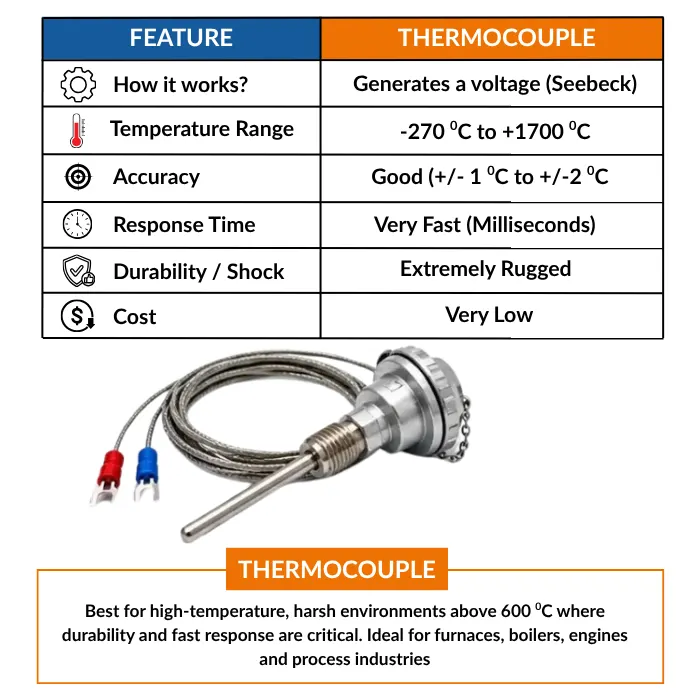
A thermocouple works based on the Seebeck Effect. When two dissimilar metals are joined together and exposed to temperature, they generate a small voltage.
This voltage changes according to temperature and is interpreted by the transmitter or controller.
Common thermocouple types include:
– Type K
– Type J
– Type T
– Type R
– Type S
Each type is designed for different temperature ranges and applications.
1. Select the Correct Thermocouple Type
One of the most important steps is choosing the correct thermocouple type for the application.
For example:
1. Type K is widely used for general industrial applications
2. Type J is suitable for moderate temperatures
3. Type T is commonly used for low temperatures
4. Type R and S are used for very high-temperature applications
Using the wrong thermocouple type can reduce accuracy and shorten sensor life.
Always consider:
1. Temperature range
2. Process atmosphere
3. Corrosion conditions
4. Required accuracy
before selecting a thermocouple.
2. Install the Thermocouple at the Correct Location
Improper sensor placement is one of the biggest causes of inaccurate readings.
If the thermocouple is installed:
1. Too close to the pipe wall
2. Near dead zones
3. In low-flow areas
it may not measure the true process temperature.
The sensing tip should ideally be placed where:
1. Good heat transfer exists
2. Proper process contact occurs
3. Representative temperature is available
Correct installation location improves measurement accuracy.
3. Use Proper Thermowells
Thermowells protect thermocouples from pressure, corrosion, and mechanical damage.
However, poorly selected thermowells can create slow response times and inaccurate readings.
For better accuracy:
1. Use correct insertion length
2. Avoid oversized thermowells
3. Ensure good thermal conductivity
4. Minimize excessive vibration
A properly designed thermowell improves both sensor life and measurement stability.
4. Avoid Electrical Noise and EMI
Thermocouples generate very small millivolt signals. Because of this, they are highly sensitive to electrical noise and electromagnetic interference (EMI).
Noise can come from:
1. Motors
2. VFDs
3. Power cables
4. High-current equipment
This interference can create unstable or incorrect temperature readings.
To reduce noise problems:
1. Use shielded cables
2. Keep signal cables away from power cables
3. Ensure proper grounding
4. Use isolated transmitters if required
Good wiring practices are essential for accurate thermocouple performance.
5. Use Correct Compensation Cable
Many technicians make the mistake of using ordinary copper cable instead of thermocouple compensation cable.
This can create significant measurement errors.
Compensation cables are specially designed to match the thermocouple characteristics.
Always ensure:
1. Correct cable type
2. Correct polarity
3. Proper termination
Wrong cable selection can easily affect accuracy by several degrees.
6. Reduce Extension Cable Errors
Long extension cable runs may introduce signal losses and electrical interference.
To improve performance:
1. Keep cable length reasonable
2. Use high-quality compensation cables
3. Avoid unnecessary junctions
4. Protect cables from moisture and heat
Proper cable management improves signal quality and stability.
7. Perform Regular Calibration
Thermocouples can drift over time due to:
1. Aging
2. Oxidation
3. Contamination
4. High-temperature exposure
Periodic calibration helps identify sensor drift before it affects the process.
Industries should establish proper calibration schedules based on:
1. Process criticality
2. Operating temperature
3. Sensor usage conditions
Regular calibration is one of the simplest ways to maintain measurement accuracy.
8. Protect Thermocouples from Moisture and Corrosion
Harsh industrial environments can damage thermocouple materials and connections.
Moisture and corrosion can:
1. Increase resistance
2. Create unstable signals
3. Cause premature failure
Using proper protection methods such as:
1. Stainless steel protection tubes
2. Weatherproof enclosures
3. Proper cable glands
helps improve sensor reliability and lifespan.
9. Minimize Response Time Errors
A slow response time may create delayed temperature readings.
This is especially important in fast-changing processes.
Response time can be improved by:
1. Using smaller thermowells
2. Improving thermal contact
3. Reducing unnecessary insulation
4. Selecting faster-response sensors
Fast and accurate response improves process control performance.
10. Avoid Mechanical Stress and Vibration
Industrial vibration can damage thermocouples and create unstable readings.
Excessive vibration may:
1. Crack thermowells
2. Damage sensor junctions
3. Cause loose connections
Proper mounting and vibration-resistant designs help improve long-term accuracy.
Common Thermocouple Mistakes
Many thermocouple problems are caused by simple installation mistakes.
Some common errors include:
1. Wrong thermocouple type selection
2. Wrong polarity connection
3. Poor grounding
4. Improper insertion depth
5. Using standard copper cable
6. Ignoring calibration schedules
Even experienced technicians occasionally overlook these basic issues.
Let us take an Example
In one chemical plant, operators noticed unstable reactor temperatures despite using high-quality thermocouples.
After investigation, engineers discovered the thermocouple cable was routed alongside a VFD power cable.
The electrical noise from the VFD created signal fluctuations.
Once the cable routing was corrected and proper shielding was installed, the temperature readings became stable and accurate.
This example shows how installation practices directly affect thermocouple performance.
FAQs About Thermocouple Accuracy
1. What affects thermocouple accuracy the most?
Improper installation, electrical noise, wrong cable selection, and sensor aging are some of the biggest factors affecting thermocouple accuracy.
2. Why is compensation cable important for thermocouples?
Compensation cables maintain the correct thermoelectric characteristics and help prevent temperature measurement errors.
3. Can EMI affect thermocouple readings?
Yes. Thermocouples generate very small millivolt signals, so electrical noise and EMI can easily create unstable or inaccurate readings.
4. How often should thermocouples be calibrated?
Calibration frequency depends on the application, but critical industrial processes usually require periodic calibration checks.
5. Which thermocouple type is most commonly used?
Type K thermocouples are the most widely used because they offer a wide temperature range and good durability for general industrial applications.
What we learn today?
Thermocouples are reliable and widely used temperature sensors, but their accuracy depends heavily on proper installation, wiring, calibration, and maintenance.
Even the best thermocouple can produce incorrect readings if:
1. Wrong cables are used
2. EMI is ignored
3. Installation is poor
4. Calibration is neglected
Improving thermocouple accuracy does not always require expensive equipment.
In many cases, simple practices such as correct cable selection, proper grounding, better installation, and periodic calibration can significantly improve performance.
In instrumentation, accurate measurement is not only about selecting the right sensor.
It is also about applying the sensor correctly in real industrial conditions.


I hope you like above blog. There is no cost associated in sharing the article in your social media. Thanks for Reading !! Happy Learning