
Table of Contents
ToggleWhat is Burner Management System (BMS)?
A Burner Management System (BMS) is a safety system used in industries to ensure the safe start-up, operation, and shutdown of burners.
In simple words, a BMS acts like a safety guard that controls and monitors flames in equipment such as:
- Boilers
- Furnaces
- Industrial burners
- Heaters
It is widely used in industries like Oil & Gas, Power Plants, Chemical plants, and manufacturing units.
Learn more about basic safety systems in instrumentation in this guide on Safety Instrumented Systems (SIS)
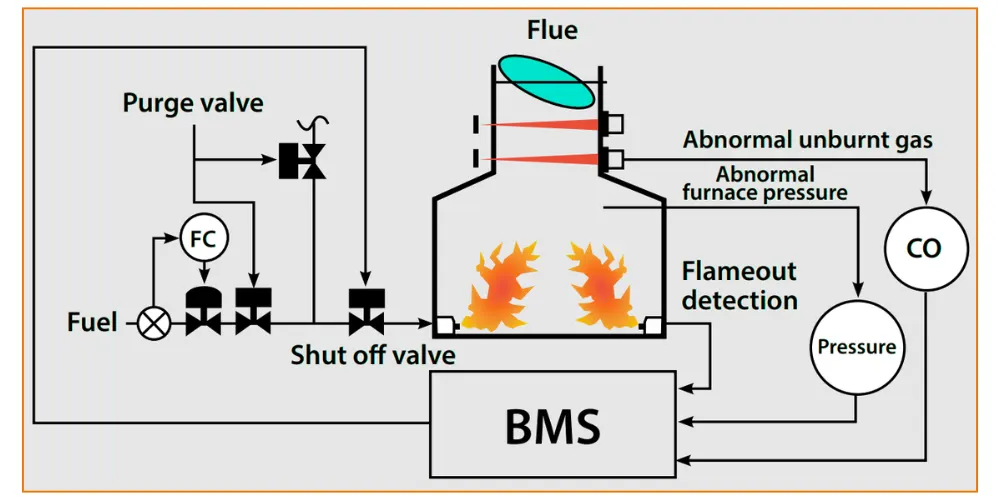
How Does a Burner Management System Work?
A BMS continuously monitors the burner using sensors and takes action when unsafe conditions occur.
- Flame Detection:
Flame detectors check whether the flame is present or not. - Monitoring Conditions:
The system checks parameters like pressure, temperature, and airflow. - Control Actions:
It controls igniters, fuel valves, and actuators. - Safety Shutdown:
If no flame is detected or unsafe conditions occur, the system immediately stops fuel flow.
Example: If the flame suddenly goes off but fuel continues, it can cause an explosion. The BMS prevents this.
Main Functions of BMS
The Burner Management System performs several important safety functions:
- Prevent Unsafe Startup
The system does not allow ignition unless all safety conditions are met. - Furnace Purge Verification
It ensures the furnace is properly purged before starting. - Interlock Checking
Start-up is allowed only when all interlocks are satisfied. - Sequence Control
It controls proper start-up and shutdown sequence. - Continuous Monitoring
The system keeps checking safety conditions during operation. - Master Fuel Trip (MFT)
In case of unsafe conditions, it shuts off fuel supply immediately.
Read more about industrial burner safety basics from NFPA guidelines
Types of Burner Management System (BMS)
There are mainly two types of BMS used in industries:
1. Separated Control System
This is the traditional method.
- The Safety Instrumented System (SIS) and Basic Process Control System (BPCS) are separate.
- Each system has its own hardware and software.
- They communicate using a network or communication protocol.
Learn the difference here: Distributed Control System (DCS)
2. Integrated Control System
This is a modern approach.
- SIS and BPCS are combined in one system.
- A single PLC (Programmable Logic Controller) handles both.
- It follows safety standards like SIL3.
You can read about PLC basics here: Programmable Logic Controller
Advantages of Integrated BMS
Integrated systems are becoming popular due to the following benefits:
- Reduced Downtime
Faster response during process issues. - Easy Recovery
System recovers quickly from faults. - Lower Cost
One system instead of two reduces hardware and installation cost. - Simplified Maintenance
Easier troubleshooting and servicing. - Less Training Required
Operators need to learn only one system. - Better Data Communication
Faster data exchange between systems. - Improved Accessibility
All controls are available in one place.
Disadvantages of Integrated BMS
Even though integrated systems are advanced, they have some limitations:
- Less Flexibility
Harder to modify compared to separate systems. - System Dependency
If one system fails, it can affect the entire setup. - Maintenance Challenges
Separate systems are sometimes easier to manage. - Reduced Redundancy
In separate systems, one can work even if the other fails.
Why is BMS Important in Industry?
A Burner Management System is critical because:
- It prevents explosions and fire hazards
- It ensures safe operation of burners
- It reduces human error
- It helps meet industrial safety standards
Without a BMS, operating burners would be extremely dangerous.
FAQs on Burner Management System (BMS)
1. What is the main purpose of a BMS?
The main purpose of a BMS is to ensure safe operation of burners by monitoring conditions and shutting down the system during unsafe situations.
2. What happens if flame is not detected in a BMS?
If the flame is not detected, the BMS immediately shuts off the fuel supply to prevent accidents or explosions.
3. What is Master Fuel Trip (MFT)?
Master Fuel Trip is a safety function where the system instantly cuts off fuel supply during dangerous conditions.
4. What is the difference between SIS and BPCS?
SIS is used for safety, while BPCS is used for process control. In integrated systems, both are combined.
5. Which industries use Burner Management Systems?
BMS is used in Oil & Gas, Power Plants, Chemical industries, and any process using burners or furnaces.
What we learn today?
A Burner Management System (BMS) is one of the most important safety systems in industries that use burners and furnaces.
It ensures that:
- The system starts safely
- Runs under safe conditions
- Shuts down immediately during danger
With modern industries moving towards automation, integrated BMS systems are becoming the standard, offering better efficiency and control.


I hope you like above blog. There is no cost associated in sharing the article in your social media. Thanks for Reading !! Happy Learning