
A rugged differential pressure element that keeps measuring where orifice plates plug, erode or lose accuracy.
A wedge flow meter uses a V shaped restriction at the top of the pipe to create differential pressure while leaving the bottom open for solids. That simple shape makes it a favourite for slurry, sludge and heavy oil lines.

What Is a Wedge Flow Meter?
A wedge flow meter is a differential pressure primary element with a V shaped restriction welded into the top of a pipe spool. The fluid squeezes under the wedge, and the pressure difference across it tells us the flow rate.
It belongs to the same family as the orifice plate, venturi and V cone meter covered in our guide on types of flow elements. The key difference is the shape, which leaves the bottom of the pipe open so solids can pass.
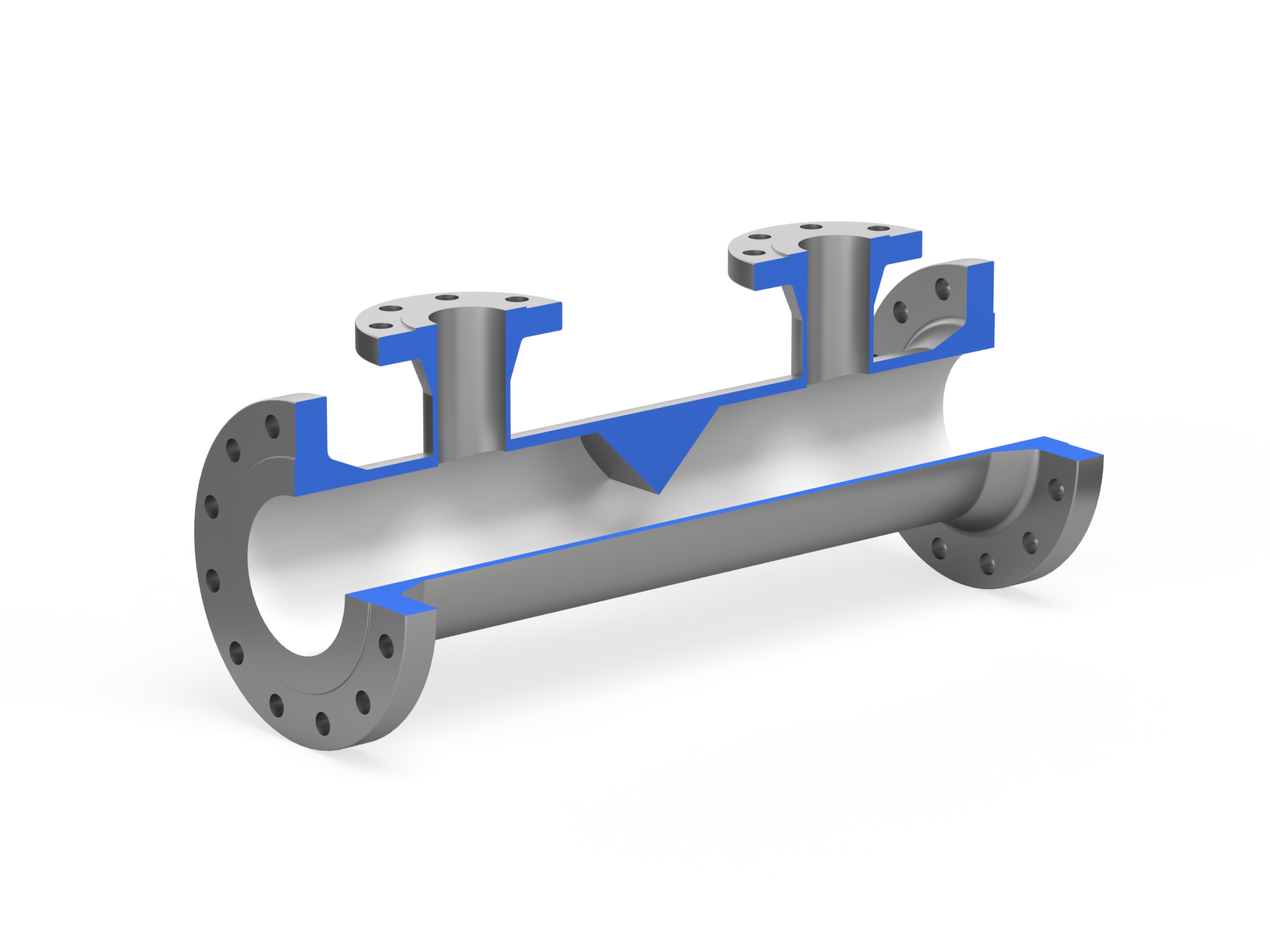
ISO 5167 Part 6 now covers wedge meters, so engineers have a recognised standard for design and uncalibrated uncertainty. Typical element ratios are H/D 0.2, 0.3, 0.4, 0.5 and 0.6, which equals a beta ratio range of about 0.377 to 0.791.
Here H is the height of the opening under the wedge and D is the pipe inside diameter. Changing the H/D ratio changes how much differential pressure the element produces at a given flow.
How the Wedge Element Creates Differential Pressure
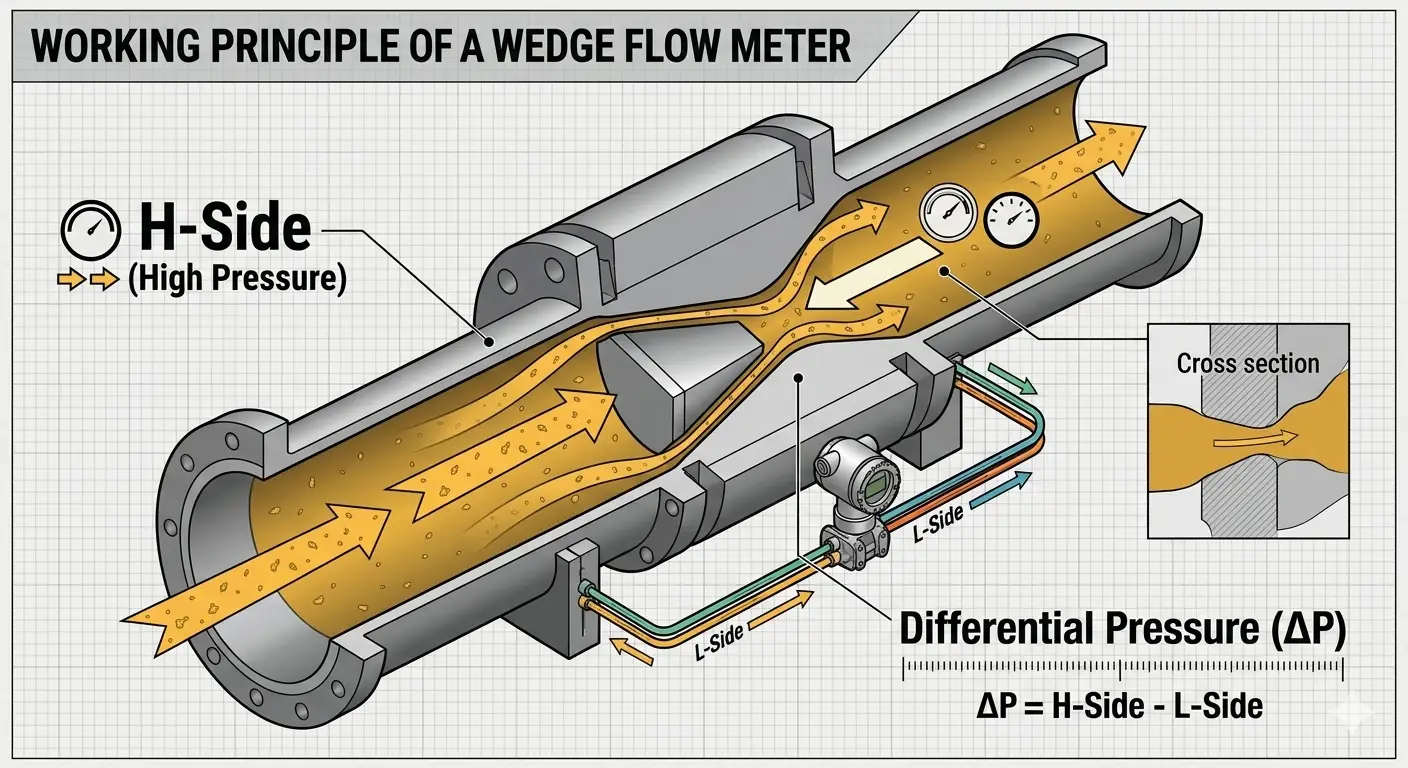
As fluid passes under the wedge, velocity rises and static pressure drops, exactly as Bernoulli equation predicts. A differential pressure transmitter reads the difference between the upstream and downstream taps.
Flow is proportional to the square root of that difference, so the transmitter or control system applies square root extraction. Most installations use flanged diaphragm seals instead of impulse lines, so there are no dead ends to plug.
The wedge profile is symmetrical, which means flow in both directions can be measured with one element. Its sloped faces also create a scouring action that keeps the restriction clean in dirty service.
5 Proven Benefits of a Wedge Flow Meter
Benefit 2 is often the deciding factor. A standard orifice loses its predictable discharge coefficient at low Reynolds number, while the wedge stays stable in heavy crude and residues.
Benefit 3 depends on the supplier. One manufacturer asks for about 7 diameters upstream and 6 downstream, while another quotes around 5 upstream, so always follow the specific datasheet.
Wedge Element Ratios and Their Uses
Smallest opening and highest differential pressure for a given flow.
A balanced choice with good signal and moderate pressure loss.
Larger opening that passes coarse particles more easily.
Largest opening, lowest DP and lowest permanent pressure loss.
Very small ratios give strong signals but raise the risk of blockage with large particles. Very large ratios reduce blockage risk but make the low flow signal weak.
Wedge Meter Flow Equation With a Worked Example
Q = actual flow rate
Qmax = flow at the calibrated maximum DP
DP = measured differential pressure
DPmax = differential pressure at Qmax
Worked example:
Qmax = 120 m³/h at DPmax = 250 mbar
Measured DP = 90 mbar
DP ÷ DPmax = 90 ÷ 250 = 0.36
√0.36 = 0.6
Q = 120 × 0.6 = 72 m³/h
Notice that 36 percent of the DP range gives 60 percent of full flow. At 10 percent flow the DP is only 1 percent of range, which is why turndown is limited.
Uncalibrated elements typically carry about 2 to 5 percent uncertainty over a 3 to 1 range. A wet flow calibrated wedge flow meter can reach about 0.5 percent when fluid density is constant.
Wedge Flow Meter vs Orifice vs Venturi vs V Cone
| Feature | Wedge | Orifice | Venturi | V Cone |
|---|---|---|---|---|
| Solids handling | Excellent | Poor | Good | Fair |
| Low Reynolds number | Very good | Poor | Fair | Good |
| Permanent pressure loss | Moderate | High | Low | Moderate |
| Straight run need | Short | Long | Moderate | Very short |
| Plugging risk | Very low | High | Low | Moderate |
| Relative cost | Medium | Low | High | High |
For clean water or gas, an orifice is usually the cheapest answer, as explained in our flow nozzle vs orifice plate vs venturi comparison. The wedge earns its place only when solids, viscosity or erosion make the orifice unreliable.
A venturi also handles dirty liquids but becomes long and expensive in large sizes. The V cone offers very short straight runs but has a central cone that can collect fibres.
Where Wedge Meters Are Used
In many of these services the alternative is a magnetic flow meter, which needs conductive liquid. The wedge works for non conductive oils as well, which widens its reach.
High temperature refinery service is another strong area. Suppliers offer wedge elements for process temperatures up to about 500 °C with suitable seals.
Installation and Calibration Tips for Wedge Meters
Install the spool with the wedge at the top of a horizontal line so solids pass along the bottom. For vertical lines, flow upward keeps the element full of liquid.
Choose seal fill fluid carefully for hot service, using our guide on fill fluid selection for diaphragm seals. Keep both capillaries the same length and at the same temperature to avoid zero shift.
Calibrate the transmitter at several points, as described in DP flow transmitter calibration. Also confirm the slurry density used in the calculation, because a wrong density directly shifts the reading.
Wedge Meter Flow Calculator
Try entering a DP of 2.5 mbar and you will see the flow is still 10 percent of Qmax. This shows how quickly the signal shrinks at low flow.
- Measures slurry and sludge without plugging.
- Stable at low Reynolds number.
- Bidirectional with one element.
- Rugged with no moving parts.
- Limited turndown because of square root law.
- Uncalibrated uncertainty is several percent.
- Density changes affect accuracy.
- Needs remote seals for most slurry duties.
Wedge Flowmeter Datasheet Download
Rosemount Wedge Flow Meter Video
Wedge Flow Meter Questions Answered
Related Articles
- Types of Flow Elements
- Orifice Plate Flow Measurement
- V Cone Flow Meter Working Principle
- Square Root Extraction in DP Flow
- Laminar and Turbulent Flow Meter Selection
External References
- ISO 5167, Wikipedia
- Wedge Flowmeter, KROHNE
- Wedge Meter Specifications, Emco Controls
- Venturi, Flow Nozzle and Segmental Wedge Elements, DwyerOmega
- Wedge Flowmeter Datasheet, BHB
What We Learn Today
- The wedge creates DP with a top restriction while leaving the pipe bottom open for solids.
- H/D ratio sets the signal strength, pressure loss and blockage risk.
- It shines in slurry, sludge and viscous service where an orifice struggles.